← All women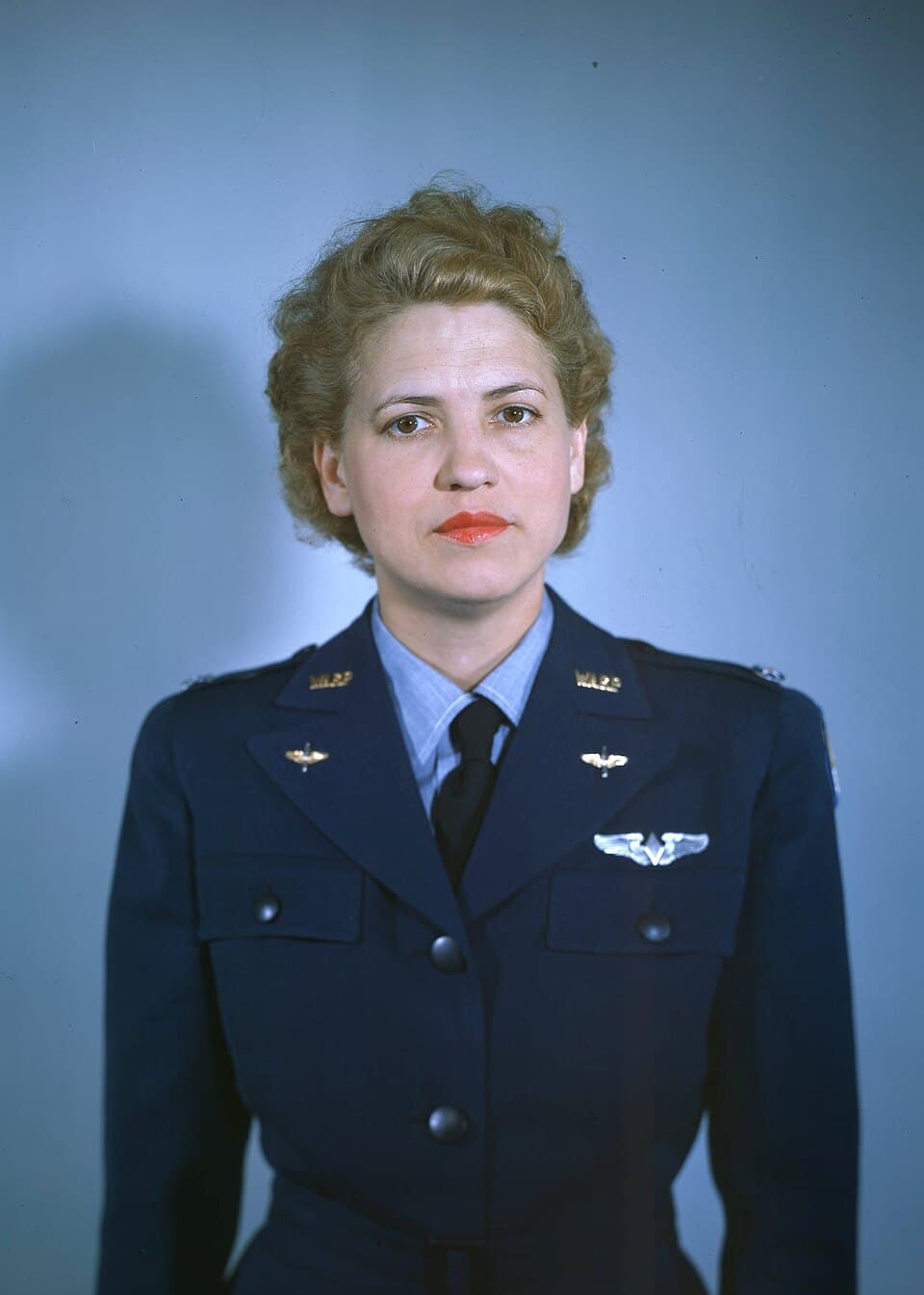
American · Aviation · Sports
Jacqueline Cochran
May 11, 1906 – August 9, 1980
Early life and background
Jacqueline Cochran was born Bessie Lee Pittman on May 11, 1906, in Muscogee County, Georgia, though later sources also associate her childhood with north Florida and Pensacola. She grew up in poverty, was orphaned early, and had very limited formal education. As a child and teenager, she worked in cotton mills and beauty shops, experiences that instilled resilience, independence, and a strong work ethic. Later biographies describe her as a self-made woman whose rise from hardship became central to her public identity.
As a young woman, she moved into the beauty industry and eventually worked in New York City. There she adopted the name Jacqueline Cochran, a name that projected sophistication and helped shape the image she would use as a businesswoman and aviator. She married young, but the marriage did not last; later she married financier Floyd B. Odlum in 1936. Odlum’s financial resources and social connections were useful to her career, though Cochran had already begun to build a public reputation before that marriage.
Entry into aviation
Cochran learned to fly in the early 1930s, reportedly beginning flying lessons in 1932. She entered aviation initially as a way to promote the cosmetics business she had founded, but she quickly became far more than a promotional pilot. She earned her pilot’s license and moved rapidly into competitive flying at a time when women pilots were still rare and often treated as novelties rather than professionals.
Her early competitive ambitions coincided with a period when air racing was one of the most glamorous and dangerous forms of public aviation. Cochran embraced that world fully. In 1934 she was the only woman entrant in the MacRobertson London-to-Australia air race, and in 1935 she became the first woman to enter the Bendix Transcontinental Air Race. These milestones established her as one of the most visible women in international aviation.
Air racing and record-setting
Cochran’s breakthrough performances in the late 1930s made her famous. In 1937 she placed third overall in the Bendix Air Race and won the women’s division. Later that year she made a blind landing on instruments, demonstrating technical skill in a field increasingly shaped by instrument-based flying. In 1938 she won the Bendix Trophy outright against an all-male field, an especially important victory because it came in one of the most prestigious long-distance races in the United States.
She continued to set and break records in speed and altitude. In 1939 she established a women’s national altitude record and broke an international speed record; in 1940 she broke the 2,000-kilometer international speed record and the 100-kilometer national record. These achievements built her reputation as a pilot who combined daring with precision and made her one of the most decorated record-holders in aviation. By the time of her death, she had accumulated more speed, altitude, and distance records than any other pilot, male or female, according to major institutional summaries.
World War II and women’s military aviation
The Second World War transformed Cochran’s career. In 1941 she became the first woman to pilot a bomber across the Atlantic Ocean in support of the war effort. That flight was part of a larger shift in which women pilots were being considered for auxiliary roles that supported military logistics but did not yet place them in combat.
Cochran became one of the most important organizers and leaders of women’s wartime flying in the United States. She was associated with the Women Airforce Service Pilots, or WASP, and helped recruit, train, and direct women who ferried aircraft, towed targets, and performed other vital noncombat flying duties. She became a central figure in proving that women could handle military aircraft reliably and professionally under demanding conditions. Although WASP service did not initially result in the full military recognition later generations might expect, the program became a landmark in the history of women’s service in aviation.
Her wartime work also earned official recognition. Later summaries identify her as receiving the Distinguished Service Medal and the Distinguished Flying Cross. She was also commissioned in the Air Force Reserve and later rose to colonel. Her leadership during the war tied her name not only to aviation records but also to military administration and women’s wartime labor.
Postwar career and supersonic milestones
After the war, Cochran remained active in both aviation and business. She continued to run her cosmetics enterprise and remained publicly associated with flight, record-setting, and advocacy for women aviators. She also stayed close to political and military figures, including President Dwight D. Eisenhower, which reflected her prominence in mid-century American public life.
Her postwar aviation achievements extended into the jet age. In 1953 she became the first woman to break the sound barrier, flying an F-86 Sabre at Rogers Dry Lake, California. That flight was one of the most celebrated achievements in aviation history and became the signature moment of her career. The same year she received a Gold Medal from the Fédération Aéronautique Internationale, further confirming the international stature of her accomplishments. She also published The Stars at Noon in 1953.
Cochran continued setting records through the 1960s. In 1960 she became the first woman to fly at Mach 2 in an A3J aircraft. In 1962 she became the first woman to fly a jet aircraft across the Atlantic, flying a Lockheed Jet Star from the United States to Germany and setting multiple distance records along the way. She also established nine international speed, distance, and altitude records in a Northrop T-38 military jet that same year. In 1963 she broke two of her own speed records in a Lockheed F-104 Starfire, and in 1964 she set a women’s world speed record of 1,429 miles per hour in an F-104G Starfighter.
Honors and recognition
Cochran received extensive recognition during her lifetime and after it. The National Women’s Hall of Fame and the Smithsonian National Air and Space Museum both honor her as a pioneering aviator. Institutional summaries also note that she was the first living woman to be inducted into the American Aviation Hall of Fame. She was awarded the Distinguished Service Medal, the Distinguished Flying Cross, and honors from aviation organizations, including the prestigious Bendix and international recognition from the Fédération Aéronautique Internationale.
Another important measure of her stature is the repeated recognition she received from aviation circles for decades. Sources note that between 1937 and 1962 she received the Hannon Trophy 15 different times as the outstanding woman flier in the world. That sustained level of recognition demonstrates not only a single breakthrough but a long career of elite performance.
Personal life
Cochran’s personal life was closely linked to her professional rise. She married twice, and her second marriage to Floyd B. Odlum was especially significant because it connected her to wealth and influence in business and public life. She did not have a widely noted family life centered on children in the available reference sources. Instead, her public identity was dominated by her careers in cosmetics, aviation, and wartime administration.
Her relationships with military and political figures also mattered. She maintained ties to prominent leaders, and her postwar role as a public aviation authority gave her access to the highest levels of American civic life. These relationships helped extend her influence beyond the cockpit and into the broader culture of Cold War America.
Legacy
Jacqueline Cochran’s legacy rests on more than her list of records. She helped redefine what women could do in aviation, from racing to wartime ferrying to supersonic flight. She was a visible example of a woman who entered a male-dominated technical field, mastered its most demanding tasks, and then used her success to open space for others. Her life bridged several eras of flight: barnstorming and air racing, wartime auxiliary service, and high-performance jet aviation.
Her career also had institutional significance. Through her leadership of women’s wartime flying programs, she contributed to the long struggle for recognition of women’s military service. Through her record-setting flights, she offered a public demonstration that women could meet or exceed the standards expected of elite male pilots. That combination of symbolism and practical accomplishment made her one of the most influential women in the history of American aviation.
Later life and death
Cochran remained a figure of interest in aviation history into her later years, but her greatest accomplishments had already been secured. She died on August 9, 1980, in Indio, California. At the time of her death, major institutional sources credited her with holding more speed, altitude, and distance records than any other pilot, male or female. Her death closed the life of a woman whose rise from poverty to international aviation fame remains one of the defining stories in women’s aeronautical history.
Dated achievements
12 indexed.
- May111906Arts
Born Bessie Lee Pittman
Birth of Jacqueline Cochran, the pioneering American aviator born Bessie Lee Pittman in Georgia.
View details Britannica biography of Jacqueline Cochran - Aug291935Aviation
First woman to enter the Bendix Transcontinental Air Race
Cochran became the first woman to enter the Bendix Transcontinental Air Race, a landmark in competitive aviation.