← All women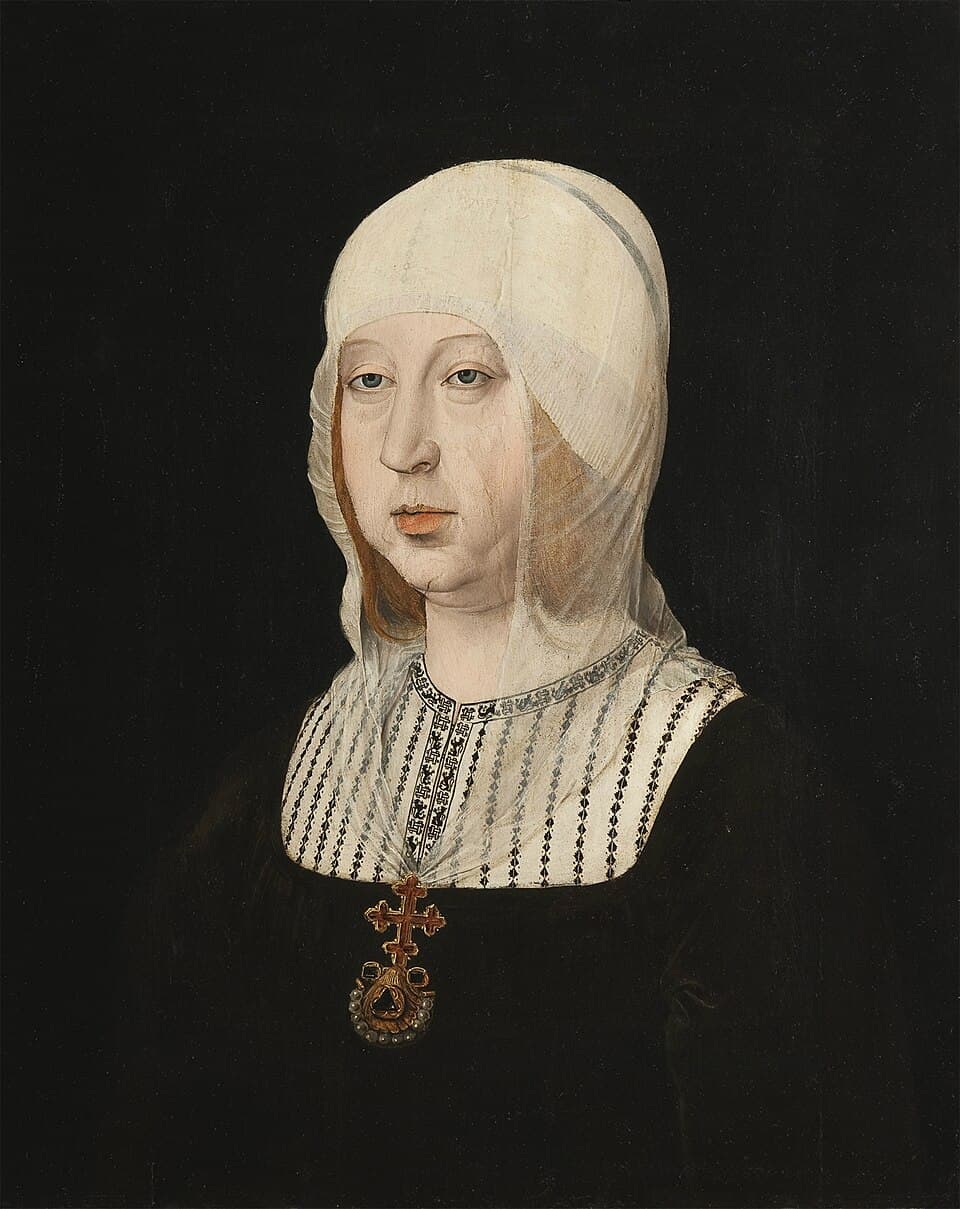
Castilian, Spanish · Politics · Exploration
Isabella I of Castile
April 22, 1451 – November 26, 1504
Early Life and Background
Isabella I of Castile (Spanish: Isabel I de Castilla; 22 April 1451 – 26 November 1504), known as Isabella the Catholic (Isabel la Católica), was born in the royal palace at Madrigal de las Altas Torres in Castile. She was the daughter of King John II of Castile and León and his second wife, Isabella of Portugal. Her birth placed her within the Trastámara dynasty at a time of intense factional struggle and contested succession in late medieval Castile.
Isabella’s early childhood was marked by instability. Her father died when she was young, and her half-brother Henry IV succeeded to the throne. Isabella and her younger brother Alfonso spent much of their youth away from the royal court, living in relative austerity in provincial towns such as Arévalo. These years exposed her to devout religious practice, economic hardship, and the power of the nobility, shaping the piety and determination that later characterized her rule.
Education for royal girls in 15th-century Castile focused on religious instruction, moral formation, and practical skills rather than the humanist curriculum increasingly available to elite men. Isabella received training in Christian doctrine, liturgy, and courtly behavior, and learned to manage household affairs. She developed a reputation for seriousness, modesty, and strong personal faith. Although she likely did not receive the classical education of contemporary male princes, her later reign shows a keen understanding of politics, law, and administration.
Position as Heir and Career Beginnings
Isabella’s path to power began amid dynastic crisis. Her half-brother Henry IV’s rule was weakened by noble revolts and controversy over the legitimacy of his daughter, Juana. In 1468, the Treaty of the Bulls of Guisando recognized Isabella as heir presumptive to the Castilian throne, displacing Juana and formally aligning key nobles behind Isabella’s claim. This recognition did not end factionalism, but it gave Isabella a legal basis to assert succession in her own right.
Marriage was central to Isabella’s political strategy. Powerful factions sought to marry her either to a Portuguese prince or to foreign claimants who could serve their interests. Isabella resisted these plans, insisting on choosing her own husband. In October 1469, she married Ferdinand, heir to the crown of Aragon, in Valladolid without Henry IV’s formal consent. The match united the ruling houses of Castile and Aragon and created the dynastic partnership that would shape Iberian politics for decades.
Isabella’s marriage contract emphasized joint rule. The couple agreed to share decisions and present themselves as co-sovereigns, reflecting Isabella’s determination not to cede her authority to her husband. After Henry IV’s death in 1474, Isabella claimed the throne as Queen of Castile and was proclaimed in Segovia, while supporters of Juana, backed by Portugal, contested her succession.
Consolidation of Power and Civil War
Isabella’s accession triggered a succession war (1474–1479) between her supporters and those of Juana, often called "la Beltraneja." Isabella and Ferdinand confronted alliances of nobles and foreign powers while asserting their legitimacy. They worked to secure key fortresses, win over undecided magnates, and appeal to urban elites who favored stronger central authority.
During these years, Isabella began to reshape Castile’s institutions. At the Cortes of Madrigal in 1476, she oversaw the creation of the Santa Hermandad, a kingdom-wide armed police force designed to curb banditry and enforce royal justice across the countryside. This innovation strengthened the monarchy’s capacity to protect trade routes and assert control over unruly nobles. She and Ferdinand also reorganized the royal council, increased oversight of local officials, and promoted a more professional bureaucracy.
The civil war ended with the Treaty of Alcáçovas (1479), in which Portugal recognized Isabella and Ferdinand as rulers of Castile. That same year, the death of John II of Aragon brought Ferdinand to the Aragonese throne. From 1479 onward, Isabella ruled Castile and León and Ferdinand ruled Aragon and its Mediterranean territories, in a personal union that foreshadowed a more unified Spain. Each kingdom retained its own laws and institutions, but the monarchs coordinated policy and presented themselves collectively as the "Catholic Monarchs."
Religious Policy and the Spanish Inquisition
Isabella’s reign is inseparable from her commitment to religious uniformity. Deeply devout, she worked with confessors such as Hernando de Talavera and later Francisco Jiménez de Cisneros to reform the clergy, improve discipline in monasteries, and promote orthodoxy. She supported visitations of religious houses and encouraged preaching and education aimed at strengthening lay piety.
A central instrument of her religious policy was the Spanish Inquisition. In the late 1470s she and Ferdinand requested papal authorization for an inquisition in Castile, primarily targeted at conversos—Jews who had converted to Christianity but were suspected of secretly practicing Judaism. In March 1479, Pope Sixtus IV issued a bull granting them authority over inquisitorial appointments and jurisdiction. This made the Inquisition unusually dependent on the crown, integrating religious policing into royal governance.
The first major Castilian tribunal of the Inquisition began operating in Seville in early 1480. Trials, confiscations, and executions followed, creating a climate of fear among minority communities and reinforcing association between monarchy and Catholic orthodoxy. While Isabella believed that the Inquisition protected the faith and social order, its activities caused significant suffering and controversy, contributing to the emigration of many conversos and the stigmatization of others.
War of Granada and Completion of the Reconquista
Isabella’s most famous military undertaking was the War of Granada (1482–1492), the campaign to conquer the last Muslim kingdom in Iberia. The Nasrid Emirate of Granada had survived for centuries as a tributary state, but internal divisions and changing geopolitics gave Castile an opportunity to press claims.
Isabella played an active role in the war, supervising finances, arranging supplies, and traveling to the front to support troops and demonstrate royal resolve. She and Ferdinand adopted new siege techniques, used artillery more extensively, and worked systematically to take fortified positions throughout the emirate.
After years of campaigning, the city of Granada surrendered on 2 January 1492. The monarchs entered the city and received the keys to the Alhambra, symbolizing Christian victory and the completion of the Reconquista. The surrender terms promised religious and legal protections to Muslims, allowing them to retain property and customs under Christian rule. These concessions were later eroded as policies of forced conversion and expulsion intensified, but the event itself marked the end of Muslim sovereignty in Iberia.
The conquest of Granada consolidated Isabella’s reputation as a war leader and champion of Christian triumph. It also freed military and fiscal resources for other projects, notably overseas exploration, and reinforced the monarchy’s image as defender of the faith—a theme that would underpin later alliances with the papacy and other Catholic powers.
Expulsion of the Jews and Religious Uniformity
In 1492, the drive for religious unity culminated in the Alhambra Decree. Concerned that practicing Jews supposedly influenced conversos and undermined efforts to secure orthodoxy, Isabella and Ferdinand consulted leading churchmen and royal advisers. They opted for a drastic solution: expelling unconverted Jews from their realms.
Signed on 31 March 1492, the decree ordered all Jews in Castile and Aragon either to convert to Catholicism or leave by a set deadline, with restrictions on what property they could take. Many chose exile, selling goods at a loss and relocating to North Africa, the Ottoman Empire, Italy, and elsewhere. The expulsion disrupted communities that had long contributed to Spanish economic and intellectual life, including finance, trade, and medicine.
Isabella regarded the decree as necessary to protect the faith and strengthen unity, but historians have emphasized its harshness and long-term negative consequences. The loss of Jewish communities impoverished certain sectors of society and contributed to a legacy of intolerance. The event remains one of the most controversial aspects of her reign, central to assessments of her moral and political legacy.
Patronage of Exploration and the New World
Isabella’s global impact stems above all from her support of Atlantic exploration. For years, the Genoese navigator Christopher Columbus sought backing for a westward voyage to Asia. After receiving rejections from other courts, he turned to Castile. Isabella initially hesitated, given the costs and uncertainty, but advisers eventually persuaded her to consider the proposal.
In April 1492, at the military camp of Santa Fe near Granada, Isabella and Ferdinand concluded the Capitulations of Santa Fe with Columbus. The agreement granted him noble titles and a share of any profits from lands he might "discover," while the crown supplied ships and partial funding. Isabella’s decision to endorse the plan, including allowing crown resources and some private contributions under her auspices, made the voyage possible.
On 3 August 1492, Columbus sailed from Palos de la Frontera under Castilian colors. His expedition reached Caribbean islands in October, making landfall in the Bahamas on 12 October 1492. Subsequent voyages would encounter larger islands and continental coasts, leading Castile to claim sovereignty over vast territories inhabited by diverse Indigenous peoples.
Isabella quickly asserted royal rights over these new lands, framing them as possessions of the crown of Castile rather than private conquests. She and Ferdinand sponsored further expeditions, sent missionaries, and participated in debates over the legal status and treatment of Indigenous populations. Isabella’s instructions sometimes urged fair treatment and forbade outright enslavement of newly baptized natives, though in practice exploitation and violence were widespread. The tension between spiritual concerns and imperial interests marked policy throughout and after her lifetime.
Diplomacy and the Treaty of Tordesillas
Isabella’s overseas ambitions had to contend with rival Portuguese claims based on earlier Atlantic exploration. To prevent conflict, Castile and Portugal turned to papal mediation and direct negotiation. After initial bulls by Pope Alexander VI drew a demarcation line, both crowns adjusted the terms by treaty.
On 7 June 1494, Castilian and Portuguese representatives signed the Treaty of Tordesillas. The treaty moved the line of demarcation westward, granting Portugal rights to lands east of the line (including future Brazil, Africa, and routes to Asia), and Castile rights to territories west of it. Isabella’s crown thus secured primary claims over most of the Americas, though the exact extent was unknown at the time.
This agreement is considered a foundational document in the history of European imperialism, dividing spheres of influence in a still-unmapped world. It reflected Isabella’s willingness to engage in complex diplomacy to protect Castile’s interests and avoid war with Portugal. The treaty’s consequences shaped linguistic, religious, and cultural patterns across continents.
Domestic Governance, Law, and Administration
Within her realms, Isabella pursued extensive reforms to strengthen royal authority. She and Ferdinand restructured the Royal Council, reducing the influence of great nobles and increasing the role of trained jurists. They oversaw improvements in the administration of justice, promoted visitation of local courts, and worked to curb corruption among officials.
Isabella also promoted fiscal reforms, seeking more regular revenue streams and better control over taxation. She negotiated with towns and Cortes to secure grants for military campaigns and administration, often emphasizing the reciprocal duty of the crown to maintain peace and defend the realm.
Her government supported agricultural recovery and trade by pacifying roads through the Santa Hermandad, encouraging settlement in reconquered territories, and standardizing certain weights and measures. She showed particular concern for the governance of Granada after its conquest, attempting—at least initially—to respect the rights of Muslim inhabitants while integrating the region into Castilian structures.
Personal Life, Marriage, and Children
Isabella’s marriage to Ferdinand was both political alliance and personal partnership. Contemporary accounts describe mutual affection and respect, though the relationship also involved tensions over authority and policy. Isabella insisted on her right to be consulted on major decisions and maintained independent control over Castilian institutions.
The couple had several children whose marriages formed part of Isabella’s diplomatic strategy:
- Isabella of Asturias, who married first Prince Afonso of Portugal and later King Manuel I.
- John, Prince of Asturias, heir to both Castile and Aragon, who married Margaret of Austria but died young.
- Joanna (Juana), later known as "la Loca," who married Philip the Handsome of Habsburg and became mother of Charles V.
- Maria, who married Manuel I of Portugal after her sister’s death.
- Catherine of Aragon, who married first Arthur, Prince of Wales, and then King Henry VIII of England.
These marriages linked Castile and Aragon to Portugal, England, and the Habsburg dynasty, embedding Isabella’s descendants in a web of European power politics that would define the 16th century.
Isabella was known for her personal austerity, devotion to prayer, and concern for education. She patronized scholars and artists, supported the foundation and reform of religious institutions, and took an interest in the upbringing of her children, particularly in ensuring their moral and religious formation.
Awards, Honours, and Recognition
Isabella’s lifetime honors reflected her status as a champion of Catholicism. In 1494, Pope Alexander VI conferred on her and Ferdinand the title "los Reyes Católicos" (the Catholic Monarchs), recognizing their role in promoting the faith through the conquest of Granada, support of the Inquisition, and broader religious policies. The title became central to their dynastic identity and to the way later generations remembered their reign.
Posthumously, Isabella has been the subject of varied commemorations and assessments. In the late nineteenth century, her sponsorship of Columbus’s voyage and her role in the "discovery" of America were celebrated at the World’s Columbian Exposition in Chicago (1893). The Isabella Quarter dollar issued for the fair depicted her portrait and made her the first named woman on a United States coin, emphasizing her importance to narratives of exploration.
In modern Spain, Isabella’s memory is visible in statues, street names, and educational curricula. She has also been considered for possible beatification in some Catholic circles because of her piety, though controversy over her role in the expulsion of the Jews and the Inquisition has complicated such efforts.
Legacy and Historical Impact
Isabella’s legacy is complex and far-reaching. As queen regnant of Castile, she demonstrated that a woman could exercise sovereign authority over a major European kingdom, managing war, law, finance, and diplomacy with considerable skill. Her reign transformed Castile from a fragmented medieval polity into the core of an expansive early modern monarchy.
In partnership with Ferdinand, she helped shape what would become Spain. Their joint rule over Castile and Aragon created a composite monarchy that, though not legally unified in her lifetime, functioned increasingly as a single actor in European politics. Under their descendants, these territories would merge with Habsburg lands to form one of the era’s most powerful empires.
Globally, Isabella’s patronage of Columbus’s voyage and subsequent expeditions inaugurated sustained European involvement in the Americas. The consequences of this decision include colonization, forced labor systems, demographic collapse among Indigenous populations due to disease and violence, and the emergence of transatlantic trade networks that reshaped economies and societies on multiple continents.
Her religious policies left a dual legacy. Efforts to reform the clergy and promote genuine piety contributed to the vitality of Spanish Catholicism and the missionary energy that accompanied imperial expansion. At the same time, the establishment of the Spanish Inquisition and the expulsion of the Jews stand as episodes of persecution and intolerance that inflicted immense suffering on minority communities and narrowed the cultural diversity of her realms.
In women’s-history scholarship, Isabella is often cited as one of Europe’s most powerful queens. She exercised authority not only as a consort but as an independent ruler, making decisions that affected millions. Her reign illustrates both the possibilities and limits of female sovereignty in a patriarchal society: she could command armies, negotiate treaties, and direct religious policy, yet she also had to navigate expectations tied to gender and rely on male partners and advisers.
Later Life and Death
Isabella’s later years were shadowed by personal tragedy and political anxiety. Several of her children died young or faced mental health challenges, including her heir John and her daughter Isabella of Asturias. Her daughter Joanna’s unstable behavior and the ambitions of her husband, Philip of Habsburg, raised concerns about the future governance of her realms.
Despite declining health, Isabella continued to participate actively in state affairs. She took interest in the administration of Granada, the governance of American territories, and the negotiation of marriages and treaties. She remained deeply engaged in religious life, attending mass, supporting reform, and seeking spiritual counsel.
On 26 November 1504, Isabella died at Medina del Campo, in the castle of La Mota. In her will, she emphasized justice, the defense of the faith, and the protection of Indigenous peoples in the New World, urging her successors to treat them as free vassals of the crown rather than as slaves. She named her daughter Joanna as her successor in Castile, with Ferdinand to act as regent if necessary.
After Isabella’s death, political instability followed. Joanna’s incapacity and the ambitions of Philip led to conflicts that ended with the accession of their son, Charles I of Spain (Emperor Charles V), who united Castile and Aragon with vast Habsburg territories. Isabella’s policies thus fed directly into the creation of a global empire under her grandson.
Isabella’s burial in Granada, alongside Ferdinand, symbolized their joint role in the Reconquista and the shaping of Spain. Over time, her memory has been interpreted variously—as a model Christian queen, a visionary state-builder, a patron of exploration, and a figure associated with persecution and exclusion. This multiplicity reflects the breadth of her impact and the moral complexity of the era she helped define.
Dated achievements
15 indexed.
- Apr221451Politics
Birth in Madrigal de las Altas Torres
Born on 22 April 1451 at Madrigal de las Altas Torres, entering the Trastámara dynasty and the contested Castilian succession.
View details Isabella I of Castile - Encyclopedia.com - Oct191469Politics
Marriage to Ferdinand of Aragon
Married Ferdinand of Aragon in Valladolid, forging the dynastic union that underpinned the future political unification of Spain.