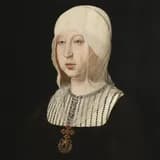
Born on 22 April 1451 at Madrigal de las Altas Torres, entering the Trastámara dynasty and the contested Castilian succession.
On 22 April 1451, Isabella was born in the royal palace of Madrigal de las Altas Torres in Castile, the daughter of John II of Castile and his second wife Isabella of Portugal. This birth placed her within the Trastámara dynasty at a moment of dynastic fragility and factional conflict.
Isabella’s early status was not that of an obvious heir. Her half-brother Henry IV already occupied the throne, and the succession was contested between his daughter Juana and other claimants. Growing up largely away from court, Isabella’s formative years in provincial Castile exposed her to piety, austerity, and the realities of noble power.
Her birth date anchors the life of a monarch whose later reign would redefine the Iberian political landscape. From this origin, she rose to become queen of Castile and, through marriage, joint ruler of Aragon, presiding over the transition from medieval Castile to an increasingly centralized and expansive monarchy.
In women’s history, Isabella’s birth is significant because it marks the arrival of a woman who would wield sovereign authority over a major European kingdom for three decades, influence religious policy, and sponsor maritime exploration that transformed global history.