← All women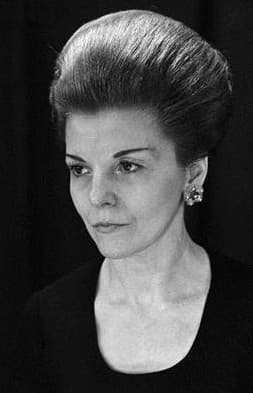
Argentine · Politics
Isabel Peron
February 4, 1931 – present
Early Life and Background
María Estela Martínez Cartas, later known internationally as Isabel Perón or "Isabelita," was born on 4 February 1931 in the city of La Rioja, capital of the province of the same name in northwestern Argentina.[2][4][10] She was the third of five children in a middle‑class family. Her father, Marcelo Martínez Rosales, worked as a branch manager for the National Mortgage Bank, while her mother, María Josefa Cartas, managed the household.[4] Growing up far from Buenos Aires, the political and cultural center of Argentina, Isabel experienced a provincial childhood in a region marked by economic underdevelopment and limited opportunities.
Isabel left formal schooling after the sixth grade, a decision consistent with the expectations placed on many girls in mid‑twentieth‑century Argentina, particularly outside the major urban centers.[4] She instead pursued artistic and cultural training, studying ballet, Spanish dance, French, and piano.[4] These skills would lead her toward a career as a professional dancer, an unconventional background for someone who would later occupy the presidency of a large Latin American nation.
Biographical accounts emphasize that Isabel’s early life did not involve political engagement or activism.[3][4] She was not part of the emerging women’s suffrage movements, nor did she come from a family deeply embedded in party politics. Her trajectory into public life would be shaped instead by migration, performance work, and, above all, her relationship with exiled leader Juan Domingo Perón.
Career Beginnings and Entry into Peronist Politics
In the 1950s, Isabel joined a dance troupe that toured Latin America.[12] During this period, she encountered Juan Domingo Perón, the former Argentine president who had been overthrown in a military coup in 1955 and was living in exile, mainly in Madrid, Spain.[1][3][4] Sources describe their meeting in Panama or Venezuela, where Perón saw her perform and invited her to join his entourage.[3][12] She accepted, relocating to Spain and becoming part of his inner circle.
On 15 November 1961, Isabel married Juan Perón in Madrid, becoming his third wife.[4] The marriage marked the beginning of her immersion in Peronist political networks. While living in Spain, Isabel served as a companion to Perón and a liaison between him and loyalists in Argentina, helping to maintain communication with union leaders and party activists.[3][4] She traveled periodically to Argentina in the 1960s and early 1970s, strengthening ties with Peronist organizations and building her own visibility among supporters.[3]
Isabel did not hold formal office during these years, but her proximity to Perón and her role in sustaining contact with the movement contributed to her gradual political socialization. The Peronist movement, known formally as the Justicialist Party, combined labor unions, populist organizations, and radicalized youth groups. Within this complex structure, Isabel came to be seen as a trusted representative of the exiled leader, especially among traditional union leaders who valued her loyalty and discretion.[3][4]
Vice Presidency and Path to Power
In 1973, after years of proscription and military rule, the Peronist movement returned to legality, and elections were called. In March 1973, the Peronist candidate Héctor Cámpora won the presidency, but he resigned in July to pave the way for Perón’s return to office.[1][3] In the subsequent election, Juan Perón ran for president with Isabel as his chosen vice‑presidential candidate, a decision that surprised many observers given her limited experience but reflected Perón’s personal trust and his desire to balance factional interests inside the movement.[1][4][10]
The Perón–Perón ticket won a landslide victory. On 23 September 1973, following the electoral process, Isabel Perón assumed office as Vice President of Argentina alongside her husband.[1][11] Her inauguration made her the first woman elected vice president in Argentine history and placed her constitutionally next in line to the presidency.[11] During this period, she also served as First Lady, combining ceremonial duties with participation in political negotiations and public appearances.[9][10]
Isabel’s vice presidency unfolded amid growing instability. The Peronist coalition was increasingly divided between left‑wing “Revolutionary Peronists” and right‑wing union leaders and bureaucrats.[3][4] Armed leftist groups such as the Montoneros and the Ejército Revolucionario del Pueblo (ERP) escalated their activities, while the right‑wing Argentine Anticommunist Alliance (AAA), linked to Peronist security adviser José López Rega, carried out assassinations against perceived enemies.[3][4] Isabel, though vice president, relied heavily on López Rega and conservative union figures, a pattern that would continue into her presidency.
Assumption of the Presidency
In June 1974, President Juan Perón’s health deteriorated sharply. On 29 June 1974, Isabel Perón was sworn in as acting President of Argentina, temporarily exercising presidential powers while Perón lay gravely ill.[1][17] History.com notes that this made her the Western Hemisphere’s first female head of government, a milestone that drew considerable international attention.[17]
Two days later, on 1 July 1974, Juan Perón died in office.[1][3][10] As vice president and acting president, Isabel constitutionally succeeded him and was formally sworn in as President of the Argentine Nation.[1][3][10] Major reference works, including Britannica and Encyclopedia.com, describe her as the world’s first woman president, the first woman chief executive of a Latin American nation, and the first woman to serve as president of a country in a presidential republican system.[2][3][4][6][10][15] While some scholars have pointed out that earlier women led republics under different titles—such as Khertek Anchimaa‑Toka in Tuva—Isabel’s succession remains widely cited as a global first in the specific role of “president” of a modern republic.[11][15]
Simultaneously, Isabel became president of the Justicialist Party, consolidating formal leadership over both the state and the Peronist movement.[4][10] This concentration of power in a woman was highly unusual in the Cold War era, particularly in a large, conflict‑ridden Latin American country.
Presidential Policies, Decrees, and Governance
Isabel Perón’s presidency lasted from 1 July 1974 until her overthrow on 24 March 1976.[1][10] Her government confronted enormous challenges: soaring inflation, declining real wages, political assassinations, and deep factionalism within Peronism. Economically, the administration struggled to manage inflation and recession, oscillating between populist wage policies and austerity measures, while capital flight and labor unrest intensified.[3][4]
Politically, Isabel relied heavily on her inner circle, particularly José López Rega, her personal secretary and Minister of Social Welfare, who exercised vast influence over security policy.[3][4][10] López Rega was widely associated with the Argentine Anticommunist Alliance (AAA), a right‑wing paramilitary group that targeted leftist activists, intellectuals, and unionists.[3] Under Isabel’s presidency, the AAA’s activities expanded, contributing to a climate of fear and extrajudicial violence.
A crucial turning point came on 5 February 1975, when Isabel issued Decree 261/75, the first of several “decrees of annihilation”.[10] This decree declared a military emergency zone in parts of Tucumán Province, authorizing the armed forces to “annihilate” the ERP guerrilla insurgency.[10] Subsequent decrees extended military authority over internal security. Historians have identified these measures as key legal foundations for the systematic repression that followed, bridging the gap between civilian government and the later military dictatorship.[3][4]
Isabel’s presidency thus occupies a controversial place in Argentine memory. While her government operated within a constitutional framework, it also sanctioned heavy‑handed security operations and tolerated, or enabled, paramilitary violence. These policies alienated sectors of the public and contributed to a perception among military officers that the civilian government was incapable of restoring order.[3][4]
Awards, Honors, and International Recognition
Isabel Perón’s tenure attracted extensive international media coverage because of her status as a trailblazing woman head of state. Contemporary press accounts and later retrospectives highlighted her distinction as the first woman to serve as president of a country, the first non‑royal female head of state and head of government in the Western Hemisphere, and the first woman president of Argentina and Latin America.[2][4][6][10][15] These characterizations appear in reference works such as Britannica, Encyclopedia.com, and Wikigender, reflecting a broad consensus in mainstream historiography.
However, detailed records of specific state honors or decorations awarded to Isabel during or after her presidency are limited in standard biographical sources. The emphasis in most accounts is on the symbolic significance of her office rather than on particular prizes or medals.[2][3][4][10] Later, her legal difficulties in connection with human rights investigations in Argentina and Spain further complicated any public commemoration of her rule.
Personal Life
Isabel’s personal life is closely intertwined with her political trajectory. Her marriage to Juan Domingo Perón in 1961 placed her at the center of a powerful populist movement.[4] The couple had no children, and biographical entries note that Isabel devoted herself to supporting Perón’s political activities and managing aspects of his exile household.[4]
During Perón’s third term as president (1973–1974), Isabel served as both First Lady and Vice President, an unusual combination of roles that underscored the personalization of power in Peronism.[9][10] She accompanied Perón on official functions, received foreign dignitaries, and represented the presidency at various ceremonies, even as her formal constitutional duties as vice president expanded.
After her overthrow and subsequent exile, Isabel lived a largely private life in Spain. Reports emphasize that she avoided public political activity and rarely gave interviews, contributing to a sense of opacity around her personal views on the events of the 1970s.[1][12][15] She did not remarry and maintained a low profile, in contrast to the iconic public persona of Perón’s second wife, Eva Perón (Evita).
Overthrow, Exile, and Later Life
On 24 March 1976, the Argentine armed forces launched a coordinated coup d’état that removed Isabel Perón from the presidency.[1][10] Tanks and troops occupied strategic points, communication channels were seized, and the military announced the dissolution of Congress and the suspension of political parties. Isabel was detained and placed under house arrest, where she remained for several years.[1][12]
The new regime, calling itself the National Reorganization Process, implemented a systematic campaign of repression against suspected opponents. According to human rights investigations, thousands of people were abducted, tortured, and "disappeared" in clandestine detention centers.[3][13] In this context, Isabel’s government came to be remembered as both the last constitutional administration before the dictatorship and a predecessor whose policies had helped pave the way for military rule.
In 1981, after five years under house arrest, Isabel was allowed to leave Argentina and went into exile in Spain, where she settled permanently.[1][12] Reuters reports that she has lived in Spain since then, largely withdrawing from public life and refraining from political involvement.[12] Subsequent democratic governments in Argentina occasionally sought her testimony regarding abuses committed during her presidency and the early period of military rule, and at times she faced legal proceedings connected to human rights cases, but she remained abroad.[1][10]
As of recent accounts, Isabel Perón resides quietly in Spain, her later years marked more by legal and historical scrutiny than by active political engagement.[1][12][15] There is no widely recognized public record of her involvement in organizations or foundations, nor of any formal apology or comprehensive reflection on her presidency.
Legacy and Historical Impact
Isabel Perón’s legacy is deeply ambivalent and the subject of ongoing historical debate. On one hand, she occupies a prominent place in women’s political history as a pioneering female head of state. Encyclopedias and gender studies resources emphasize that she was the first woman to serve as president of a country, the first non‑royal female head of state and government in the Western Hemisphere, and the first woman president of Argentina and Latin America.[2][3][4][6][10][14][15] Her rise demonstrated that constitutional mechanisms and party structures could, in certain circumstances, elevate women to the very top of executive power.
On the other hand, her presidency is widely criticized for its association with economic mismanagement, political violence, and the institutionalization of repressive security practices. Historians argue that decrees such as Decree 261/75, and the toleration of paramilitary violence by the AAA, helped create the conditions for the Dirty War and the subsequent military dictatorship.[3][4][10] This duality—symbolic trailblazer and controversial ruler—makes Isabel’s legacy particularly complex for feminist historiography, which must grapple with the fact that women leaders can preside over illiberal or abusive regimes.
Isabel’s path to the presidency also illustrates the role of personalism and family ties in women’s political advancement. Like some other women who have reached executive office in Latin America, she did so as the spouse of a powerful male leader, inheriting his political network rather than building her own through grassroots mobilization or party competition. Scholars of gender and politics note that such routes can both open opportunities for women and constrain their autonomy once in office.[4][6]
In Argentina’s collective memory, Isabel Perón is often overshadowed by Eva Perón, whose charismatic style and social welfare initiatives have been mythologized in culture and film. Isabel’s more reserved personality, administrative focus, and association with a period of mounting crisis have limited her popular appeal. Nonetheless, she remains a central figure in studies of the 1970s, Peronism, and the origins of the dictatorship.
Internationally, her story continues to be cited in discussions of women’s access to executive office, appearing in gender equality resources and comparative politics textbooks as a case study in both the opportunities and risks that accompany female leadership in volatile contexts.[2][6][10][15] As such, Isabel Perón’s life and career offer a rich, if troubling, lens through which to examine the intersections of gender, populism, authoritarianism, and democratic breakdown in twentieth‑century Latin America.
Death and Current Status
Isabel Perón is still alive according to recent biographical and news sources.[1][10][15] Deutsche Welle reported on her turning 90 in February 2021, noting her continued residence in Spain and her absence from public political life.[15] There is no confirmed public record of her death, and standard reference works list her as living. She remains a subject of historical and legal interest rather than an active political figure.
Dated achievements
7 indexed.
- Feb041931Science
Birth of María Estela Martínez Cartas (Isabel Perón)
Isabel Perón was born María Estela Martínez Cartas in La Rioja, Argentina, on 4 February 1931.
View details Isabel Perón - Britannica - Sep231973Science
Becomes first woman elected Vice President of Argentina
Isabel Perón assumed office as Vice President of Argentina after being elected on the same ticket as her husband Juan Perón, a first for a woman in the country.