← All women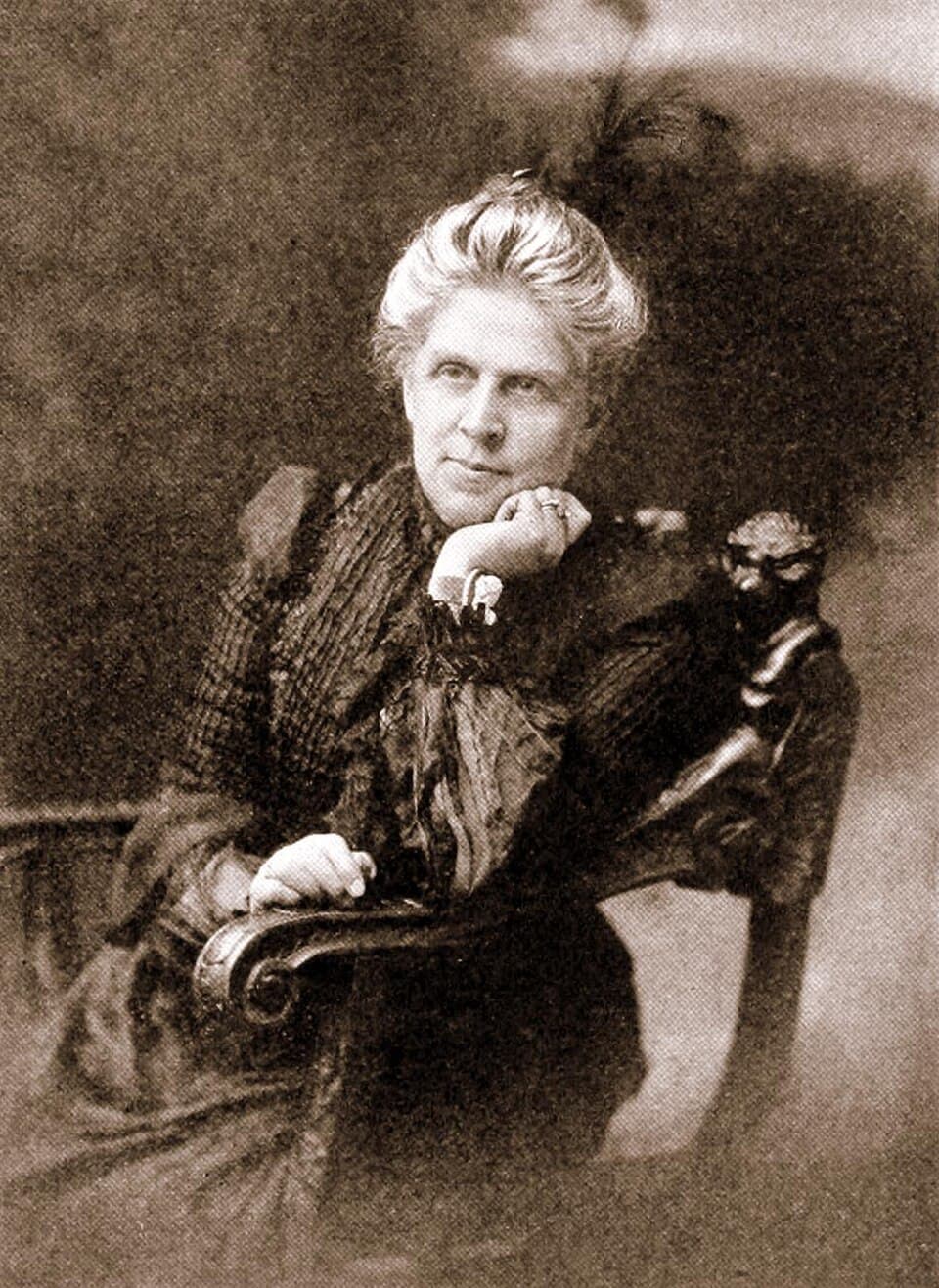
American · Science · Activism
Harriet Williams Russell Strong
July 23, 1844 – September 16, 1926
Early Life and Family Background
Harriet Williams Russell Strong was born on July 23, 1844, in Buffalo, New York, the fourth daughter of Henry Pierrepont Russell and Mary Guest (Musier) Russell.[2][11][5] Her family traced its lineage to prominent New England and early American figures, including a founder of Yale College and relatives connected to poet Henry Wadsworth Longfellow, reflecting a tradition of education and public service.[9] This heritage shaped expectations that she would be cultured and civically engaged, even if formal professional careers for women were rare.
In 1852, when Harriet was about eight, the Russell family moved west to northern California, settling near Quincy in Plumas County.[15][11] The region was part of the mining frontier along the California–Nevada border, exposing her to the boom‑and‑bust cycles of gold and silver extraction and the harsh realities of resource scarcity, including unreliable water supplies. These early experiences in mining communities would later inform her understanding of flood control, irrigation, and land management.
Harriet received a substantial education for a girl of her era. She attended Miss Mary Atkin’s Young Ladies Seminary in Benicia, California, a respected institution that provided instruction in literature, languages, music, and other subjects considered suitable for middle‑class young women.[4][16] Though she did not study engineering or the physical sciences formally, the seminary helped develop her intellectual discipline and confidence, giving her skills she would later apply to business correspondence, civic speeches, and technical patent applications.
Marriage, Early Adulthood, and Move to Southern California
During the early 1860s, the Russell family relocated again, this time to Nevada. In 1861, in Virginia City—then a booming silver‑mining town—Harriet met Charles Lyman Strong, superintendent of the Gould and Curry Mine.[16][12] She married him at age 19, around the mid‑1860s, entering into a partnership deeply tied to the volatile mining economy.[8][12] The couple eventually had four daughters—Louise, Harriet, Mary, and Georgina—whose upbringing would be central to Harriet’s motivations after she was widowed.[4][16]
Charles Strong later resigned his position at Gould and Curry and the family moved to Oakland, California.[16] Seeking more stable prospects than mining, they purchased a portion of former governor Pío Pico’s ranch near Whittier, in what was then rural Los Angeles County.[16][7] The property, known as Rancho del Fuerte, comprised roughly 220 acres of semi‑arid land.[17] Managing it required careful attention to water and soil, and the Strongs experimented with crops as they tried to convert the ranch into a productive enterprise.
Mining investments and other ventures eventually failed, leaving the family in precarious financial circumstances.[4][12] Around 1883, Charles Lyman Strong died by suicide after a series of unsuccessful business efforts, a tragedy that left Harriet a widow at 39 with four daughters to support and a failing farm.[4][16][17] In the gender norms of the 1880s United States, this situation was dire: widowed women were expected to rely on male relatives rather than manage large properties or engage in technical innovation.
Taking Over Rancho del Fuerte and Agricultural Innovation
In 1883, after Charles’s death, Harriet Strong became the sole owner and manager of Rancho del Fuerte.[4][13] Determined to protect her family’s future, she immersed herself in practical agriculture and water management. She studied the problems posed by Southern California’s semi‑arid climate, including drought, flash floods, and erosion. Instead of selling the land, she set about transforming it.
Strong experimented with new crops and business methods. She shifted the ranch’s focus towards walnut cultivation, recognizing the potential for a stable, high‑value crop suited to the climate.[17][11] By implementing irrigation strategies and careful orchard management, she greatly increased yields. Within roughly five years of her innovations, she became one of the leading commercial walnut growers in the United States, earning the nickname “Walnut Queen of Whittier.”[17][7] Her success demonstrated that a woman could direct large‑scale agribusiness.
To protect her land from flood damage and to secure water for irrigation, Strong devised a system of multiple dams and reservoirs. Observing how stormwater moved through canyons and ravines, she designed structures that would capture runoff, control debris, and store water for dry periods.[4][10] Working without formal engineering training, she relied on experimentation, practical observation, and consultation with craftsmen to develop ideas that would later be codified in her patents.
Early Patents and Mechanical Inventions
Strong’s inventive career can be traced through a series of U.S. patents obtained in the 1880s and 1890s. Her earliest documented patents addressed domestic and building‑related problems. On October 7, 1884, she was granted a patent for a device for raising and lowering hard‑to‑reach windows.[1] This mechanism made it easier and safer to operate high or inaccessible window sashes, particularly in large homes or institutions. The patent shows that she was already translating household observations into mechanical solutions.
Less than a month later, on November 4, 1884, Strong secured another patent, this one for a hook‑and‑eye fastener.[1] Hook‑and‑eye closures were widely used in clothing and textiles; her refinement likely improved durability, ease of use, or manufacturability. Together, these early patents reveal her ability to identify small mechanical inefficiencies and to use the patent system—still largely male dominated—to protect her innovations.
On November 16, 1886, she received a patent for a window sash holder.[1] This device helped keep windows in desired positions, improving ventilation control and safety. The sequence of patents from 1884 to 1886 shows Strong systematically addressing everyday mechanical challenges while she simultaneously grappled with much larger questions of flood control and water storage on her ranch.
Pioneering Dam and Reservoir Construction
Strong’s most influential inventions concerned water conservation and flood control. On December 6, 1887, she was granted U.S. Patent No. 374,378 for dam and reservoir construction.[4][10][17] The design called for a succession of dams built along a valley or canyon, arranged so that water from the lower dams would support and reinforce the upper ones. This configuration improved stability and allowed for the staged capture of floodwaters and debris.
She implemented variations of this system at Rancho del Fuerte, using dams and reservoirs to protect walnut orchards and store irrigation water.[4][17] By harnessing stormwater and runoff rather than simply allowing it to erode her land, Strong transformed the ranch from marginal to highly productive. Her success demonstrated the practical viability of her ideas and lent credibility to her claims about their broader applicability in the arid West.
On November 6, 1894, Strong received another patent, covering a method of impounding debris and storing water.[1][6] This innovation addressed the tendency of reservoirs to fill with silt, sand, and other material carried by floods. By designing structures that trapped debris in controlled areas while conserving water, she improved both safety and long‑term reservoir capacity. Historical accounts emphasize that her work anticipated modern integrated approaches to watershed management, recognizing the need to consider sediment, flood risk, and water supply together.[6][11]
Strong’s dam and debris‑impounding patents were later cited as conceptual precursors to major projects on the Colorado River, including Hoover Dam and the All‑American Canal.[2][19][11] Although she did not design those structures herself, her techniques and advocacy contributed to the intellectual environment in which large federal water projects were developed.
Correspondence, Intellectual Networks, and Public Advocacy
In addition to her practical work, Strong participated in wider intellectual and reformist networks. On January 28, 1885, she wrote a letter to Mary Baker Eddy, founder of Christian Science; this letter survives in the collections of the Mary Baker Eddy Library.[6] Library research characterizes Strong as “an inventor, horticulturist, businesswoman, music composer, conservationist, philanthropist, suffragist, and social activist,” suggesting the breadth of her activities and the esteem in which some contemporaries held her.
Strong engaged actively in civic organizations in the Los Angeles region. She became a prominent clubwoman and social leader, participating in cultural and reform circles that shaped public opinion on education, women’s rights, and municipal development.[16][1] Later accounts note that she served as the first woman member of the Board of the Los Angeles Chamber of Commerce and as the first woman trustee of the University of Southern California Law School, though available sources do not fix precise dates for these milestones.[1] These roles signaled her acceptance as a serious voice in business and legal education, arenas traditionally closed to women.
Strong was also deeply involved in the women’s movement. She advocated for women’s suffrage, women’s higher education, and women’s economic independence.[1][11] Sources report that she traveled across the continent with suffrage leader Susan B. Anthony to promote women’s causes, reinforcing ties between Western activists and the national campaign for voting rights.[1] Her combined identity as inventor, rancher, and suffragist challenged narrow definitions of what women’s activism could encompass.
Engagement with National Water Policy and Congressional Testimony
By the 1910s, Strong’s reputation as an expert in water conservation earned her invitations to national policy discussions. In 1917, she presented ideas on water conservation and the damming of the Colorado River to the U.S. Congress, arguing that a series of dams could both prevent floods and store water for irrigation and power generation.[2][10][11] Available sources do not specify the exact day of this presentation, but they indicate that she foresaw multi‑purpose dam systems similar to those later built.
In 1918, she appeared before a congressional committee on water power, further elaborating her proposals.[2][11] Strong advocated what would now be termed source conservation: capturing water at its origin in mountain canyons through successive dams to regulate flows downstream.[10] Her testimony highlighted the need to balance agricultural demands, flood control, and emerging hydroelectric power.
Although her specific schemes were not adopted in detail, her interventions illustrate the role of non‑credentialed experts—and specifically women—in shaping debates over Western resource development. In the decades that followed, large dam projects, including Hoover Dam, embodied many of the principles she had articulated about storage, flood mitigation, and regional planning.[2][19]
Awards, Honors, and Recognition
Strong’s water‑conservation inventions received formal recognition during her lifetime. At the World’s Columbian Exposition in Chicago in 1893, she was awarded two medals for her dam and reservoir designs, honoring their innovation and potential public benefit.[4][10][6] These awards, given at one of the era’s most prominent international fairs, signaled that her work was respected beyond California and that a woman inventor could compete successfully on a global stage.
After her death, Strong’s contributions were further acknowledged through induction into major halls of fame. She was posthumously honored by the National Women’s Hall of Fame, which describes her as the primary innovator of dry‑land irrigation and water‑conservation techniques in late‑19th‑century Southern California and emphasizes her roles as inventor, agricultural entrepreneur, civic leader, philanthropist, and women’s‑rights advocate.[1] She has also been featured by the National Inventors Hall of Fame and innovation‑focused institutions such as the Lemelson‑MIT Program, which highlight the technical significance of her water‑storage systems.[2][11][10]
Modern accounts in engineering, conservation, and women‑in‑STEM publications continue to celebrate Strong as a pioneer whose work illustrates the intersection of rural practice, civil engineering, and feminist history.[10][12][14] Podcasts, museum exhibits, and archival projects have brought her story to wider audiences, framing her as an exemplar of resilience and creativity.
Personal Life and Character
Beyond her public achievements, Strong’s personal life was marked by resilience and a commitment to family. After being widowed in 1883, she refused to leave Rancho del Fuerte, choosing instead to rebuild it in order to support her four daughters.[4][16][17] She carefully educated them and involved them in ranch operations and civic activities, modeling independence and responsibility.
Archival descriptions portray Strong as a businesswoman and social leader, active in cultural circles in Los Angeles.[16] She composed music, participated in clubs, and cultivated a wide network of acquaintances and collaborators. Correspondence preserved in the Harriet Williams Russell Strong papers (1815–1939) at the University of California documents her administrative skills, her habit of meticulous record‑keeping, and her ability to articulate complex ideas clearly.[16]
Her letters and public speeches reflect a blend of practicality and idealism: she believed that careful management of land and water could secure prosperity, and that women should be empowered through education and property rights. Contemporary observers, including those cited by the Mary Baker Eddy Library, described her as "one of the brightest women in Oakland," a phrase indicating both intellectual esteem and social prominence.[6]
Legacy and Historical Impact
Harriet Williams Russell Strong’s legacy operates on several intertwined levels. Technically, her patents for dam and reservoir construction and for impounding debris and storing water represented early, sophisticated attempts to solve the challenges of hydraulic management in arid and flood‑prone regions.[4][10][1] Her ideas about successive dams in canyons anticipated later multi‑dam systems and influenced the conceptual framework for major Upper and Lower Colorado River projects.
Economically, she demonstrated that a woman could successfully direct large‑scale agricultural production and technological innovation. By turning Rancho del Fuerte into a leading walnut enterprise, she contributed to the development of Southern California’s commercial agriculture and showed that women could manage capital‑intensive operations.[17][7][11]
Socially and politically, Strong advanced the cause of women’s rights and civic participation. Her advocacy for women’s suffrage, higher education, and independence, her travels in support of women’s causes, and her reported roles on the Los Angeles Chamber of Commerce board and at the University of Southern California Law School helped normalize women’s presence in professional and policymaking spaces.[1][11]
In historical memory, Strong serves as a case study of how women in the late 19th and early 20th centuries navigated restricted opportunities to influence science, engineering, and public policy. She operated outside formal professional channels, yet her inventions, congressional testimony, and organizational leadership left a lasting imprint on both regional development and feminist history. Contemporary projects such as the Los Angeles Archivists Collective’s "Nameless Multitudes" and museum exhibits in Whittier and elsewhere have sought to re‑center her story within narratives of urban and environmental change.[13][1]
Later Life and Death
In her later years, Strong remained engaged in civic affairs and continued to speak and write about water conservation and women’s rights. She lived in an era of rapid technological change, witnessing the transition from frontier mining and horse‑powered transport to automobiles and the early planning of large federal infrastructure projects.
Harriet Williams Russell Strong died on September 16, 1926, in Los Angeles County, California, reportedly from injuries sustained in an automobile accident.[12][1] Some secondary sources list September 6, 1926, as her date of death,[2][3][19] but museum research and biographical brochures associated with the Whittier Museum consistently identify September 16, and that date is widely used in local historical scholarship.[1]
After her death, her papers, spanning 1815–1939, were preserved and eventually archived, providing historians with rich material on her business dealings, inventions, correspondence, and civic activism.[16] Over the ensuing decades, as interest in women’s history and environmental policy grew, Strong’s work was rediscovered and reevaluated. She was inducted into the National Women’s Hall of Fame and recognized by inventors’ and engineering organizations for her pioneering role in water conservation and dry‑land irrigation.[1][2][11]
Today, Strong is remembered as an inventor, conservationist, businesswoman, and suffragist whose life illustrates the capacity of women to transform adversity into innovation and to shape the physical and political landscape of the American West.
Dated achievements
8 indexed.
- Jul231844Science
Birth of Harriet Williams Russell Strong
Harriet Williams Russell Strong was born in Buffalo, New York, on July 23, 1844.
View details Harriet Williams Russell Strong - Wikipedia - Oct071884Science
Patent granted for window-raising device
Strong was granted a U.S. patent for a device to raise and lower hard-to-reach windows, one of her earliest documented inventions.