← All women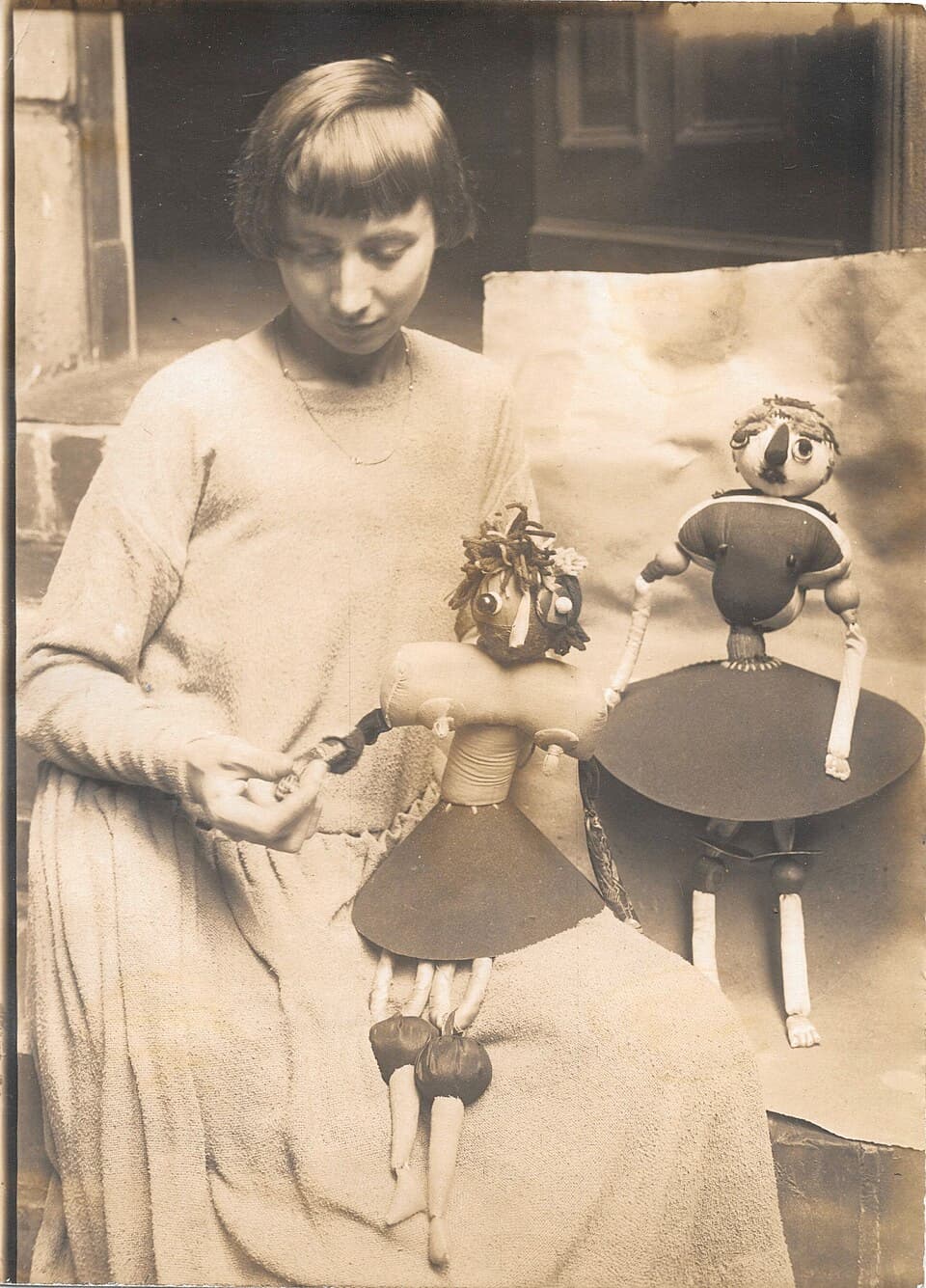
German · Arts
Hannah Hoch
November 1, 1889 – May 31, 1978
Early Life and Background
Hannah Höch was born Anna Therese Johanne Höch on 1 November 1889 in Gotha, Thuringia, Germany.[1][2][7][10] She was the eldest of several children in an upper‑middle‑class family; her father, Friedrich Höch, worked as an insurance manager, and her mother, Rosa Sachs Höch, was a homemaker.[7][10] Growing up in a provincial town, she received a solid general education but, like most girls of her generation, faced social expectations that prioritized domestic roles over artistic ambition.
Höch showed early interest in drawing and craft, and this practical, applied orientation would remain central to her work. Rather than following the traditional fine‑art academy route, she gravitated toward fields—such as glass design, embroidery, and graphic arts—where women’s professional participation was more tolerated.[9][13] This combination of decorative arts training and exposure to commercial imagery later proved crucial for her breakthrough in photomontage, a medium that depended on cutting and recombining the mass‑produced visuals of magazines and newspapers.
Education and Formative Influences
In 1912, Höch left Gotha for Berlin, then a rapidly modernizing metropolis and one of Europe’s principal artistic centers.[4][9][13][15] She enrolled at the School of Applied Arts in Berlin‑Charlottenburg, where she studied calligraphy, embroidery, wallpaper design, and graphic arts under teachers including Emil Orlik.[4][9][13] Her training at this institution and later at the Royal School of the Applied Arts Museum immersed her in the principles of design, typography, and reproducible imagery.[9]
The atmosphere of Berlin in the 1910s—marked by avant‑garde movements, radical politics, and the growth of illustrated periodicals—had a strong impact on her developing sensibility. As she studied, Höch encountered new artistic currents including Expressionism and the emergent Dada movement. She also became aware of debates over the Neue Frau, or "New Woman," a figure that symbolized expanding roles for women in urban life, work, and culture.[3][11][15] These debates about gender, labor, and representation would later become central themes in her photomontages.
Career Beginnings and Entry into Berlin Dada
After completing her studies, Höch began working in applied graphic fields. By the mid‑1910s she was employed in the graphics and advertising department of the Berlin‑based publisher Ullstein Verlag, where she designed patterns and layouts for publications and commercial products.[10][15] This work familiarized her with contemporary photography, typefaces, and the visual language of advertising—material that she would later appropriate and subvert.
In 1915, she met the Austrian‑born artist Raoul Hausmann in Berlin.[4][8][15][16] The two began an intense personal and artistic relationship that lasted into the mid‑1920s.[7][16] Through Hausmann, Höch entered the circle of Berlin Club Dada, joining figures such as George Grosz, John Heartfield, Johannes Baader, and Richard Huelsenbeck.[4][13][15] She became the only woman closely associated with this predominantly male group.[1][7][14][15]
Berlin Dada emerged during World War I as a vehemently anti‑bourgeois, anti‑war movement that embraced irreverence, nonsense, and collage as means of attacking conventional politics and aesthetics.[1][15] In this setting, Höch and Hausmann began experimenting with cutting and reassembling photographs from illustrated magazines and newspapers, a practice that became known as photomontage.[4][7][11][16] Several accounts credit the pair with helping to invent this technique within the German avant‑garde.[4][7][16]
First Artistic Successes
Höch’s first substantial public success came with the publication of her woodcut "Der Prophet Matthäus" (The Prophet Matthew) in the art periodical Das Kunstblatt in 1917.[10][17] The exact day of publication is not clearly documented, but contemporary scholars emphasize that this print marked her emergence as a recognized artist.[10][17] The work demonstrated her facility with stark contrasts and expressive line, qualities that carried over into her later collage practice.
By 1919, she was exhibiting with the Berlin Dada group and had completed one of her most celebrated works, the large‑scale photomontage "Schnitt mit dem Küchenmesser Dada durch die Bierbauch des Weimarer Republik" (Cut with the Kitchen Knife Dada Through the Beer‑Belly of the Weimar Republic).[1][5][15][16] This complex montage, composed of hundreds of cut‑out images, juxtaposed portraits of politicians, soldiers, dancers, and Dada artists with mechanical parts and maps. It offered a scathing, humorous critique of the male‑dominated political establishment and the chaos of the Weimar Republic.
Major Works and the Weimar Period
The years of the Weimar Republic (1919–1933) were the most prolific and historically significant in Höch’s career. She produced numerous photomontages, collages, and graphic works that responded to the turbulent politics, economic instability, and rapidly changing gender norms of the time.[1][2][3][11]
In 1920, she participated in the landmark First International Dada Fair in Berlin, exhibiting photomontages alongside her male colleagues.[8][15] Though specific opening and closing dates are not consistently documented in accessible sources, the fair has been widely cited as a defining public event for Berlin Dada. Höch’s inclusion made visible the central role she played in developing photomontage, even as contemporaneous critics and historians often downplayed her contribution.
Among her notable works from the early 1920s are photomontages such as "Das schöne Mädchen" (The Beautiful Girl) and compositions exploring the "Neue Frau" ideal.[3][11][15] In these works, Höch cut out images of fashion models, athletes, machinery, and consumer products, combining them to question how modern femininity was being constructed by advertising and popular media.[11] She often juxtaposed female bodies with mechanical parts, suggesting both empowerment through technology and the commodification of women.
Another important series from the later 1920s is her "Ethnographic Museum" or "Ethnographic" photomontages, where she combined images from European fashion magazines with reproductions of non‑European art and artifacts.[15][17] These works interrogated exoticism, racial stereotyping, and the patriarchal gaze embedded in both ethnographic display and mass media, raising questions that contemporary postcolonial and feminist theorists would later articulate more systematically.
International Contacts and the Netherlands
In 1926, Höch traveled to the Netherlands, a move that marked a significant new phase in her life and work.[4][8][16] During this period she developed close professional and personal relationships with artists and writers associated with the Dutch avant‑garde, including members of De Stijl such as Piet Mondrian and the collage innovator Kurt Schwitters.[4][16] She also formed a long‑term partnership with the Dutch writer Til Brugman, with whom she lived from 1929 to 1935.[7][10]
Living between Germany and the Netherlands broadened Höch’s artistic horizons. She produced works that showed a greater interest in abstraction and in the interplay of color and geometric form, while maintaining her commitment to collage as a critical tool. Her relationship with Brugman provided emotional support and intellectual companionship at a time when she was breaking away from the intense, often turbulent bond with Raoul Hausmann.[7][10][16]
Confronting Nazism and Internal Exile
The rise of the Nazi regime in Germany after 1933 had devastating consequences for avant‑garde artists, and for Höch in particular. The Nazis condemned modernist art as Entartete Kunst ("degenerate art"), and Höch’s politically charged photomontages, with their satirical treatment of authority and gender, were incompatible with Nazi cultural policies.[16][17]
In 1934, she moved to a small house with a garden in Heiligensee, on the outskirts of Berlin.[4][18] This home became her long‑term refuge and studio. Under the Nazi regime she was largely forced to withdraw from public exhibition; her work was seldom shown, and she survived by keeping a low profile and producing art privately.[16][17] The relative isolation of Heiligensee allowed her to avoid direct persecution while continuing to experiment with collage, watercolors, and drawings.
During these years, Höch’s style became more introspective and formally abstract, reflecting both the inner pressures of life under dictatorship and a shift away from explicit political satire. Nevertheless, her compositions retained a subtle critical edge, and her decision to continue working in the face of censorship demonstrates a quiet form of resistance.
Postwar Activity and Renewed Recognition
Following the end of World War II in 1945, Höch re‑emerged in the Berlin art scene.[4][18] She resumed more public artistic activity, participating in exhibitions that sought to rebuild cultural life in a city devastated by bombing and political division. Her earlier Dada photomontages, once marginalized or suppressed, began to receive renewed attention from artists, historians, and curators.
In the postwar decades, Höch’s work evolved again. She produced collages and paintings that were less overtly satirical but still engaged with questions of fragmentation, identity, and memory. Her use of bright colors and more lyrical forms contrasted with the stark blacks and whites of some earlier works, yet the underlying concern with how images construct reality remained consistent.[17]
The late 1960s and 1970s brought growing institutional recognition. In 1968, the Berlinische Galerie—which would later become a museum of modern art—began collecting works by Höch, laying the foundation for one of the most important public holdings of her oeuvre.[20] In 1971, the same institution organized one of the early substantial museum presentations of her work, helping to secure her status as a major figure in 20th‑century art, although exact opening dates for this exhibition are not easily documented.[20]
Internationally, her significance as a photomontage pioneer and as a rare woman in the historical avant‑garde was increasingly acknowledged. The Museum of Modern Art (MoMA) in New York acquired and exhibited her works, and scholarship such as The Photomontages of Hannah Höch highlighted the technical and conceptual sophistication of her practice.[17][19]
Awards, Honors, and Institutional Collections
While Höch did not accumulate the kind of official state honors sometimes granted to male contemporaries, she received growing recognition from art institutions and critics in her later years. Retrospectives in German museums and galleries, and later in international venues, presented her as a key figure in Dada and modernist collage. The Berlinische Galerie, MoMA, and other major museums assembled significant collections of her works, including photomontages, collages, prints, and paintings.[17][19][20]
Posthumous exhibitions have further solidified her reputation. For instance, the Whitechapel Gallery in London organized the first major UK exhibition devoted to Höch, emphasizing her role as a pioneer of collage and a crucial member of Berlin Dada.[12] Institutions such as the National Museum of Women in the Arts and leading galleries and auction houses have highlighted her importance in their artist profiles, auction catalogues, and educational materials.[4][11][16]
Personal Life and Relationships
Höch’s personal life was intertwined with her artistic development. Her long, often stormy relationship with Raoul Hausmann began in 1915 and significantly shaped her entry into Dada and photomontage.[4][7][16] Hausmann’s attitudes toward women and marriage were inconsistent, and the relationship exposed Höch both to avant‑garde circles and to patriarchal dynamics she later critiqued in her work.
In the late 1920s, she formed a deeply important relationship with the Dutch writer Til Brugman. The two women lived together from 1929 to 1935, sharing both domestic life and creative exchange.[7][10] Their partnership has been recognized by historians as a significant same‑sex relationship in the context of early‑20th‑century European culture and as part of the broader milieu of the "New Woman" and lesbian subcultures of Weimar Berlin.[3][7]
After separating from Brugman, Höch later married Kurt Matthies, adopting the married name Hanna(h) Matthies‑Höch, although the marriage was not long‑lasting.[7][10] She did not have children. Throughout her life, Höch cultivated friendships across artistic circles—including with De Stijl artists, writers, and younger practitioners—while maintaining a degree of privacy, particularly during the dangerous years of Nazi rule and wartime.
Artistic Style, Themes, and Contributions
Höch is best known for her photomontage and collage works, in which she appropriated and recombined images and text from mass media to create layered, often ambiguous compositions.[1][2][4][11][17] Technically, she developed a refined cutting and pasting method, sometimes integrating gouache or pencil to unify elements. Her approach differed from more didactic photomontage practitioners such as John Heartfield; whereas Heartfield used bold slogans and direct political messages, Höch favored metaphor, irony, and visual complexity.[11]
Key themes in her work include:
- Gender and the "New Woman": Höch explored how modern femininity was represented and constrained, critiquing both traditional domestic stereotypes and the commodified images of emancipated women in advertising.[3][11][15]
- Politics and authority: Works like Cut with the Kitchen Knife... dissect the male‑dominated political apparatus of the Weimar Republic, juxtaposing leaders with machinery and absurd juxtapositions to reveal the instability beneath official images.[1][15][16]
- Race and ethnography: Her "Ethnographic" montages challenge colonialist and exoticizing representations by mixing European fashion images with non‑European art, exposing the constructed nature of cultural difference.[15][17]
- Fragmentation and identity: Across her oeuvre, bodies, faces, and objects appear fragmented and recombined, reflecting modern anxieties about selfhood, technology, and social change.
Her work helped establish photomontage as a central technique of 20th‑century art and visual politics, influencing subsequent generations of artists ranging from Pop and Conceptual artists to feminist and queer practitioners who use collage to interrogate media imagery.
Legacy and Historical Impact
Hannah Höch occupies a crucial place in the history of modern art. She is widely acknowledged as one of the originators of photomontage and as the only woman who was a core member of the Berlin Dada group.[1][2][4][7][14][15] For decades, however, her contributions were overshadowed by those of her male colleagues, reflecting broader patterns of gender bias in art history.
Beginning in the later 20th century, feminist art historians and curators brought renewed attention to her work, emphasizing how her photomontages dissected gender, sexuality, race, and consumer culture from a distinctly female perspective. Institutions such as the National Museum of Women in the Arts present her as a pioneering feminist artist whose imagery of the New Woman, androgyny, and lesbian love challenged normative representations.[3][4][11]
Her legacy extends beyond Dada and collage. Contemporary artists who work with appropriated imagery, montage, and critical interventions in mass media—ranging from political photomonteurs to digital remix practitioners—draw on strategies that Höch helped to formulate. Her willingness to occupy a marginal yet independent position, working from the outskirts of Berlin and maintaining artistic integrity under authoritarian rule, has made her an emblem of resilience.
Today, her works are held in major museum collections worldwide, including MoMA in New York, the Berlinische Galerie, and other leading institutions.[17][19][20] Art historical surveys routinely include her among the essential figures of European modernism, Dada, and feminist visual culture.
Later Life and Death
In her later decades, Höch continued to live and work in her house and garden in Berlin‑Heiligensee, maintaining a modest lifestyle while her reputation slowly grew.[4][18] She remained active in producing collages, watercolors, and drawings, sometimes revisiting earlier themes through new formal experiments. Younger artists and scholars sought her out, recognizing her as a living link to the historical avant‑garde.
On 31 May 1978, Hannah Höch died in Berlin‑Heiligensee, West Berlin, at the age of eighty‑eight.[1][2][7][10][16] By that time, she had experienced both neglect and growing acclaim. Posthumous exhibitions and research accelerated the reassessment of her role, transforming her image from a marginal Dada participant into a central innovator in photomontage and a key figure in women’s art history.
Her life, spanning from the late 19th century into the late 20th, mirrored the upheavals of modern Germany: empire, war, revolution, dictatorship, and division. Through it all, she maintained an unwavering commitment to exploring how images shape perceptions of power, gender, and identity. That commitment ensures that her work remains relevant in contemporary debates about visual culture and continues to inspire artists and scholars worldwide.
Dated achievements
4 indexed.
- Nov011889Arts
Birth of Hannah Höch in Gotha, Germany
Hannah Höch, pioneering Dada photomontage artist, was born in Gotha, Thuringia, Germany.
View details Hannah Höch - Britannica - Jan011917Arts
First notable artistic success: publication of woodcut 'Der Prophet Matthäus'
Höch's woodcut 'Der Prophet Matthäus' was published in Das Kunstblatt, marking her first public artistic recognition.