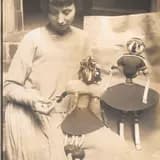
Hannah Höch died on May 31, 1978, in Berlin-Heiligensee, the West Berlin neighborhood that had been her home since 1934.
Hannah Höch died on May 31, 1978, in Berlin-Heiligensee, then part of West Berlin, Germany. She had lived in this quiet, garden-filled home on the outskirts of Berlin since 1934, a period during which she withdrew somewhat from public artistic life under the pressures of the Nazi regime, which condemned avant-garde and Dada art as 'degenerate.'
Despite this enforced isolation, Höch continued to create art privately throughout the 1930s and 1940s, and after World War II she re-emerged into public artistic life, gradually receiving greater institutional recognition. By the time of her death at age 88, Höch had lived through both World Wars, the rise and fall of the Weimar Republic, the Nazi dictatorship, and the division and partial recognition of postwar Germany — a life that spanned nearly the entire tumultuous twentieth century in her home country.
Her death marked the end of an era: she was the last surviving major figure of the original Berlin Dada group, and her passing prompted renewed art-historical interest in her singular role as the movement's only female member. In the decades since, retrospectives, scholarly studies, and museum acquisitions (including significant holdings at the Berlinische Galerie) have cemented her legacy as a pioneering photomontage artist whose critical, feminist-inflected visual language anticipated much of later twentieth-century feminist and collage art.