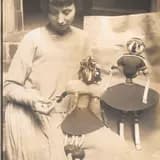
Höch's woodcut 'Der Prophet Matthäus' was published in Das Kunstblatt, marking her first public artistic recognition.
In 1917, Hannah Höch achieved her first significant public recognition as an artist when her woodcut Der Prophet Matthäus (The Prophet Matthew) was published in the influential German art periodical Das Kunstblatt. At the time, Höch was studying at the School of Applied Arts and, later, under Emil Orlik at the Berlin Museum of Applied Arts, developing a strong grounding in graphic design, textile pattern-making, and printmaking techniques that would inform her later photomontage work.
This publication was an important milestone: it signaled that Höch's work was being taken seriously within established art publishing circles, well before her involvement with the radical Dada movement in Berlin. For a young woman artist in early twentieth-century Germany, gaining recognition through a respected art periodical was a notable achievement, as women were frequently marginalized in mainstream art institutions and press.
The woodcut medium itself reflected the era's fascination with expressionist and modernist printmaking, and Höch's early success in this format helped establish her artistic credibility. This foundational recognition preceded her more famous contributions to Dada and photomontage, situating her not merely as a follower of the men in her circle (notably Raoul Hausmann, whom she met in 1915) but as an artist with her own independent trajectory and reputation. This early success laid important groundwork for the experimental, boundary-pushing work she would soon undertake.