← All women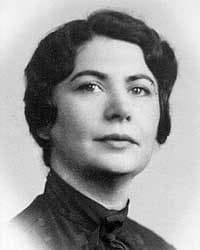
American, Polish · Science
Gertrude Blanch
February 2, 1897 – January 1, 1996
Early life and education
Gertrude Blanch was born Gittel Kaimowitz on 2 February 1897 in Kolno, then in the Russian Empire and now in Poland. She came from a Jewish family, the daughter of Wolfe Kaimowitz and Dora Blanc, and emigrated to the United States with her family around 1907, settling in New York City. Her early years were shaped by migration, working-class labor, and the educational opportunities available to immigrant girls in the early twentieth century. Sources on her life consistently show that the path to a mathematical career was not straightforward: she completed secondary school, worked for years as a clerk, and only later returned to formal study with the intention of becoming a mathematician.
Blanch graduated from high school in Brooklyn in 1914. For many years afterward, she worked in clerical positions in New York while saving money for college, an experience that gave her practical exposure to the kinds of systematic calculation and record-keeping that would later prove useful in numerical work. She entered New York University’s evening program in 1928, a relatively late start for a future research mathematician, and earned her bachelor’s degree in mathematics in 1932. She also completed graduate study at Cornell University, where she worked under Wallie Abraham Hurwitz. Her dissertation concerned Mathieu functions, a topic with important applications in mathematical physics. She received her Ph.D. in 1935. Her educational path is historically important because it illustrates how a woman from an immigrant and working-class background could, despite substantial barriers, enter advanced scientific life.
Early career and the Mathematical Tables Project
Blanch’s doctorate did not immediately lead to a stable professional appointment. Like many women mathematicians during the Depression, she encountered limited employment opportunities in universities and research institutions. She taught as a substitute at Hunter College and took additional coursework, including a physics class taught by Arnold Lowan. That class proved decisive. Lowan recognized her mathematical ability and hired her as the first professional mathematician for the Mathematical Tables Project, a Works Progress Administration program in New York devoted to producing accurate tables of functions and mathematical constants.
By 1938, Blanch had become the project’s technical director. From then until 1948, she led what became the largest and most sophisticated human-computing organization in the United States. The project employed hundreds of workers, many of them women, who performed calculations by hand under carefully designed procedures. Blanch’s contribution was not simply managerial. She organized the project’s mathematical workflow, created efficient procedures for computation, and helped shape the literature of numerical analysis. In a period before digital computers were widely available, table production was a crucial scientific service: astronomers, engineers, physicists, and military planners depended on reliable numerical tables for calculation.
Her work helped transform what might have been seen as clerical labor into a more systematic computational science. She designed algorithms that could be executed by teams of human computers and ensured that the calculations were checked and standardized. This was foundational to later programming practice, because it required one to think of mathematics not only as abstract proof but also as a sequence of steps optimized for repeated execution. In that sense, Blanch occupied a pivotal place between traditional arithmetic labor and the logic of modern computing.
Wartime computation and federal service
During the Second World War, the Mathematical Tables Project became increasingly important to federal science. By 1942, the project had moved under the National Bureau of Standards, bringing Blanch’s work into the federal research system. The project’s tables and calculations supported a wide range of wartime needs, including military research and applied science. In this period, Blanch helped ensure that the expertise of the human-computation workforce was preserved and redirected toward national priorities.
Her role was especially significant because the wartime state depended heavily on technical work that was often invisible to the public. Human computers, numerical analysts, and table-makers were essential to the development of applied science, but their labor rarely received the same status as theoretical research. Blanch’s leadership in this environment demonstrated not only technical skill but also institutional intelligence: she managed people, procedures, and mathematical standards at a time when speed, accuracy, and reliability all mattered. Her work in these years also connected the project to broader efforts in scientific administration, including military research on ballistics, engineering, and other calculations requiring accurate numerical data.
The war years reinforced the importance of women in computational labor, but they did not eliminate the gender barriers that Blanch had faced throughout her career. Instead, her success shows how women could attain influence in emerging technical fields even while remaining underrepresented in the broader profession. Blanch’s achievements were part of a larger, often under-credited history of women’s work in wartime science.
From human computation to electronic computers
When the Mathematical Tables Project came to an end in 1948, Blanch did not leave computational work behind. Instead, she moved into the new world of electronic and institutional computation, helping shape the field of numerical analysis for early computers. She worked at the Institute for Numerical Analysis and later in the computer division of Consolidated Engineering, which became ElectroData. She eventually served as head of mathematical research for the Air Force’s Aeronautical Research Laboratory at Wright-Patterson Air Force Base in Dayton, Ohio.
This phase of her career is historically important because it shows continuity between the pre-digital and digital eras. Blanch was among the mathematicians who understood that computers required not just hardware but methods: routines, algorithms, checks, and problem-specific numerical strategies. Her experience with the Mathematical Tables Project made her unusually well suited to this transition. She continued to work on approximation methods and on Mathieu functions, which had applications in physics and engineering, including optics and quantum mechanics. In the eyes of later historians, she can be seen as one of the first numerical analysts for electronic computers and one of the last major leaders of the human-computation era.
Blanch’s postwar career also reflects the institutional fragmentation of mid-century science. Rather than occupying a single long-term university appointment, she moved through government laboratories and industrial research settings. That pattern was common for applied mathematicians, but for women it also reflected persistent barriers to academic advancement. Even so, she built a career of substantial influence in environments that valued practical results and technical expertise.
Recognition, honors, and professional standing
Blanch’s scientific reputation grew steadily in the 1960s. In 1962, she was elected a Fellow of the American Association for the Advancement of Science, an acknowledgment of her contributions to numerical analysis and computation. Two years later, on 17 March 1964, she received the Federal Woman’s Award in Washington, D.C. Contemporary coverage also appeared on 18 March 1964, bringing her achievements to broader public attention. The award was a particularly important recognition because it explicitly honored her as one of the outstanding women in federal service, validating work that had often been performed behind the scenes.
Her honors were meaningful for the history of women in science because they documented a successful career in a field where women’s labor was often invisible or treated as auxiliary. Blanch’s awards recognized technical leadership rather than celebrity. That distinction matters: much of the infrastructure of scientific computation depends on people who design methods, manage workflow, and solve practical numerical problems, and those contributions can be overlooked in standard histories of mathematics. Blanch’s later honors helped correct that imbalance, even if belatedly.
Personal life
Publicly available sources provide relatively little detail about Blanch’s personal life beyond her family origins and migration. She was born into a Jewish family and emigrated to the United States with her parents and siblings in childhood. The historical record that survives most clearly concerns her education and professional work rather than marriage or children, and available biographical sources do not consistently report a spouse or descendants. That absence itself is part of the historical picture: many women scientists of her generation are documented primarily through their labor, while private life remains less visible in the archive.
Later life, archival preservation, and death
Blanch remained active in computational work into the later part of her career, and by the early 1970s she was participating in historical documentation of computing. On 16 May 1971, she gave an oral history interview for the Smithsonian’s Computer Oral History Collection, an important source for understanding the early history of human and electronic computation. Her papers later became an archival collection at the University of Minnesota, where processing began in 1990 and the collection was eventually made available to researchers. These archival efforts have been crucial to sustaining modern scholarship on her life and on the Mathematical Tables Project.
Gertrude Blanch died on 1 January 1996 in San Diego, California. She left behind a career that links immigrant education, women’s labor, federal science, wartime computation, and the origins of numerical analysis as a professional discipline. Today she is remembered as a key figure in the history of computing, not because she became famous in her own time, but because her work helped define the practices that made later computing possible. Her life demonstrates how women’s technical labor, often conducted under institutional constraints, could shape major scientific transitions.
Legacy
Blanch’s legacy lies in three overlapping contributions. First, she helped professionalize the production of mathematical tables and transform large-scale human calculation into an organized computational enterprise. Second, she carried that expertise into the electronic era, helping develop early numerical analysis for computers. Third, she served as an example of how a woman mathematician could exercise real authority in mid-twentieth-century science despite limited access to prestige and institutional power.
Historians of computing increasingly recognize the importance of the Mathematical Tables Project as a bridge between manual calculation and digital computation, and Blanch is central to that story. Her career also broadens the history of women in science by showing that leadership did not always take the form of university professorships or public theorems. Sometimes it took the form of algorithms, tables, procedures, and the patient organization of mathematical labor. Blanch’s life remains a key reference point for understanding the hidden architecture of modern computation.
Dated achievements
10 indexed.
- Feb021897Science
Birth of Gertrude Blanch
Birth of Gertrude Blanch in Kolno, then in the Russian Empire, before her later rise as a pioneer in numerical analysis and computation.
View details Gertrude Blanch - St Andrews MacTutor Biography - Jun101935Science
Ph.D. in mathematics from Cornell University
Gertrude Blanch earned her Ph.D. in mathematics from Cornell University, a key barrier-breaking step in her career in numerical analysis.