← All women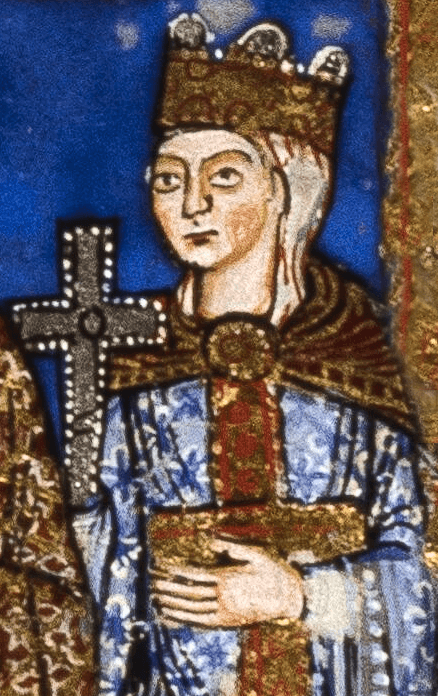
English · Politics
Empress Matilda
February 7, 1102 – September 10, 1167
Early life and family background
Empress Matilda (also known in later sources as Maud) was born at Winchester on 7 February 1102, the daughter of King Henry I of England and Matilda of Scotland. She was the only surviving legitimate daughter of Henry I, a fact that made her central to the royal succession after the death of her brother William Adelin. Her mother linked her to the old Anglo-Saxon royal house, while her father belonged to the Anglo-Norman dynasty established after the conquest of England, placing Matilda at the junction of two important lines of legitimacy.
Matilda spent her early years in a courtly environment shaped by dynastic calculation, literacy, religion, and governance. Medieval royal daughters were commonly used to strengthen alliances, and from an early age she was a political asset as much as a family member. The evidence for her education is limited, but she appears to have been raised to understand the symbolic and practical demands of high status. Her later command of charters, seals, and court ritual suggests familiarity with the political language of monarchy.
As a child, Matilda was betrothed to Henry V, King of the Romans. The match reflected the international ambitions of Henry I and helped position Matilda within the highest circles of European power. Her upbringing therefore prepared her for a life in which marriage, diplomacy, and dynastic strategy would define her public role.
Marriage to Henry V and imperial queenship
On 7 January 1110 Matilda married Henry V at Mainz, and on 13 April 1111 she was crowned Holy Roman Empress by Pope Paschal II in Rome. These events transformed her from an English princess into one of the leading women of Europe. As empress, she occupied a ceremonial and political role at the imperial court, and the title remained central to her identity for the rest of her life. Medieval rulers valued the prestige of imperial rank, and Matilda’s status gave her a visibility that later strengthened her English claim.
Her position in Germany and Italy also reveals how elite women could move within transnational dynastic systems. She was not an independent sovereign there, but neither was she merely a passive spouse. As empress, she participated in the representation of imperial authority, and her presence at court linked England to the wider politics of Latin Christendom. This prestige became especially important after Henry V died in 1125.
Widowed at a relatively young age, Matilda lost the direct imperial role that had defined her adult life. Henry I then recalled her to Normandy and turned her into the leading candidate for the English succession. Her transition from empress to heir illustrates how women of rank could be moved between political systems according to dynastic need.
Return to the Anglo-Norman world and designation as heir
Henry I had lost his only legitimate son in the White Ship disaster, and after Henry V’s death he began to focus on Matilda as his successor. On Christmas Day 1126 he compelled the leading nobles to swear an oath recognizing her as heir to the English throne. This was an extraordinary act in a society where kingship was strongly associated with male heirs and military leadership. Matilda thus became the first woman formally designated heir to the English throne by such an oath-taking ceremony.
The designation did not erase the obstacles she faced. Many nobles accepted the oath out of duty but did not embrace the idea of female rule. In 1128 Matilda married Geoffrey of Anjou, a political alliance that created the dynastic framework later known as the Angevin line. Although the marriage was useful to her father’s long-term strategy, it also tied Matilda to a partner with whom relations were often strained. The union nevertheless produced Henry, the future Henry II, making Matilda the mother of the dynasty that would eventually rule England after Stephen.
Matilda’s years in Normandy and Anjou were marked by the preparation of a claim that depended on hereditary legitimacy, marriage alliances, and elite support. Her political identity increasingly rested on the title Empress and on her status as Henry I’s named heir. That status was highly unusual for a woman in twelfth-century England and made her a focus of both loyalty and resistance.
The succession crisis and the Anarchy
Henry I died on 1 December 1135. Despite the oath sworn to Matilda, her cousin Stephen of Blois moved swiftly to seize the throne. The resulting contest led to civil war, a prolonged period of instability later called the Anarchy. Matilda’s position was weakened by the practical realities of medieval politics: she was abroad when Henry died, she was a woman in a militarized political culture, and key nobles were willing to abandon earlier commitments when expedient.
In 1139 Matilda landed at Arundel to press her claim in England. Her cause advanced dramatically in February 1141 when Stephen was captured at the Battle of Lincoln by forces led by her half-brother Robert of Gloucester. The victory gave Matilda the best opportunity she ever had to rule directly. On 24 June 1141 she entered London and was received as prospective ruler, adopting the title domina Anglorum, or Lady of the English, and issuing charters under her own seal.
The documentary and visual significance of this moment is remarkable. The National Archives notes that the seal used for her royal charters was the first in English royal history to picture female power in this way. Matilda’s brief regime showed that a woman could exercise royal authority, authenticate documents, and present herself in the idiom of kingship. Yet her government proved fragile. London turned against her, Stephen’s supporters regrouped, and on 14 September 1141 Matilda suffered defeat at Winchester, forcing her retreat.
She was not defeated in the larger sense, however, because her claim endured and the war continued. In 1142 she famously escaped from Oxford Castle during winter conditions, a story preserved in later chronicles as one of the most dramatic episodes of the civil war. Even when she was no longer in immediate control of events, Matilda remained the focal point of opposition to Stephen’s rule.
Later political influence and the settlement of the throne
Although Matilda never gained the crown, she remained politically active in the background. Her cause was increasingly carried by her son Henry and by allies such as Robert of Gloucester and, later, other members of the Angevin affinity. The civil war gradually exhausted both sides, creating pressure for compromise. On 6 November 1153 the Treaty of Wallingford recognized Henry as Stephen’s heir and effectively brought the Anarchy to an end.
The settlement did not fulfill Matilda’s original ambition of reigning as queen, but it secured the throne for her line. When Stephen died in 1154, Henry II became king. Matilda’s political labor had therefore achieved a dynastic victory even if it had not produced a personal one. Her son’s reign established the Plantagenet order that would shape English and continental politics for generations.
Matilda’s role in this process was more than maternal. She had held the royal claim through years of crisis, sustained her faction, and helped keep open the possibility of hereditary succession through her line. Her persistence mattered in an age when women’s political claims were often minimized or erased in later narratives.
Personal life
Matilda’s personal life was deeply entwined with the needs of dynastic strategy. Her first marriage to Henry V brought imperial status but no surviving children. Her second marriage to Geoffrey of Anjou was politically important but reportedly unhappy in some later traditions. The marriage produced several children, most notably Henry II, who inherited England and Normandy. Through him, Matilda became the ancestress of the Angevin, or Plantagenet, monarchy.
Her relationships with powerful men framed much of her historical memory: her father Henry I designated her heir; Henry V gave her imperial rank; Geoffrey of Anjou secured the line that would inherit; and her son Henry II realized the political outcome she had fought for. Yet Matilda was not merely a conduit between men. Modern historians emphasize that she acted with determination, negotiated alliances, issued charters, and claimed authority in her own right during the Anarchy.
Later life, death, and legacy
After the accession of Henry II, Matilda lived mainly in Normandy, where she continued to use the titles Empress and Lady of the English. She assisted in family and territorial governance and remained an important adviser within the Angevin world. Her later years were quieter than the political upheavals of her middle age, but she retained prestige and influence until her death on 10 September 1167 in Rouen.
Matilda’s historical significance lies in several interlocking achievements. She was a major European royal woman, the first woman formally designated heir to the English throne by oath, the first to use English royal authority in a sustained way as a claimant, and the first woman to have female power represented on an English royal seal in the specific form noted by The National Archives. Although she never became queen regnant, her struggle helped redefine what could be imagined for royal women in England.
Her legacy also endures through dynastic history. The throne ultimately passed to her son, and every later English and British monarch descends from her through the later royal line. As a result, Matilda stands at the center of both the political crisis that produced the Angevin dynasty and the longer history of female sovereignty in medieval Europe. Her life is remembered as a story of persistence in the face of institutional resistance, and as a rare case in which a woman’s claim to rule changed the course of a kingdom even without a coronation.
Dated achievements
14 indexed.
- Feb071102Science
Birth of Empress Matilda
Matilda was born at Winchester, daughter of King Henry I of England and Matilda of Scotland.
View details Empress Matilda - Wikipedia - Jan071110Science
Marriage to Henry V, King of the Romans
Matilda married Henry V, King of the Romans, at Mainz, becoming queen-designate of the Holy Roman Empire.