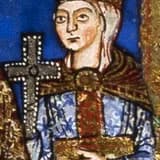
Empress Matilda died on 10 September 1167 at Rouen, having spent her final years advising her son Henry II.
Empress Matilda died on 10 September 1167 at Rouen in Normandy, where she had spent much of her later life overseeing her estates and serving as a trusted advisor to her son, King Henry II of England, following his accession to the throne in 1154.
In her final decades, Matilda largely withdrew from direct political and military engagement in England, instead establishing herself at the priory of Notre-Dame-du-Pré near Rouen, from which she exercised considerable influence over Anglo-Norman and continental affairs. She acted as a diplomatic intermediary for Henry II, corresponding with popes, bishops, and foreign rulers, and helped mediate several disputes, including aspects of the early conflict between Henry and Thomas Becket.
She was buried at the Abbey of Bec-Hellouin, a religious house she had patronized extensively, under an epitaph reflecting her extraordinary life: 'Great by birth, greater by marriage, greatest in her offspring: here lies the daughter, wife, and mother of Henry.' This epitaph, composed by contemporaries, deliberately downplays her own personal claim to rule in favor of framing her significance through the men in her life — an irony given that she had spent nearly two decades fighting for recognition as a ruler in her own right.
Matilda's legacy endured through her son's establishment of the Plantagenet dynasty and through the broader precedent she set for female political agency and claims to sovereign rule in medieval England, influencing how later female claimants and queens, including Elizabeth I, would be perceived and remembered.