← All women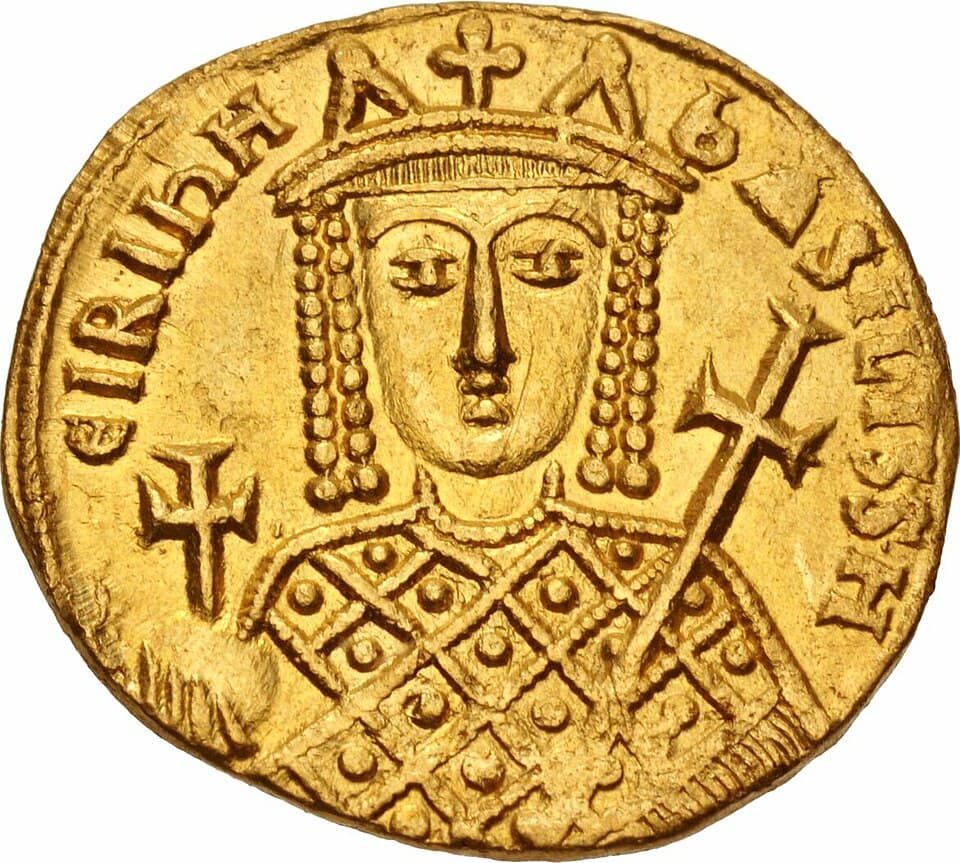
Byzantine Greek · Politics
Empress Irene of Athens
January 1, 752 – August 9, 803
Early life and background
Irene of Athens (Greek: Eirēnē) was born around 752 in Athens, in the Byzantine Empire. Very little is known with certainty about her family, but later sources describe her as coming from a noble Athenian background, probably of modest provincial aristocratic rank rather than from the highest imperial elite. Her surname, Sarantapechaina, survives in several traditions and indicates a family identity that was remembered well enough to distinguish her from other Irene’s in later Byzantine memory. The historical record does not provide detailed evidence of her childhood, education, or early influences, yet her later political and religious effectiveness suggests that she possessed the manners, literacy, and court intelligence expected of an imperial bride in the eighth-century Byzantine world.
Irene grew up during a period of intense religious controversy. The Byzantine Empire was deep in the long struggle over iconoclasm, the rejection of holy images, and the associated tensions between imperial authority and monastic and popular devotion. Athens itself lay outside the center of power, and Irene’s rise from provincial origins to the imperial palace is one of the most striking features of her biography. Her life demonstrates how marriage could serve as the principal avenue through which women entered the highest levels of politics in Byzantium.
Marriage to Leo IV and entry into imperial politics
In December 769, Irene married Leo IV the Khazar, the son of Emperor Constantine V. The marriage brought her to Constantinople and into the ruling Isaurian dynasty. By the time she entered court life, the empire was already shaped by military pressure, dynastic calculation, and religious dispute. As empress consort, Irene occupied a formal but constrained position; nonetheless, the marriage gave her proximity to authority and the opportunity to build influence among courtiers, officials, and churchmen.
Her status changed again with the birth of her son, Constantine VI, in 771. The birth secured the succession and made Irene the mother of the heir to the throne. In Byzantine politics, dynastic motherhood could be a powerful source of legitimacy. When Leo IV died in 780, Irene used that legitimacy to claim the regency for her young son. Her ascent from empress consort to regent marked the beginning of her independent political career.
Regency and the struggle over power
As regent, Irene governed an empire under pressure from internal faction and external enemies. She had to defend her position against powerful military and administrative interests suspicious of female authority. The regency was not merely ceremonial: Irene directed government, managed diplomacy, and shaped ecclesiastical policy. Her most important early initiative was her support for the restoration of icons. For decades, iconoclastic emperors had condemned the use of religious images, and the issue remained one of the empire’s deepest ideological fractures.
Irene’s political skill was evident in her ability to hold power despite periodic setbacks. In 790, opposition forced her aside and her son assumed control. Yet she returned to power in 792 as co-ruler, showing both persistence and an extraordinary capacity for political recovery. The relationship between mother and son then deteriorated. Court conflict, military discontent, and questions over who truly ruled the empire all intensified. Irene’s career illustrates the unstable and often violent nature of Byzantine succession politics, in which family bonds could not overcome the demands of authority.
Restoring icons and the Second Council of Nicaea
Irene’s greatest and most enduring achievement was her role in the restoration of icon veneration. In 787, she sponsored the Second Council of Nicaea, which formally approved the veneration of sacred images. The council ended the most severe phase of iconoclast policy and restored icons to an official place in the liturgical life of the Eastern Church. This was a major religious settlement, not simply a theological refinement. The decision had broad implications for art, devotion, and imperial authority.
The restoration of icons secured Irene a lasting reputation in Orthodox tradition, where she is remembered as a defender of the true faith. The council also had political significance: by aligning imperial power with iconodule theology, Irene strengthened her position among monks, clergy, and many lay believers. Her support for the council showed that her rule was not only about maintaining dynastic power but also about reordering the religious culture of the empire. In this sense, she was both a politician and a religious patron, using state power to settle a controversy that had divided Byzantium for generations.
Sole rule and imperial originality
In 797, Irene achieved what had never before been done in Byzantine history: she became the sole ruler of the empire. After the overthrow and blinding of Constantine VI, she ruled in her own right, taking the title and authority of emperor rather than merely queen or regent. This made her the first woman to govern Byzantium independently, a landmark in the history of women’s political power. Her accession was unprecedented and deeply controversial. It challenged assumptions about gender, legitimacy, and the nature of Roman imperial office.
Her rule as sole sovereign lasted until 802. During this period, she remained an important symbol of imperial authority, but she also faced criticism from contemporaries who objected to a woman occupying the throne. Her reign intersected with wider transformations in Mediterranean politics, including the emergence of a rival imperial claim in the West. The coronation of Charlemagne in 800 was shaped in part by the political and ideological uncertainty created by Irene’s rule in Byzantium. Although she did not directly cause the western coronation, her sovereignty became one of the factors that made the Carolingian imperial title imaginable to papal and Frankish leaders.
Later life, deposition, and death
Irene’s reign ended in 802, when a palace coup deposed her and sent her into exile first to Prinkipo and then to Lesbos. She died there on 9 August 803. Her fall demonstrated the fragility of power at Constantinople, where fiscal, military, and court opposition could rapidly overturn even an emperor who had ruled for years. Yet her death did not erase her importance. In later tradition, Irene was honored as a saint in the Greek Orthodox Church, a recognition tied above all to her defense of icons.
Her personal life was inseparable from the politics of succession and legitimacy. She was wife to Leo IV, mother to Constantine VI, regent during his minority, co-ruler during the struggle for power, and ultimately sole ruler. The most controversial aspect of her career is the brutal treatment of her son, a grim reminder that Byzantine politics often involved violence and betrayal. Still, her life remains extraordinary because she navigated structures that rarely allowed women to govern at the imperial level. Even though her methods could be ruthless, she permanently expanded the historical memory of what a woman in power could be in the medieval world.
Legacy
Irene’s legacy is multifaceted. She is remembered as the first woman to rule the Byzantine Empire in her own right, as a defender of icons, and as a politically formidable figure who shaped both internal Byzantine policy and broader medieval imperial politics. Orthodox memory preserves her as a saint; secular history remembers her as a ruler whose reign changed assumptions about gender and sovereignty. Her life also remains inseparable from the larger story of iconoclasm and the transformation of Byzantine religious art. By restoring icons, she helped secure one of the defining visual cultures of Eastern Christianity.
Irene’s career shows the possibilities open to elite women in Byzantium when dynastic circumstances, regency, and personal determination converged. It also shows the costs of such power. Her rise depended on a political order she did not create, and her authority was always contested. Yet her achievement endured: she ruled, briefly but decisively, as the empire’s sole sovereign and left behind one of the most remarkable female biographies in medieval history.
Dated achievements
10 indexed.
- Dec01769Politics
Marriage to Leo IV brings Irene into the imperial line
Irene married Leo IV in Constantinople in December 769, entering the imperial family and beginning the path that would lead to her regency and sole rule.
View details Encyclopedia.com, Irene of Athens (c. 752–803) - Jan14771Politics
Birth of Constantine VI