← All women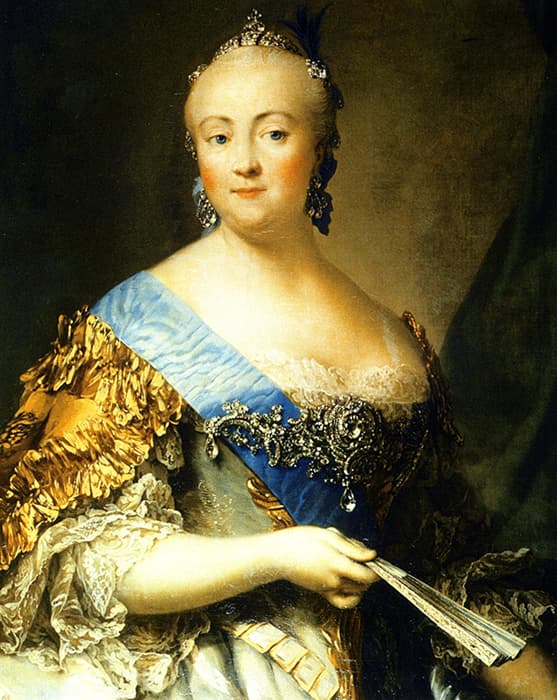
Russian · Politics · Science · Arts · Law
Elizabeth I of Russia
December 29, 1709 – January 5, 1762
Early life and family background
Elizabeth Petrovna (29 December 1709–5 January 1762, New Style) was the daughter of Peter the Great and Catherine I, born at Kolomenskoye near Moscow in the Romanov dynasty’s era of transformation. Her birth took place during the period in which Peter was reshaping Russia’s political institutions, military structure, and court culture along more European lines. Elizabeth therefore entered the world as both a dynastic princess and a symbol of the new imperial order her father was building.
Although she was born into the highest rank of Russian society, her upbringing was shaped by the unusual circumstances of her parents’ marriage and by the unstable succession politics of the early eighteenth century. Her mother was of non-noble origin before her rise at court, and her father’s reign had been marked by reform, war, and the creation of a more centralized state. Elizabeth was raised in the shadow of these changes, and later observers often saw her as inheriting Peter’s energetic temperament, taste for display, and interest in military and administrative power.
Elizabeth received a court education, but she was not trained in the systematic academic fashion later associated with enlightened monarchs. As a princess, she was taught what a Romanov daughter needed to know for dynastic life: court manners, religion, and the social arts of presence and persuasion. Sources describe her as beautiful, lively, and charismatic, qualities that later became important in the politics of loyalty and image. She was also known for her French and her familiarity with European court life, both of which helped her operate in the international and diplomatic world of eighteenth-century monarchy.
Her position in the succession, however, was not straightforward. The Romanov line in the generation after Peter the Great was marked by competing claims and short-lived rulers. Elizabeth’s status as Peter’s daughter gave her prestige, but her access to power depended on court alliances, guard regiments, and the broader political instability of the empire. Those conditions would later shape the coup that brought her to the throne.
Rise at court and political marginalization
Before her accession, Elizabeth lived for years on the margins of formal power. She belonged to the imperial family, yet she was not immediately the central political figure. The reigns and regencies that followed Peter the Great did not place her at the center of government, and she spent much of her early adult life navigating court factions, dynastic uncertainties, and the danger that a member of the Romanov family could become politically useful or politically threatening depending on the moment.
Her beauty and popularity did not translate automatically into authority, but they helped her become a well-known figure at court. She was admired by many contemporaries and became associated with elegance, charisma, and ceremonial vitality. These traits mattered because in an autocratic court culture, legitimacy was not only legal or hereditary; it was also performative. A ruler needed to be seen, recognized, and accepted. Elizabeth’s later success owed much to the fact that she had spent years building a recognizable presence among the elite and the guards who mattered in a capital city where coups were always possible.
She was also frequently the subject of dynastic speculation. As the daughter of Peter the Great, she represented a direct link to the most admired tsar of the previous generation. That connection became decisive when political conditions favored a restoration of authority associated with Peter’s line. Elizabeth’s eventual coup was made possible not only by her own ambition and supporters, but by the symbolic power of descent from Peter, which gave her a stronger claim than many of her rivals.
Accession through the palace coup of 1741
Elizabeth’s path to the throne culminated in the palace coup of 6 December 1741, when she was proclaimed Empress of Russia. The operation was carried out in St. Petersburg with the backing of loyal guardsmen and court supporters who opposed the regency regime governing in the name of the infant Ivan VI. This was one of the most dramatic political seizures in eighteenth-century Russian history.
The coup was important because it showed how unstable succession remained in Russia after Peter the Great. Elizabeth did not come to power through a smooth hereditary transition. Instead, she acted in a political environment where army loyalty, elite maneuvering, and speed determined success. Once she secured the support of the guard regiments, the balance of power shifted rapidly. The regency collapsed and Elizabeth became the sovereign ruler.
Her takeover also had a gendered significance. Although Russia had already seen powerful women in court politics, a woman seizing the throne through military-backed action was still extraordinary. Elizabeth’s triumph demonstrated that female rule could be not only dynastic but also forceful and decisive. Her accession has therefore been remembered as one of the key examples of women’s political power in early modern Europe.
Coronation, authority, and the style of rule
Elizabeth was formally crowned on 25 April 1742. The coronation in Moscow transformed the coup leader into a sacral monarch and reaffirmed the Orthodox and dynastic foundations of her rule. In the Russian imperial tradition, coronation mattered deeply because it publicly ratified the sovereign’s legitimacy before the church, nobility, and people of the realm.
Her reign is often associated with court magnificence and the revival of imperial pageantry. Elizabeth favored grandeur, ceremony, and visual splendor. She cultivated a dazzling court culture that reflected both her personal taste and the political needs of a ruler who had gained the throne through a coup and therefore benefited from public reaffirmation of legitimacy. The court became a stage on which imperial power could be displayed through architecture, fashion, ritual, and artistic patronage.
Elizabeth also relied on favorites and trusted courtiers, especially in matters of administration and cultural policy. Like many eighteenth-century monarchs, she governed through a combination of direct authority, patronage, and reliance on capable ministers and advisors. Her personal rule was real and sustained, but it also rested on the court structures that surrounded the sovereign in a patrimonial monarchy.
Domestic policy, legal culture, and governance
One of the most frequently noted features of Elizabeth’s reign is her reported refusal to sign death warrants, which led to an effective suspension of capital punishment. This was not a modern legal abolition, but it was an extraordinary policy in the context of an early modern empire where harsh penalties were normal instruments of power. The absence of judicial executions under her rule became one of her most distinctive personal legacies.
Elizabeth’s government also worked to strengthen the state and its cultural institutions. Her reign fell within the broader eighteenth-century Russian movement toward administrative consolidation and westernization. While she did not transform Russia into a constitutional state, she helped reinforce imperial authority and supported the development of state-sponsored learning and culture. Her rule is often described as a period of prosperity for court arts and architecture, even though it retained the coercive features of autocratic rule and serf society.
She inherited a state that had already been reorganized by Peter the Great and continued the process of integrating Russia into European diplomacy and warfare. Her government took part in the power struggles of the era, including the Great Northern and Seven Years’ War contexts that shaped Russia’s rise as a great power. Although military policy is often discussed more in relation to her ministers and generals, Elizabeth’s reign is remembered as part of the consolidation of Russia’s international status.
Patronage of the arts, architecture, and the Enlightenment
Elizabeth’s reign was a high point for Russian Baroque culture. Under her patronage, St. Petersburg and its imperial surroundings saw major architectural expansion, and the court became a center of artistic production. She supported projects that helped define the visual identity of the Romanov empire and signaled Russia’s participation in European court culture.
Her reign also fostered institutions associated with the Age of Enlightenment in Russia. Elizabeth’s support of learning and scholarship was significant even if it was filtered through autocratic patronage rather than liberal reform. The founding of Moscow University in 1755 is the clearest and most enduring example of this tendency. As the first university in Russia, it created a domestic center for higher education and helped establish a Russian scholarly elite.
Architecture and urban culture likewise flourished under Elizabeth. The imperial court invested in the embellishment of palaces and ceremonial spaces, especially in and around St. Petersburg. These projects did not merely beautify the capital; they projected the authority and permanence of the Romanov dynasty. Elizabeth’s personal taste for magnificence made the arts a form of statecraft.
Personal life, relationships, and succession
Elizabeth never had legitimate children, and her personal life has long attracted historical interest. Sources suggest that she may have secretly married Aleksei Razumovsky, a favorite and court singer, though the marriage remains historically uncertain. Regardless of the exact legal status of the relationship, Razumovsky was an important figure in her intimate circle and in later narratives about her reign.
Because she left no direct heir, succession remained a persistent issue. That problem became increasingly important as her health declined. Elizabeth’s lack of children meant that the Romanov line would pass to her nephew Peter III, a transition that proved unstable almost immediately. The succession after her death in 1762 became a prelude to yet another transformation in Russian monarchy, ultimately opening the way for Catherine II’s rise.
Her private life is often discussed alongside the contrast between public authority and personal restraint. Elizabeth projected splendor and confidence as ruler, yet the evidence suggests a more complicated private world shaped by devotion, favorites, and dynastic pressure. As with many sovereign women of the era, her personal relationships were filtered through court politics and later historiography that alternately romanticized or judged them.
Later years and death
By the late 1750s, Elizabeth’s health had begun to deteriorate. Her final years were marked by fatigue and increasing infirmity, though she remained the symbolic center of the Russian court until the end. She died in St. Petersburg on 25 December 1761 Old Style, corresponding to 5 January 1762 New Style, after a fatal stroke.
Her death closed nearly two decades of rule and ended one of the more distinctive female reigns in European history. In practical terms, it transferred the throne to Peter III; in historical terms, it ended a period of court magnificence, educational patronage, and unusual legal symbolism. Elizabeth was buried in the Peter and Paul Cathedral, the Romanov dynastic necropolis, placing her among the central rulers of imperial Russia.
Legacy
Elizabeth I of Russia is remembered as a ruler who combined dynastic legitimacy, political audacity, and cultural patronage. Her accession by coup, formal coronation, and long reign made her one of the most important women sovereigns of the eighteenth century. She strengthened the Romanov monarchy, helped elevate Russian court culture, and supported educational institutions that would shape the empire’s intellectual life.
Her legacy is especially visible in three areas. First, she helped consolidate Russia’s standing as a great power in Europe. Second, she made St. Petersburg and Moscow sites of imperial display and learning through architecture and university patronage. Third, she remains notable for the symbolic suspension of capital punishment, an unusual policy that distinguished her reign from many of her contemporaries.
As the daughter of Peter the Great and a predecessor to Catherine the Great, Elizabeth occupies a crucial place in Russian history. She served as a bridge between Peter’s reforms and the Enlightenment-era monarchy that followed. Her reign demonstrated that a woman could not only inherit the throne but seize it, govern it, and leave a durable institutional and cultural legacy.
Dated achievements
6 indexed.
- Dec291709Politics
Birth of Elizabeth Petrovna at Kolomenskoye
Elizabeth Petrovna, future Empress of Russia, was born near Moscow on 29 December 1709 (New Style).
View details Elizabeth of Russia - Wikipedia - Dec061741Politics
Palace coup and accession as Empress of Russia
Elizabeth led a bloodless palace coup in St. Petersburg, overthrowing infant Emperor Ivan VI and proclaiming herself Empress.