← All women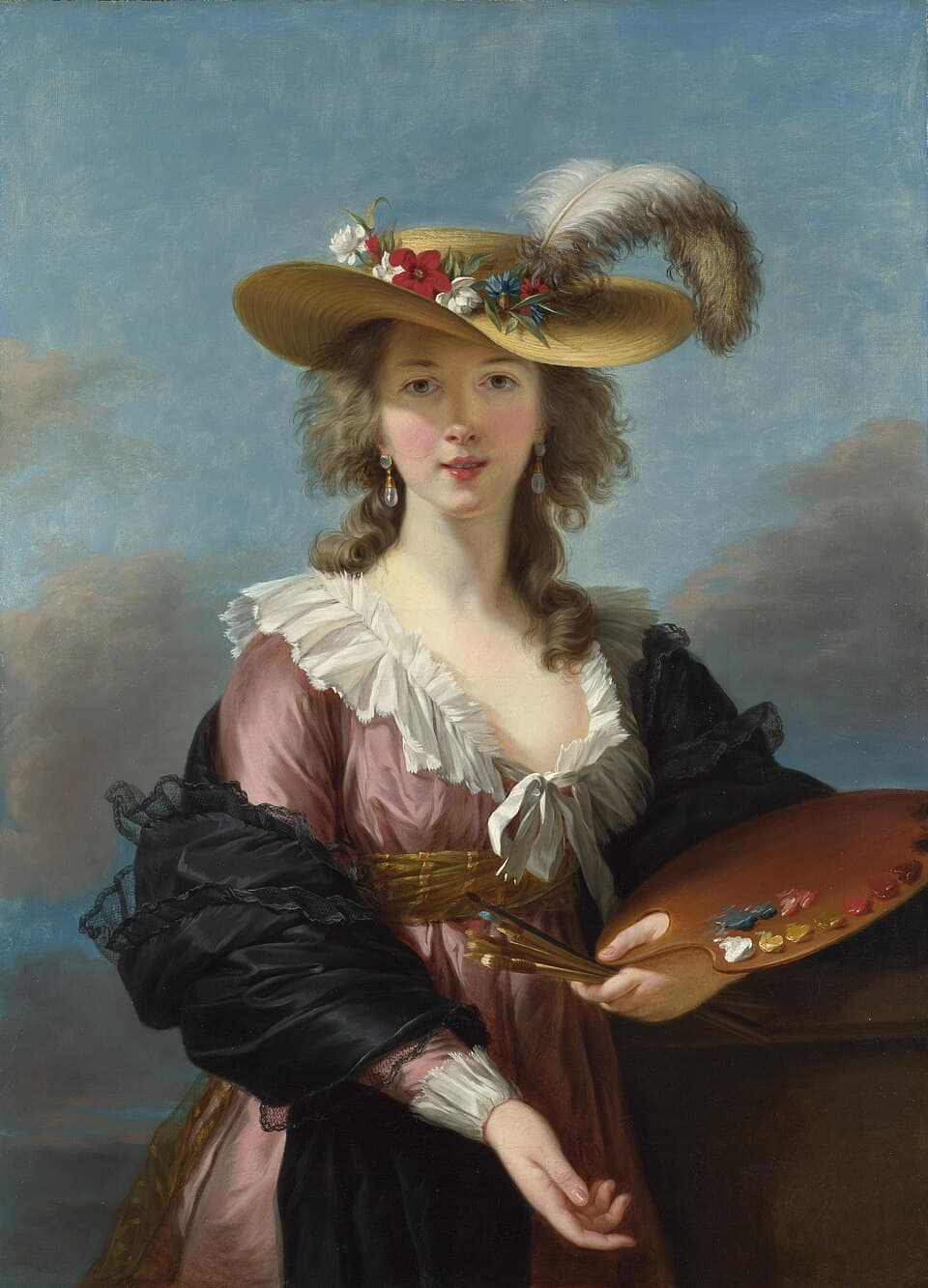
French · Arts
Elisabeth Vigee-Lebrun
April 16, 1755 – March 30, 1842
Early Life and Background
Élisabeth Louise Vigée Le Brun (née Vigée) was born on 16 April 1755 in Paris, in the Rue Coq‑Héron, into a modest yet artistic family.[8][17] Her father, Louis Vigée, was a pastel portraitist and member of the Académie de Saint‑Luc, while her mother, Jeanne Maissin, came from rural origins and later ran a boarding house.[6][12][15] This milieu exposed Vigée early to professional artistic practice, even though social norms restricted girls’ access to formal training.
As a child she attended a convent school until about age eleven, receiving only a basic education before leaving to concentrate on drawing.[9] According to biographical accounts, she was already sketching before she could write, and her father encouraged her by allowing her to copy his works and those of other artists.[15][19] His death in 1767, when she was about twelve, was a personal and economic blow; she moved with her mother to a new household where boarders included artists, further immersing her in Parisian cultural life.[9][17]
Denied access to the École des Beaux‑Arts and life‑drawing classes that were closed to women, Vigée Le Brun largely trained herself by studying Old Master paintings in collections and copying engravings.[5][10] She practiced portraiture on family and acquaintances, soon developing a style that combined Rococo softness with a keen eye for character. These early years forged her determination to succeed in an environment that often relegated women to amateur status.
Career Beginnings and Development
By her mid‑teens, Vigée Le Brun was already working as a professional artist. The National Gallery and other sources note that by age fifteen she was earning enough from portrait commissions to support herself, her widowed mother, and her younger brother.[3][5] Her sitters included members of the Parisian bourgeoisie and minor aristocracy, drawn by her ability to flatter without sacrificing likeness.
At nineteen she gained entrance to the Académie de Saint‑Luc, a guild‑like artists’ organization in Paris, an unusual achievement for a woman.[3][12] Exhibiting there expanded her clientele and visibility. Her growing reputation brought commissions from increasingly high‑ranking patrons, and she began to paint well‑known figures in literary and artistic circles.[10][19]
On 6 February 1776, she married painter and dealer Jean‑Baptiste‑Pierre Le Brun
A major turning point came when she began to paint Queen Marie Antoinette. Sources date their first sittings to around 177830 times
In the late 1770s and early 1780s Vigée Le Brun effectively became Marie Antoinette’s official portraitist, a role many art historians describe as the queen’s principal or court painter and likely the first time a woman held such rank at Versailles.[3][6][7] Through this position she shaped the queen’s public image at a time of growing political tension. Her portraits presented Marie Antoinette as graceful, maternal, and approachable, countering pamphleteers’ depictions of the queen as frivolous or immoral.[1][5] Vigée Le Brun’s best‑known royal portraits include Marie Antoinette in a Muslin Dress (1783), which stirred controversy for its informal chemise gown, and Marie Antoinette and Her Children (completed in 1789), a large composition showing the queen with the Dauphin and his siblings.[1][10] The latter was intended to rehabilitate the queen’s reputation by highlighting her role as a loving mother.[1][5] These images circulated widely through engravings and copies, making Vigée Le Brun instrumental in crafting one of the most iconic visual personas of the late Ancien Régime. Her success at court brought financial rewards and social elevation but also public exposure that would later endanger her. She became a well‑known figure in Paris, befriending writers and musicians and attending salons where political currents increasingly ran against the monarchy.[9][16] Despite her standing as the queen’s favorite painter, Vigée Le Brun faced institutional resistance when she sought admission to the Académie Royale de Peinture et de Sculpture, the pre‑eminent art academy in France. Some members opposed admitting more women beyond the tightly limited quota. In 1783, however, Louis XVI intervened on her behalf.[1][8] On 31 May 1783, she was received into the Académie Royale as a painter of "history" subjects, the most prestigious genre in the academic hierarchy.[1][8][13] Her reception piece, Peace Bringing Back Abundance, demonstrated her ability to handle allegorical themes as well as portrait likenesses.[1][10] As one of very few women members before the Revolution, her admission represented a significant breach in the institutional barriers that had long restricted women to minor artistic roles. Membership entitled her to exhibit at the official Salon. On 25 August 1783 she appeared there for the first time, showing portraits including that of the Comte de Provence, the king’s brother and future Louis XVIII.[8][19] The Salon brought her work to a broad public and critical audience, confirming her status as a leading painter of the day. Subsequent Salon appearances consolidated her reputation and generated further commissions from both French and foreign patrons.[1][3] Vigée Le Brun’s oeuvre comprises primarily portraits, though she also produced allegorical and mythological works. Scholars estimate that she created more than 600 paintings, perhaps over 660, during her long career.[1][9][3] Her sitters included royalty, aristocrats, artists, and intellectuals from France, Italy, Austria, Germany, and Russia. Among her most famous works are: Her style evolved from a Rococo sensibility—light colors, soft brushwork, and emphasis on elegance—to a more Neoclassical tone influenced by her travels and exposure to Italian and antique art.[4][19] She often portrayed women in slightly informal poses, sometimes outdoors, with a focus on expressive eyes and natural grace. Critics have noted how her images of motherhood and friendship humanized elite women while still idealizing their beauty.[3][5] The outbreak of the French Revolution dramatically altered Vigée Le Brun’s situation. As the queen’s intimate portraitist and a conspicuous royalist, she became a target for public hostility. On 5–6 October 1789, after the Women’s March on Versailles and the royal family’s forced move to Paris, she feared for her safety.[6][10] On the morning of 6 October 1789 she fled the city with her young daughter, beginning a long exile.[8][6] Her first destination was Italy, where she worked in Florence, Rome, and Naples, painting local aristocrats and earning election to the Accademia di San Luca in Rome on 15 June 1790.[8][10] This honor confirmed her international stature and provided a new institutional base. In 1792 she moved from Italy to Austria, working in Vienna and later in German courts such as Dresden and Berlin.[8][9] Despite the turmoil, exile was professionally fruitful. Vigée Le Brun adapted her style to local tastes, incorporating Italian colorism and Central European sensibilities while maintaining her characteristic focus on refinement and character. Her ability to secure commissions from foreign nobility underscores both her resilience and the cosmopolitan nature of late 18th‑century portrait markets.[9][10] On 12 January 1795, Vigée Le Brun arrived in Saint Petersburg.[8][9] Russia, under Catherine the Great and later Paul I and Alexander I, was eager to import Western artistic expertise. Vigée Le Brun quickly obtained commissions from members of the imperial family and aristocracy, painting grand duchesses, princes, and prominent courtiers.[9][10] Her Russian portraits often depict sitters in parks or gardens, emphasizing natural grace and fashionable dress. She became known for her ability to capture both status and personality, a quality that appealed to Russian patrons seeking modern yet elegant images. Her success led to her being made an honorary member of the Saint Petersburg Academy of Fine Arts on 5 November 1805, an exceptional distinction for a foreign woman.[13][8] During her years in Russia she also traveled to Moscow, where she painted noble families and interacted with local artistic circles.[9] This period broadened her influence, contributing to the development of Russian portraiture and further solidifying her reputation as one of Europe’s leading portraitists. Throughout the 1790s Vigée Le Brun remained officially classified as an émigré, which barred her from returning to France and threatened confiscation of her property.[16] After political tides shifted under the Directory and early Consulate, she petitioned for removal from the émigré list. On 18 January 1800 authorities granted her request, legally permitting her return.[8][13] She did not immediately settle in Paris, continuing to travel and work abroad; however, by 1802 she had returned to France and resumed her career there.[8][9] In the Napoleonic and Restoration eras she painted members of the new elites, though the scale and political prominence of her earlier royal commissions were not replicated. She also worked in Switzerland and other parts of Europe, maintaining a diverse clientele.[9][10] In her later decades Vigée Le Brun divided her time between a residence in Paris and a country house in Louveciennes, near Versailles. There she hosted salons that drew artists, writers, and aristocrats, continuing her role as a cultural figure even as younger generations of painters emerged.[3][10] She remained active, painting and drawing well into old age. Vigée Le Brun’s career was marked by a series of significant honors that were rare for women of her time: These institutional recognitions across multiple countries underscore her status as a transnational figure in European art. They also demonstrate that, despite systemic barriers, a woman artist could achieve high professional standing when her talent and social skills aligned with elite patronage. Vigée Le Brun’s personal life was closely intertwined with her professional trajectory. Her marriage to Jean‑Baptiste‑Pierre Le Brun in 1776 brought opportunities but also strain. Contemporary accounts and later biographies describe Le Brun as a capable dealer but financially irresponsible, whose debts contributed to the couple’s eventual separation.[9][16] The marriage did, however, give Vigée Le Brun valuable access to artworks and patrons in her formative years. The couple had one surviving child, a daughter Jeanne Lucie Louise, known as Julie, born in 1780.[9] Julie appears in several of her mother’s most tender portraits, including Madame Vigée Le Brun and Her Daughter, which became emblematic of sentimental motherhood.[9][10] The relationship between mother and daughter was affectionate but complicated, especially during the years of exile and Julie’s later marriage to a Swiss officer, Nigris. Julie died relatively young, in 1819, a loss that deeply affected Vigée Le Brun.[9] In her later years, Vigée Le Brun enjoyed friendships with writers, musicians, and fellow artists across Europe. Her salons in Paris and Louveciennes were known for lively conversation and for bringing together remnants of pre‑Revolutionary aristocracy with members of the new bourgeois elite.[3][10] Vigée Le Brun left an extensive written record in the form of her multi‑volume Souvenirs, memoirs that recount her life from childhood through her travels and old age. The first volume was published in 1835, and later volumes followed.[10][1] In these texts she offers observations on art, court life, travel, and the character of the many notable individuals she painted. Her memoirs are valued by historians as a key primary source on late 18th‑ and early 19th‑century European courts, providing a rare female perspective on figures such as Marie Antoinette, Catherine the Great’s circle, and various princes and princesses.[10][16] They also reveal her self‑conception as a professional artist and independent woman, emphasizing hard work, moral character, and the importance of patronage. Élisabeth Vigée Le Brun is now widely recognized as one of the most successful women artists of the 18th century and early 19th century.[1][3][17] Her portraits, especially of women, helped shape contemporary and later perceptions of aristocratic femininity, balancing idealization with psychological insight. Through her images of Marie Antoinette she fixed one of the most enduring visual representations of the French monarchy.[1][5] Her career demonstrates both the possibilities and limits faced by women artists of her era. She achieved institutional recognition in multiple academies, commanded high fees, and moved in elite circles, yet she repeatedly confronted barriers to training and membership because of her gender.[3][5] Her success owed much to her strategic use of charm, social skills, and adaptability alongside technical skill. In the 19th century her reputation waned somewhat as tastes changed, but the 20th century saw renewed interest, particularly from feminist art historians and institutions like the National Museum of Women in the Arts.[3] Major exhibitions and scholarly works have re‑evaluated her contributions, situating her within broader narratives of Rococo and Neoclassical portraiture and women’s professionalization in the arts.[17][20] Her paintings are now held by leading museums, including the Louvre, the National Gallery in London, the Metropolitan Museum of Art in New York, and others, and they feature prominently in exhibitions on women artists and on late 18th‑century portraiture.[1][5][10] In her final decades Vigée Le Brun enjoyed relative comfort and esteem. She continued to paint, though at a reduced pace, and devoted significant time to writing and revising her Souvenirs.[10][16] She maintained residences in Paris and Louveciennes, where she cultivated gardens and hosted visitors who sought stories of the vanished world of Versailles and the courts of Europe. On 30 March 1842 she died in Paris, aged 86, at 99 rue Saint‑Lazare.[1][8] She was buried in Louveciennes, where her grave remains a site of interest for admirers of her art.[2][13] Her long life spanned seismic political changes, from the Ancien Régime through the Revolution and into the July Monarchy, and her career adapted to each without losing its distinctive stylistic identity. Today, Vigée Le Brun stands as a central figure in women’s art history, exemplifying how a woman of talent and determination could carve out a remarkable international career despite social and institutional constraints. Her portraits and writings continue to inform understandings of gender, power, and representation in the age of revolution.Official Portraitist to Marie Antoinette
Admission to the Académie Royale and Salon Exhibitions
Major Works and Artistic Style
Exile During the French Revolution
Russian Period and International Recognition
Return to France and Later Career
Awards, Honors, and Institutional Recognition
Personal Life
Memoirs and Writings
Legacy and Historical Impact
Later Life and Death
Dated achievements
11 indexed.
- Apr161755Arts
Birth of Élisabeth Vigée Le Brun in Paris
Élisabeth Louise Vigée was born in Paris, later becoming one of the most celebrated portrait painters of the 18th century.
View details Encyclopædia Britannica: Élisabeth Vigée Le Brun - Feb061776Arts
Marriage to Jean-Baptiste-Pierre Le Brun
Élisabeth Vigée married art dealer Jean-Baptiste-Pierre Le Brun, after which she became known as Madame Vigée Le Brun.