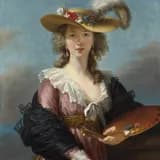
Élisabeth Louise Vigée was born in Paris, later becoming one of the most celebrated portrait painters of the 18th century.
Élisabeth Louise Vigée was born on 16 April 1755 in Paris, the daughter of Louis Vigée, a portraitist and pastelist, and Jeanne Maissin, a hairdresser. Her father recognized her artistic talent early and encouraged her to draw and paint, providing a foundation that would prove essential given the limited formal training opportunities available to women in art at the time.
Growing up in the vibrant artistic milieu of pre-Revolutionary Paris, young Élisabeth was exposed to painters, dealers, and connoisseurs who frequented her father's circle. After his death when she was only twelve, she continued honing her skills, studying works by masters such as Rubens and Raphael in private collections, since women were barred from formal academic training at the time, including life-drawing classes at the Académie Royale.
Her birth marks the beginning of a career that would see her become the preferred portraitist of Queen Marie Antoinette and one of the few women admitted to the French Royal Academy. Vigée Le Brun would go on to paint over 600 portraits and 200 landscapes across a career spanning six decades, working in the courts of France, Italy, Austria, Russia, and beyond. Her birth in this era of rigid gender constraints makes her subsequent achievements as a self-taught woman artist all the more historically remarkable, as she navigated and ultimately transcended the significant barriers facing women in the arts.