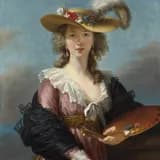
Vigée Le Brun was appointed official portraitist to Queen Marie Antoinette, an association widely cited as a first for a woman court painter.
Following her initial portraits of Queen Marie Antoinette, Élisabeth Vigée Le Brun became recognized as the queen's official and preferred portrait painter, a distinction some art historians describe as making her the first woman to hold such a rank at the French court. Though the precise administrative date of a formal appointment is not clearly documented in primary court records, the relationship was firmly established by around 1780 and defined much of Vigée Le Brun's early fame.
Over the following years, she would paint more than thirty portraits of the queen, ranging from formal state portraits in elaborate court dress to more intimate depictions, including the controversial 'Marie Antoinette in a Chemise' (1783), which caused a scandal for depicting the queen in informal muslin attire. This close relationship with the monarchy elevated Vigée Le Brun's status dramatically, bringing her a stream of aristocratic clients eager to be painted by the artist favored by the queen herself.
Being a woman in such a position was extraordinary for the era; the role of official court painter was almost universally held by men, and Vigée Le Brun's success represented a significant breach of the gendered norms of artistic patronage. Her close identification with Marie Antoinette would later prove perilous, forcing her into exile during the Revolution, but during the 1780s it secured her position as one of the most celebrated and sought-after portraitists in Europe, a rare achievement for a self-taught woman artist of her time.