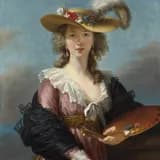
By royal command, Vigée Le Brun was admitted to the Académie Royale, one of only a handful of women granted membership before the Revolution.
On 31 May 1783, Élisabeth Vigée Le Brun was received into the prestigious Académie Royale de Peinture et de Sculpture in Paris, an extraordinary achievement given that the institution rarely admitted women. Her admission came by direct intervention of King Louis XVI, reportedly at Marie Antoinette's urging, overriding objections from academicians who cited her husband's profession as an art dealer as grounds for exclusion under academy statutes.
She was received as a painter of 'historical' subjects, submitting La Paix ramenant l'Abondance (Peace Bringing Back Abundance) as her reception piece, a genre traditionally considered the most prestigious category in academic hierarchy and one rarely attempted by women artists of the period. This placed her among an elite group; at the time of her admission, the Academy limited female membership to only four women simultaneously, and she joined the ranks alongside her rival and contemporary, Adélaïde Labille-Guiard.
This membership was historically significant because it granted Vigée Le Brun the right to exhibit at the official Paris Salon, access to which was otherwise restricted, and lent her institutional legitimacy in a male-dominated profession. It represented one of the highest honors available to an artist in Ancien Régime France and cemented her position at the pinnacle of the French art establishment, despite the systemic barriers facing women seeking formal artistic education and recognition during this era.