← All women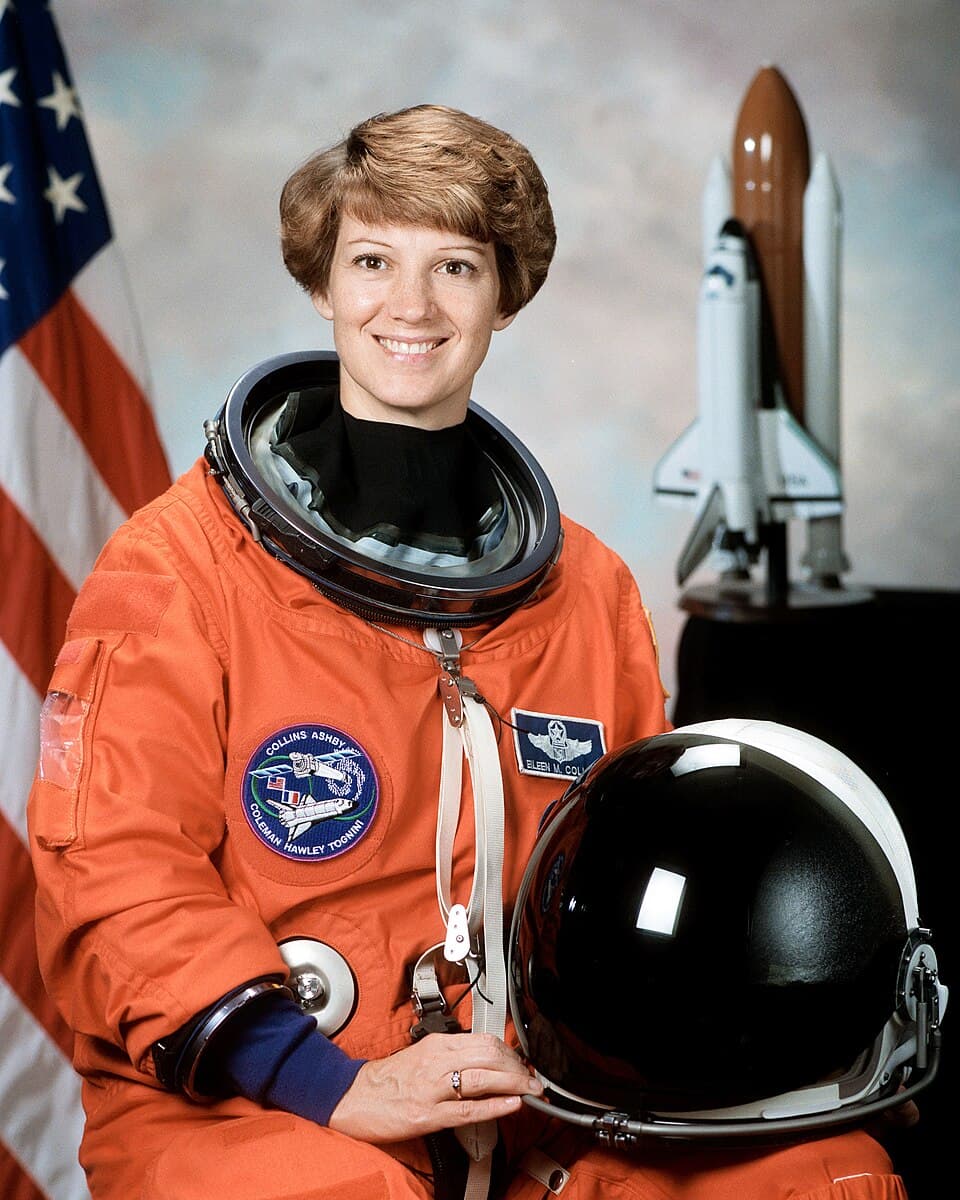
American · Science · Exploration · Aviation
Eileen Collins
November 19, 1956 – present
Early Life and Background
Eileen Marie Collins was born on 19 November 1956 in Elmira, New York, into a family of Irish immigrants.[6][1] Her parents worked multiple jobs and experienced periods of financial hardship, an environment that impressed upon Collins the importance of self‑reliance and determination.[6] From an early age she was drawn to aviation and spaceflight, reading about pilots and astronauts and following the United States space program.[6][2]
Collins grew up in public schools in Elmira and began working for pay around age 13 to help support the family and to save money for her future education.[6] She excelled in mathematics, a subject that would later underpin her careers in engineering, test piloting, and astronautics.[2][6] Lacking the means for a direct path to a four‑year university, she first attended community college, earning an associate degree in mathematics and securing a two‑year ROTC scholarship that opened the door to military aviation.[6]
Transferring to Syracuse University, Collins studied mathematics and economics while participating in Air Force Reserve Officer Training Corps.[6] She graduated in 1978 with a bachelor’s degree and a commission as a Second Lieutenant in the U.S. Air Force, setting her on the trajectory that would eventually lead to the flight decks of the Space Shuttle.[6][2]
Military Career Beginnings and Development
Following her commissioning, Collins entered Undergraduate Pilot Training at Vance Air Force Base in Oklahoma, graduating in 1979 as an Air Force pilot.[7] She initially flew the T‑38 Talon and other training aircraft, serving as a instructor pilot and developing the teaching and leadership abilities that would later prove crucial in mission command roles.[5]
During the early 1980s, Collins accumulated experience in a variety of aircraft and flight environments. She attended advanced training and moved into roles that combined operational flying with instruction. In 1980, she completed a master’s degree in operations research at Stanford University, gaining rigorous analytical skills in optimization, statistics, and systems analysis.[7] These skills were particularly valuable for a test pilot, where understanding complex data and risk trade‑offs is part of daily work.
From 1986 to 1989, Collins served as a mathematics instructor at the U.S. Air Force Academy while simultaneously training and working as a test pilot at Edwards Air Force Base in California.[2] At Edwards she flew numerous aircraft, with one account noting that she piloted 26 different aircraft in a single year, underscoring both her versatility and her appetite for demanding assignments.[2] In 1989, she added another advanced credential, earning a master’s degree in space systems management from Webster University, a program that steeped her in the technical and managerial aspects of space operations.[7]
By the end of the 1980s, Collins had established herself as a highly skilled Air Force officer with experience as an instructor, test pilot, and technical specialist. This combination of operational and analytical expertise made her an ideal candidate for NASA’s astronaut program, which increasingly sought pilots who could integrate flight skills with complex systems understanding.
Selection and Training as a NASA Astronaut
While attending the U.S. Air Force Test Pilot School at Edwards Air Force Base, Collins was selected by NASA in January 1990 as an astronaut candidate.[7][11] Her selection came at a time when the astronaut corps remained predominantly male, particularly in pilot positions; relatively few women had flown in space, and none had yet piloted or commanded the Space Shuttle.
Collins reported to NASA’s Johnson Space Center in Houston for intensive astronaut training, which included shuttle systems, robotics, space sciences, and survival and flight readiness exercises.[11] In July 1991, she completed this training and became a full NASA astronaut, qualifying for assignment as a Space Shuttle pilot.[7][11]
Her early assignments in the Astronaut Office included work in Orbiter engineering support and on the astronaut support team, where she participated in pre‑launch checkout, final launch configuration, crew ingress and egress, and post‑landing recovery operations.[11] Collins also served as a CAPCOM (spacecraft communicator) in Mission Control, relaying critical instructions and updates between the ground and crews in orbit.[11] She later held several leadership positions in the Astronaut Office, including Spacecraft Systems Branch Chief, Chief Information Officer, Shuttle Branch Chief, and Astronaut Safety Branch Chief, roles that placed her at the center of shuttle operations and safety oversight.[11]
First Spaceflight and First Female Shuttle Pilot: STS‑63
Collins’s first spaceflight came with the STS‑63 mission aboard Space Shuttle Discovery. On 3 February 1995, she launched as pilot, becoming the first woman to pilot a Space Shuttle.[11][7][9] The mission was an eight‑day flight that included the first rendezvous with the Russian space station Mir and a series of experiments in the Spacelab module.[11][2]
As pilot, Collins shared responsibility for all phases of flight, from ascent to orbital maneuvers and re‑entry. The mission’s high‑profile objectives were part of the broader Shuttle‑Mir program, intended to test cooperative operations between NASA and the Russian space agency and to prepare both partners for a future jointly built space station.[7] During the approach to Mir, Discovery executed a close fly‑around instead of docking, allowing rendezvous techniques to be rehearsed and relative navigation systems to be validated.[11]
STS‑63 concluded with Discovery’s landing on 11 February 1995, successfully completing Collins’s first spaceflight and confirming her historic status as the first female shuttle pilot.[11] The mission demonstrated that women could occupy the demanding shuttle pilot role and helped erode institutional and cultural barriers that had long restricted women’s access to frontline aviation and aerospace leadership.
Second Shuttle‑Mir Mission: STS‑84
Collins’s second mission, STS‑84, launched on 15 May 1997 aboard Space Shuttle Atlantis.[11][9] Again serving as pilot, she participated in the sixth Shuttle‑Mir docking mission, part of a series of flights that steadily deepened operational ties between NASA and the Russian space program.[9]
STS‑84 involved docking with the Mir space station, transferring supplies, experiments, and equipment, and delivering a U.S. astronaut for a long‑duration stay aboard the station.[11] Collins helped oversee the intricate rendezvous and docking procedures and managed shuttle systems that supported joint operations with Mir. These missions tested the logistics, human factors, and technical interoperability that would later be crucial for the International Space Station (ISS).
The mission ended when Atlantis landed on 25 May 1997, concluding a ten‑day flight that further solidified Collins’s credentials as a reliable and skilled shuttle pilot in complex international operations.[11] Her work on STS‑84 contributed to the experiential foundation for the ISS program and reinforced the normalization of women in operational leadership roles in human spaceflight.
First Female Shuttle Commander: STS‑93
Collins’s third spaceflight was the historic STS‑93 mission aboard Space Shuttle Columbia. On 23 July 1999, she launched as mission commander, becoming the first woman to command a Space Shuttle mission.[11][7] Her five‑person crew was tasked with deploying the Chandra X‑ray Observatory, one of NASA’s Great Observatories intended to study high‑energy processes in the universe.
During ascent, STS‑93 experienced technical anomalies, including a premature shutdown of one of Columbia’s three main engines and associated performance issues. Collins and her crew responded with calm professionalism, managing the situation safely and achieving orbit within acceptable parameters.[11][1] The incident showcased her ability to command under pressure and underscored the role of rigorous training and discipline in shuttle operations.
Once in orbit, the crew successfully deployed Chandra into a highly elliptical orbit using an upper‑stage rocket.[1] Chandra has since provided transformative insights into black holes, neutron stars, supernova remnants, and galaxy clusters. The mission concluded with Columbia’s landing on 27 July 1999, marking the completion of Collins’s first command and a major milestone in both astronomical research and women’s leadership in space.[11]
Return to Flight Commander After Columbia: STS‑114
Collins’s fourth and final spaceflight, STS‑114, came in the aftermath of the Space Shuttle Columbia disaster of February 2003, in which seven astronauts were killed when the shuttle broke up during re‑entry.[7][11] NASA suspended shuttle flights and embarked on a comprehensive review and redesign of safety and inspection procedures.
On 26 July 2005, Collins launched aboard Space Shuttle Discovery as commander of STS‑114, NASA’s designated “Return to Flight” mission.[11][7] The mission had dual objectives: testing new safety and inspection protocols for the shuttle’s thermal protection system and delivering supplies and equipment to the International Space Station.[11][9] The crew conducted detailed in‑flight inspections using cameras and sensors, performed spacewalks to evaluate repair methods, and installed hardware on the ISS to support its ongoing assembly and operations.[11]
STS‑114 revealed that foam shedding from the external tank, a key factor in the Columbia accident, remained a concern, leading NASA to suspend further flights temporarily for additional engineering work. Nonetheless, the mission demonstrated that NASA had significantly enhanced its risk awareness and mitigation strategies, and Collins’s leadership was widely praised as steady and transparent in the face of continuing uncertainty.[9]
Discovery landed on 9 August 2005, bringing STS‑114 to a successful close and marking the end of Collins’s on‑orbit career.[11] Over four spaceflights—STS‑63, STS‑84, STS‑93, and STS‑114—she logged more than 872 hours in space, establishing herself as one of the most experienced shuttle pilots and commanders of her generation.[11][9]
Awards, Honors, and Recognition
Collins’s pioneering career has been recognized with numerous awards and honors. She received the Harmon International Trophy in 1995, in part for her achievement as the first female Space Shuttle pilot on STS‑63.[6] Her military decorations include the Defense Superior Service Medal, the Defense Meritorious Service Medal, and the Distinguished Flying Cross, among others.[7][2]
NASA awarded her Space Flight Medals and the Outstanding Leadership Medal for her contributions to the shuttle program and astronaut office.[2][7] International recognition includes honors such as the French Legion of Honor, reflecting the global significance of her role in human spaceflight.[2]
In the civic sphere, Collins has received the Free Spirit Award and the National Space Trophy, and she has been inducted into the National Women’s Hall of Fame, which describes her as “launched into history” as the first American woman to pilot a spacecraft and the first to command a shuttle.[2] In 2013, she was inducted into the U.S. Astronaut Hall of Fame, further solidifying her status as one of the program’s most distinguished veterans.[9]
Personal Life
Collins has maintained a relatively private personal life, but some details are documented in public sources. She married Pat Youngs in 1987, and the couple has two children.[10] Balancing family responsibilities with the demands of an Air Force and NASA career required careful planning and support systems, particularly given the long hours, travel, and risks associated with test piloting and spaceflight.
Her later decisions, including her retirement from NASA in May 2006, were influenced in part by a desire to spend more time with her family and to pursue new interests outside of full‑time astronaut duties.[9] Collins has often spoken publicly about the importance of mentorship, education, and family encouragement in enabling women and girls to pursue careers in science, technology, engineering, and mathematics.
Later Career and Public Engagement
After leaving NASA, Collins retired from the U.S. Air Force in 2005 at the rank of Colonel.[7] She then embarked on a career that blended aerospace consulting, public speaking, and media analysis. Collins has worked with CNN as a space shuttle analyst, providing expert commentary on shuttle launches and landings and explaining complex technical matters to a broad audience.[9]
She has served as an adviser to the National Space Biomedical Research Institute and as a consultant in the aerospace industry, contributing her experience to discussions about human factors, safety, and long‑duration spaceflight.[9] Collins also appears periodically at educational and commemorative events, including museum programs and conferences, where she advocates for STEM education and encourages young people, particularly girls, to consider careers in aviation and space.
In public talks, Collins often reflects on her journey from a working‑class upbringing in Elmira to commanding the Space Shuttle, emphasizing themes of perseverance, continuous learning, and the value of taking on difficult challenges.[6][2] Her narrative has become part of the broader story of women entering and excelling in previously male‑dominated fields.
Legacy and Historical Impact
Collins’s legacy rests on a combination of historic firsts and sustained professional excellence. As the first woman to pilot a Space Shuttle and the first woman to command a Space Shuttle mission, she broke highly visible gender barriers in both military aviation and human spaceflight.[1][11] NASA also notes that, as of her biography’s publication, she is the only woman to have commanded the shuttle twice, highlighting the depth of trust placed in her leadership.[11][9]
Her accomplishments have had symbolic and practical impacts. Symbolically, Collins became an icon of women’s capabilities in high‑risk, high‑technology environments, demonstrating that women could not only participate in but lead complex missions involving international coordination and cutting‑edge science. Practically, her work on Shuttle‑Mir and the ISS Return to Flight missions contributed to the operational knowledge that underpins ongoing human presence in low‑Earth orbit.[9][11]
Collins’s story also reflects broader social changes. She entered the Air Force and NASA at a time when policies restricting women’s roles in combat and high‑performance aviation were gradually being relaxed. Her success helped validate these changes and encouraged institutions to further open pathways for women.[2][6] Many later female astronauts, pilots, and aerospace engineers cite Collins as a role model whose visibility made their own aspirations seem attainable.
In the wider context of women’s history, Collins stands alongside figures such as Valentina Tereshkova, Sally Ride, and Mae Jemison in the continuum of women in space. While Tereshkova was the first woman in orbit and Ride the first American woman in space, Collins’s achievements are distinct in their focus on command authority and piloting, areas historically dominated by men.[1][4][8] Her career underscores that full inclusion in space exploration involves not only presence but leadership and technical mastery.
Later Life
As of the mid‑2020s, Collins remains alive and active in public and advisory roles.[1][9] She continues to speak at events, participate in board and advisory activities, and lend her expertise to discussions about the future of human spaceflight. Her official and institutional biographies—from NASA, the New Mexico Museum of Space History, Syracuse University, and the National Women’s Hall of Fame—ensure that her story is documented for future generations.[11][1][2][6]
Although no longer flying in space, Collins’s influence persists through the programs she helped shape, the missions she led, and the people she has inspired. Her life from her birth in Elmira in 1956 through her trailblazing career in the Air Force and NASA encapsulates a pivotal era in which women moved decisively into the highest levels of aerospace exploration and command.
Dated achievements
9 indexed.
- Nov191956Aviation
Birth of Eileen Marie Collins
Eileen Marie Collins was born in Elmira, New York, to Irish immigrant parents, later becoming a pioneering U.S. Air Force test pilot and NASA astronaut.
View details Eileen Marie Collins – New Mexico Museum of Space History - Feb031995Aviation
First woman to pilot a Space Shuttle — launch of STS-63 Discovery
Eileen Collins became the first woman to pilot a Space Shuttle when Discovery launched on STS-63, a mission featuring the first rendezvous with Mir.