← All women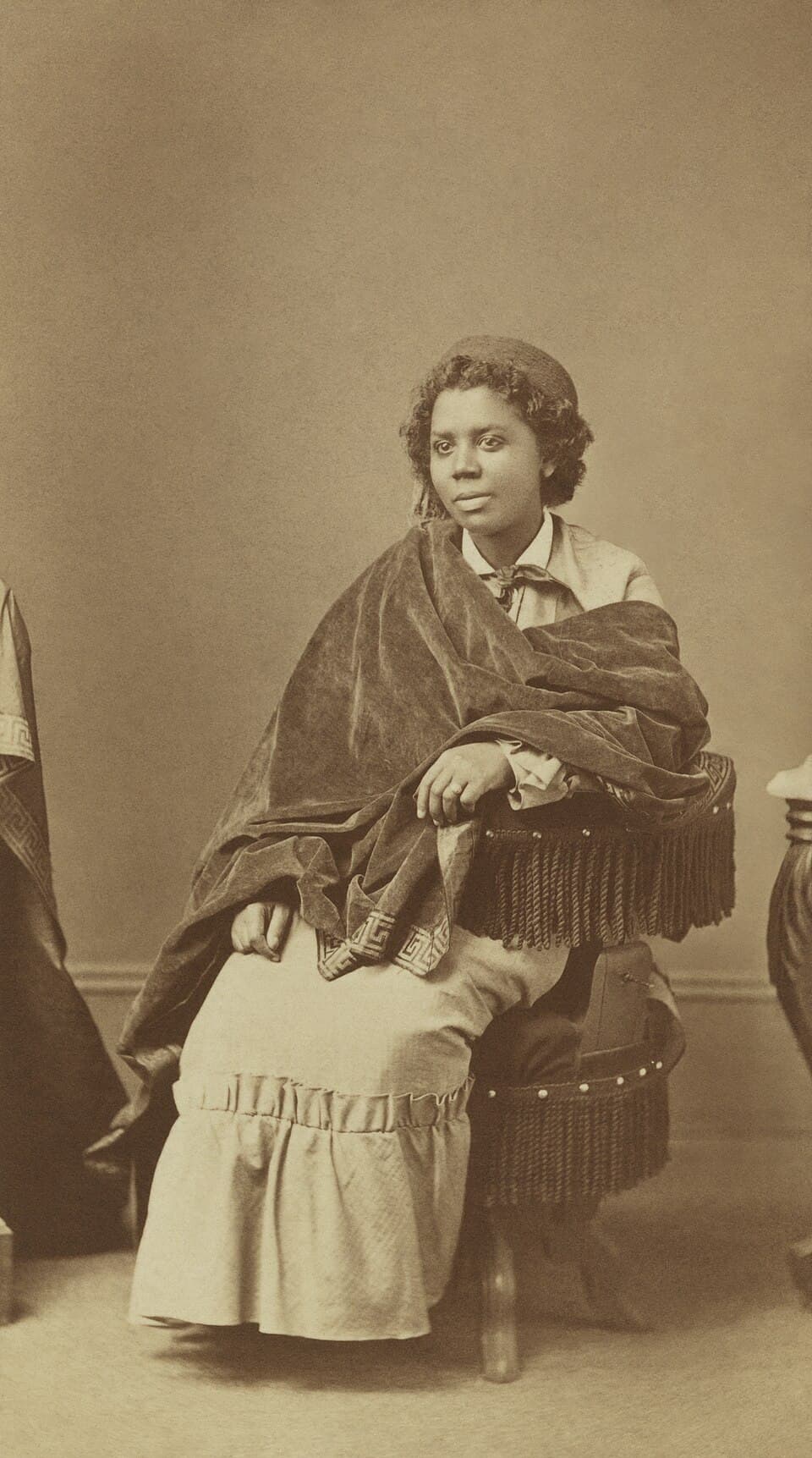
American · Arts
Edmonia Lewis
July 4, 1845 – September 17, 1907
Early Life and Background
Mary Edmonia Lewis, later known professionally as Edmonia Lewis and by the childhood nickname “Wildfire”, was born in the mid‑1840s near Greenbush (now Rensselaer), New York. Most major references place her birth around July 4, and several specify July 4, 1845, though some give 1844 or treat the year as approximate.[2][4][6][8] Her father was of African descent and worked as a laborer or servant; her mother was of Native ancestry, often identified as Chippewa/Ojibwe or Mississauga Ojibwe, who made and sold crafts.[1][3][8][12] Lewis was born free in a United States still marked by slavery and violent dispossession of Indigenous peoples.
Both of her parents died when she was young, and Lewis spent part of her childhood living with maternal relatives in a Native community near the Great Lakes.[1][3][7][17] She later recalled that with “my mother’s people” she fished, roamed the woods, and learned to make small objects for sale, acquiring basic skills in handiwork and entrepreneurship that she would later translate into sculpture and studio management.[3][7] These early years also embedded in her a dual cultural inheritance that would become central to her artistic themes.
Lewis’s schooling before adolescence was sporadic. In the 1850s she attended schools in upstate New York and may have spent time at a Baptist abolitionist community in New Jersey, but documentation is fragmentary.[1][7][11] What is clear is that she came of age at a moment when abolitionism, debates over Native sovereignty, and women’s rights were reshaping public discourse in the North. Her mixed heritage, rural upbringing, and early encounters with racial prejudice formed the backdrop against which she pursued an education almost no Black or Indigenous girl of her generation could expect.
Education and the Oberlin College Ordeal
In 1859, Lewis enrolled at Oberlin College in Ohio, one of the first U.S. institutions to admit both African American students and women.[1][3] Oberlin was a center of antislavery activism and progressive religious thought, and its curriculum offered her, for the first time, structured instruction in literature and the arts. She studied drawing among other subjects and was exposed to ideas about moral reform and spiritual uplift that later informed her choice of religious and allegorical themes.
Her time at Oberlin was cut short by a traumatic and widely publicized episode. In 1862, two white female classmates whom she had served spiced mulled wine accused her of poisoning them. Although a local doctor apparently found no evidence of poison, Lewis—who was beaten by a mob before the trial—was arrested and tried.[1][3][4] She was ultimately acquitted, but the incident underscored the vulnerability of a young woman of color in a predominantly white town.
Shortly afterward, she was accused of stealing art supplies and was barred from registering for her final term, effectively ending her chance to graduate.[1][3][4] These events, widely understood by modern scholars as racially motivated, were pivotal: they ended her formal education but propelled her toward an independent artistic career. The Oberlin ordeal also deepened her awareness of racialized injustice, a theme that would surface repeatedly in her later work.
Move to Boston and Early Career
Around 1863, Lewis moved to Boston, Massachusetts, then a hub of abolitionism and reform.[1][4][19] Initially, she supported herself by making and selling small plaster medallions and portrait busts, often of prominent antislavery figures. With the help of abolitionist contacts, she was introduced to the sculptor Edward A. Brackett, under whom she received informal training in modeling and carving.[1][4] Although Brackett did not take her on as a formal apprentice for long, his guidance helped her gain basic technical proficiency.
Lewis quickly learned to capitalize on the abolitionist network as a patron base. She produced portrait busts of figures such as Colonel Robert Gould Shaw, commander of the Black 54th Massachusetts Regiment, and other Union heroes.[1][4] Subscriptions for these works circulated among antislavery activists, providing both income and publicity. By 1864 she had created a now‑lost plaster statuette of Sergeant William H. Carney, widely cited as the first sculptural representation in the United States of a named Black subject.[18] The work aligned her with a growing movement to commemorate African American military service.
In Boston, Lewis developed a public persona as a determined, self‑taught artist who had overcome severe adversity. Newspapers reported on her Oberlin experiences and highlighted her mixed Black and Native heritage, sometimes in exoticizing terms.[11][15] She herself adopted the name “Wildfire” in some accounts, emphasizing her connection to her mother’s people. These representations were double‑edged: they attracted patrons and public curiosity but also risked reducing her to a racial curiosity rather than a serious sculptor.
Relocation to Rome and the Expatriate Women Sculptors
By 1865, Lewis had earned enough from her Boston commissions to travel to Rome, then the center of Neoclassical sculpture and a destination for many American artists.[1][3][4] She joined a community of expatriate women sculptors, including Harriet Hosmer, Anne Whitney, and others, who were pushing the boundaries of what women could do in the arts. Rome offered her not only access to marble and skilled stonecutters but also a more flexible social environment in which a woman of color could live with somewhat less overt racial hostility than in the United States.
Unlike many of her contemporaries, however, Lewis insisted on doing much of her own stone carving, a choice she later explained as necessary to ensure that critics could not claim that Italian workmen had created her sculptures.[3][4] This decision reflected both pride in craftsmanship and an acute awareness of the ways racism and sexism could be used to undermine her authorship. Working from a studio in Rome’s art district, she established herself as a professional sculptor, welcoming American and European visitors who came to see and purchase her works.
Rome also shaped the thematic direction of her art. Surrounded by classical ruins and Renaissance masterpieces, she adopted the Neoclassical style—idealized forms, smooth marble surfaces, and allegorical subjects—but infused it with narratives drawn from African American emancipation, Native American legend, and contemporary religious experience.[3][4] This hybrid approach allowed her to speak in the visual language respected by elite patrons while smuggling in radical content about race and freedom.
Major Works and Thematic Concerns
Lewis’s surviving and documented works reveal a consistent interest in three broad thematic clusters: emancipation and African American experience, Native American and specifically Ojibwe stories, and Christian and allegorical subjects. Her best‑known sculptures emerged in the late 1860s and 1870s.
Emancipation and African American Subjects
One of her most important works is Forever Free, completed in 1867 and publicly dedicated in Boston in 1871.[18] The marble group portrays a Black man rising from a kneeling position, broken shackles at his wrists, beside a seated Black woman who also bears traces of her former bondage. The composition draws on Neoclassical conventions but differs from many contemporary emancipation monuments that centered white liberators. Here, the formerly enslaved themselves are the protagonists of freedom.
Art historians and institutions have frequently described Forever Free as likely the first sculpture by a Black artist to celebrate the end of slavery in the United States.[18] The piece circulated in abolitionist and African American communities as a powerful symbol of Black agency during Reconstruction, even as its idealized figures and modest scale remained legible to white patrons accustomed to classical forms.
Lewis also created busts and statues of abolitionist leaders and Union officers, including Abraham Lincoln, John Brown, and Robert Gould Shaw, although many of these works are now lost or known only through descriptions.[4][11] These portraits allowed supporters of the antislavery cause to literally “take home” images of their heroes crafted by an artist who had personally experienced racial persecution.
Native American and Longfellow‑Inspired Works
Lewis’s Native ancestry and early life with her mother’s relatives informed a second major group of works based on Indigenous themes, especially those popularized by Henry Wadsworth Longfellow’s 1855 poem The Song of Hiawatha. Longfellow’s verses, though steeped in romanticized and sometimes stereotyped images of Native life, were immensely popular with American and European audiences.
In the late 1860s and early 1870s, Lewis produced sculptures such as Minnehaha, Hiawatha, and The Marriage of Hiawatha.[18] These works depict idealized Native figures in moments of tenderness or contemplation, carved in luminous white marble. While they echoed Longfellow’s sentimental narrative, scholars have argued that Lewis’s insider knowledge subtly reshaped the representations, granting her subjects a quiet dignity and emotional complexity.
Another important piece in this vein is The Old Arrow Maker and His Daughter (completed in the early 1870s), which shows an elderly Native man at work while his daughter interacts with Hiawatha.[18] By focusing on familial and generational relationships rather than warfare or spectacle, Lewis challenged dominant Euro‑American images of Native peoples as either noble savages or vanishing relics, emphasizing instead continuity and skill.
Biblical and Allegorical Works: Hagar and Cleopatra
Lewis’s religious and allegorical works often encoded commentary on race, gender, and bondage. Her sculpture Hagar in the Wilderness, usually dated to 1868, depicts the biblical Egyptian servant Hagar, cast out by Abraham and Sarah, moments before the angel reveals the water that will save her and her son.[18] For nineteenth‑century Black audiences, Hagar had long symbolized enslaved motherhood and racialized suffering. Lewis’s Hagar is poised and introspective, embodying both desperation and resilience.
The public exhibition of Hagar at Farwell Hall in Chicago in August 1870 marked her first major U.S. public showing and signaled her growing national reputation.[18] Critics noted the work’s emotional power and technical refinement, and it attracted American patrons to her Roman studio.
Her most ambitious and controversial work is The Death of Cleopatra, completed in the mid‑1870s and exhibited at the 1876 Centennial Exposition in Philadelphia.[4][18] Departing from conventional portrayals of Cleopatra as a seductress or purely decorative figure, Lewis sculpted the Egyptian queen at the moment immediately after her suicide: slumped in her throne, crowned but lifeless, with the asp visible. The sculpture’s realism—emphasizing the body’s weight and the starkness of death—shocked some viewers but was praised by others as one of the most remarkable works in the American section of the fair.
Though Cleopatra was not a Black figure in Lewis’s hands, the subject resonated with contemporary debates about empire, race, and female power. A woman of color representing a non‑European queen’s defiant death at the nation’s centennial celebration invited viewers to reflect, whether consciously or not, on alternative narratives of sovereignty and resistance. The sculpture later fell into neglect, spending decades displayed at a Chicago racetrack and eventually stored in a salvage yard before being rediscovered and ultimately acquired and conserved by the Smithsonian American Art Museum.[3][4]
Career Development, Patronage, and Exhibition History
Throughout the 1860s and 1870s, Lewis navigated a complex transatlantic patronage system. She relied heavily on American tourists visiting Rome, who would sit for portrait busts or commission ideal works to be shipped home. Her mixed heritage was a selling point, with many patrons eager to support a “Negro and Indian” sculptor whose life story they saw as proof of American progress.[11][15] At the same time, Lewis sought to assert her professionalism by mastering Italian marble and insisting on being recognized for technical skill rather than novelty.
She periodically returned to the United States to exhibit and promote her work. In addition to the Farwell Hall showing and the Centennial Exposition, she sent works to other fairs and exhibitions, including shows in Boston, Chicago, and Cincinnati, as well as international exhibitions in Europe.[4][18] Critical response was generally respectful, though often filtered through racialized and gendered lenses; reviews frequently emphasized her appearance and background alongside her artistic merits.
By the late 1870s and 1880s, however, tastes in sculpture were shifting away from high Neoclassicism toward new realist and avant‑garde approaches. Patronage for allegorical marble works declined, and it became more difficult for Lewis to sustain large commissions. She continued to work, producing religious subjects and portrait busts, but the historical record grows thinner, with fewer documented sales or major exhibitions.[4][7][18]
Personal Life and Identity
Edmonia Lewis never married, and there is no evidence that she had children. Her personal life, like that of many nineteenth‑century women artists, is partially obscured by a lack of surviving correspondence and by the discretion with which nonconforming relationships were often treated in that era.
Recent scholarship has explored Lewis as a possible queer figure, not in the sense of modern identity labels but in terms of non‑heteronormative life patterns. She lived for long periods in homosocial expatriate communities in Rome, where women artists shared studios, lodgings, and professional networks.[12] A Historic New England study has argued that her life and choices—remaining unmarried, prioritizing career and same‑sex social networks, and inhabiting spaces where gender roles were more fluid—invite a queer reading, even if her intimate relationships cannot be definitively documented.[12]
Lewis herself was strategic in how she presented her identity. In interviews, she alternately highlighted her African ancestry, her Native heritage, or her Catholic faith, depending on the audience.[7][11] She converted to Catholicism at some point, as evidenced by her burial in a Catholic cemetery, and religious imagery in her work suggests an enduring spiritual sensibility.[7][5] Her ability to navigate multiple cultural frameworks—Black, Indigenous, American, and European—was both a survival strategy and a source of creative energy.
Later Life and Death
Information about Lewis’s later years is fragmentary, but available evidence indicates that she continued to work and exhibit into the late nineteenth and possibly early twentieth century. She maintained a studio presence in Rome and later in England, showing works at exhibitions in London and elsewhere.[4][7][18] However, as artistic fashions changed and newer generations of artists came to the fore, she received fewer major commissions.
For much of the twentieth century, reference works gave conflicting accounts of her death, often repeating that she died in Rome sometime after 1911. This uncertainty persisted until 2010, when historian Marilyn Richardson used online burial and infirmary records to locate definitive documentation. Richardson showed that Lewis died of Bright’s disease at the Hammersmith Infirmary in London on September 17, 1907, and was buried in St. Mary’s Catholic Cemetery, Kensal Green.[1][5][7]
Her grave remained unmarked for many years, reflecting both the marginalization she experienced in life and the long neglect of her legacy. Only with the late twentieth‑ and early twenty‑first‑century revival of interest in Black and Indigenous women’s history did efforts emerge to commemorate her burial site properly and to integrate her story into broader narratives of American art.[1][7]
Awards, Honours, and Contemporary Recognition
During her lifetime, Lewis did not receive the kinds of official state honors or academic positions that male sculptors of similar ability sometimes enjoyed. The very fact that she achieved steady commissions, international exhibitions, and critical notice was in itself extraordinary for a woman of color in the nineteenth‑century art world.
Modern institutions have retrospectively honored her achievements. The Smithsonian American Art Museum holds and prominently displays The Death of Cleopatra and other works, while interpreting her as the first sculptor of African American and Native American descent to achieve international recognition.[3] The National Women’s History Museum, the National Park Service, and major encyclopedias now present biographical entries that foreground her pioneering role and artistic contributions.[1][5][2][18]
In 2026, the Peabody Essex Museum organized “Edmonia Lewis: Said in Stone”, the first major retrospective devoted solely to her work, marking a significant institutional acknowledgment of her place in the canon of American art.[19] The show, and its anticipated tour to other museums, reflects a broader reevaluation of nineteenth‑century art that centers the work of artists who had been sidelined because of race, gender, or both.
Legacy and Historical Impact
Edmonia Lewis’s legacy is multifaceted. Art historians widely regard her as the first African American and Native American sculptor—and the first African American woman sculptor—to achieve sustained national and international acclaim.[1][3][5][18][19] Her success demonstrated that a Black and Indigenous woman could master the most prestigious medium of her day—monumental marble sculpture—and gain recognition in both U.S. and European art circles.
Her works also expanded the thematic range of Neoclassical sculpture. By embedding narratives of emancipation, Black heroism, and Native life into a style usually associated with Greco‑Roman subjects, she challenged viewers to see these communities as worthy of classical dignity. Pieces like Forever Free, Hagar in the Wilderness, and The Death of Cleopatra continue to be discussed in scholarship on race, gender, and memorialization, and they have influenced contemporary artists exploring similar themes.[4][11][15]
Lewis’s career further illuminates the networks that supported nineteenth‑century women artists. Her connections with abolitionists, reformers, and expatriate women sculptors underscore the importance of interracial and transatlantic alliances in expanding opportunities for marginalized creators. At the same time, her experiences of racism, sensationalized publicity, and later neglect reveal how fragile those opportunities could be.
The late twentieth‑century rediscovery of her oeuvre and biography—through archival research, conservation of her sculptures, and exhibitions—has become a case study in how the canon of art history can be revised. Scholars and curators have used her story to critique earlier historiography that overlooked women and artists of color, and to advocate for more inclusive collecting and exhibition practices.[3][7][15][19]
In broader cultural terms, Edmonia Lewis stands as a symbol of resilience and creative defiance. Born into a society that offered Black and Indigenous women few legal rights and almost no access to elite art training, she forged an international career, produced works of lasting significance, and left a legacy that twenty‑first‑century institutions are only beginning to fully acknowledge. Her life and art continue to inspire debates about representation, identity, and memory in public culture.
Dated achievements
7 indexed.
- Jul041845Arts
Birth of Edmonia Lewis
Edmonia Lewis was born near Albany, New York, to an African American father and a mother of Mississauga Ojibwe and Haitian descent.
View details Edmonia Lewis (1845–?) - BlackPast - Aug011870Arts
First major U.S. exhibition of "Hagar" at Farwell Hall, Chicago
Lewis's sculpture Hagar received its first major American public exhibition at Farwell Hall in Chicago in August 1870.