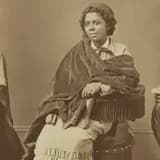
Lewis's sculpture Hagar received its first major American public exhibition at Farwell Hall in Chicago in August 1870.
In August 1870, Edmonia Lewis's marble sculpture Hagar was given its first major public exhibition in the United States at Farwell Hall in Chicago. The piece depicted the Biblical figure Hagar, the Egyptian servant of Sarah who was cast into the wilderness with her son Ishmael—a subject resonant with themes of exile, endurance, and female suffering that carried particular weight given Lewis's own experience as a woman of African American and Native American descent navigating a hostile, racially stratified art world.
By this point Lewis had already relocated permanently to Rome, Italy, where she worked among a community of expatriate Neoclassical sculptors, but she continued to send her finished marbles back to the United States for exhibition and sale, seeking to build her reputation and financial independence among American patrons, abolitionists, and church groups.
The Chicago exhibition of Hagar helped cement Lewis's growing national reputation at a pivotal moment, just five years after the end of the Civil War, when audiences were newly attentive to art that addressed themes of Black suffering, resilience, and biblical allegory. The exhibition demonstrated that a woman of her background could command serious critical and public attention for large-scale, technically accomplished marble sculpture—a genre almost entirely dominated by white male artists at the time.