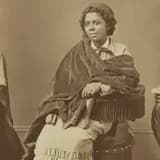
Lewis's monumental sculpture The Death of Cleopatra was shown at the Centennial Exposition in Philadelphia, opening May 10, 1876.
On May 10, 1876, the Centennial Exposition—the first official World's Fair held in the United States—opened in Philadelphia, Pennsylvania, in celebration of the nation's hundredth anniversary. Among the thousands of works displayed in the fair's Memorial Hall art galleries was Edmonia Lewis's monumental marble sculpture The Death of Cleopatra, widely regarded today as her masterpiece.
Unlike the idealized, serene depictions of Cleopatra common in Neoclassical art of the period, Lewis's version was strikingly realistic and unflinching, showing the Egyptian queen in the throes of death, slumped upon her throne with lifelike physical detail. Contemporary critics were both shocked and impressed by its stark realism, and it became one of the most talked-about and celebrated pieces in the American section of the Exposition, drawing large crowds and extensive newspaper coverage.
The exhibition of this work at such a prominent national stage—attended by nearly ten million visitors over its six-month run—represented a career-defining moment for Lewis, cementing her international reputation at a time when few women, and virtually no women of African American or Native American descent, were afforded such recognition in the fine arts. After the Exposition closed, the sculpture's whereabouts became unknown for over a century until it was rediscovered in the 1980s and eventually restored and placed in the Smithsonian American Art Museum, where it remains a celebrated centerpiece of American sculpture.