← All women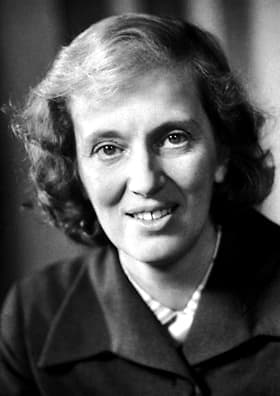
British · Science · Medicine
Dorothy Crowfoot Hodgkin
May 12, 1910 – July 29, 1994
Early Life and Background
Dorothy Mary Crowfoot Hodgkin (née Crowfoot) was born on 12 May 1910 in Cairo, Egypt, where her British parents were employed in the colonial education service.[2][3][9] Her father, John Winter Crowfoot, was a noted archaeologist and educational administrator, and her mother, Grace Mary Hood Crowfoot, was an expert in ancient textiles and actively assisted in archaeological work.[1][2] The family spent periods in Egypt and Sudan before Dorothy and her sisters were largely raised in England, reflecting the mobile, imperial context of many British professional families of the era.[11][19]
From an early age, Dorothy showed an exceptional interest in chemistry and crystals. According to Nobel Prize and biographical accounts, her fascination was sparked in childhood when she received a chemistry book containing experiments involving crystals, an experience she later described as having "captured" her for life.[9][11] This formative encounter, combined with exposure to archaeological artifacts through her parents’ work, nurtured a love of structured materials and patterns that would eventually find expression in X‑ray crystallography.
Despite prevailing social expectations that girls should pursue domestic or traditionally feminine careers, Dorothy’s parents supported her academic ambitions. She attended the Sir John Leman School in Beccles, Suffolk, where her aptitude in science became evident.[2][6] At a time when secondary schooling for girls often limited scientific training, she benefited from teachers who allowed her to study chemistry alongside boys, an early breach of gender norms that would echo throughout her career.
University Education and Early Scientific Formation
Crowfoot entered Somerville College, Oxford, in 1928 to read chemistry, one of the relatively few women admitted to study science at the university.[2][6][9] She studied under prominent chemists including H. M. Powell and Nevil Sidgwick, and encountered X‑ray crystallography through the influence of J.D. Bernal, then a rising figure in structural studies.[6][9] As a woman, she faced difficulties obtaining formal posts after graduation, reflecting Oxford’s slow pace in granting women equal status; nonetheless, she achieved top marks and graduated with a first‑class degree in chemistry in 1932.[2][9]
Following her Oxford studies, Crowfoot moved to the University of Cambridge to pursue doctoral work. There she joined Bernal’s group at the Cavendish Laboratory, a center for pioneering research in X‑ray diffraction.[6][9] Under Bernal’s mentorship, she developed practical and conceptual expertise in crystallographic techniques, applying them to organic and biological molecules. In 1937 she earned her Ph.D. in chemistry from Cambridge with a thesis entitled "X‑Ray Crystallography and the Chemistry of Sterols", a topic that foreshadowed her later determination of steroid structures.[4]
Her time at Cambridge was critical for establishing her identity as a crystallographer. In collaboration with Bernal, she helped perform the first X‑ray diffraction studies of a protein crystal, pepsin, in 1934, demonstrating that protein crystals must be examined in a hydrated state to yield interpretable diffraction patterns.[5][17] This insight laid the methodological foundation for what would become the field of protein crystallography, positioning Crowfoot as a key figure in an emerging discipline just as she was completing her graduate training.
Return to Oxford and Career Beginnings
After receiving her Ph.D., Dorothy Crowfoot returned to Somerville College, Oxford, in 1934, where she remained for most of her professional life.[9][6] She initially held research fellowships and lectureships rather than full professorial posts, reflecting the limited formal opportunities for women academics in interwar Britain. Nonetheless, she built a productive research group and began a series of ambitious projects applying X‑ray crystallography to increasingly complex organic molecules.
At Oxford she focused on compounds of biological and medical significance, including sterols, steroids, antibiotics, and vitamins.[6][12] Her early sterol work extended her Ph.D. insights, and by the mid‑1940s she and colleague C.H. Carlisle had reported the crystal structure of cholesteryl iodide, yielding the first completely stereochemically correct formula for a steroid.[8][1] These studies demonstrated that X‑ray methods could definitively resolve three‑dimensional arrangements of atoms in molecules with multiple chiral centers, strengthening the case for crystallography as a decisive tool in organic chemistry.
During the Second World War, Crowfoot (later Hodgkin) turned her attention to penicillin, the revolutionary antibiotic whose synthesis and mass production were of urgent medical and military importance.[6][11] Working with pharmaceutical and academic collaborators, she sought to determine the precise structure of penicillin using X‑ray diffraction. In the mid‑1940s, amidst secrecy and the pressures of wartime research, she carried out painstaking analyses that culminated in the determination of its beta‑lactam ring structure by 1946, resolving chemical controversies and laying groundwork for the development of related antibiotics.[9][12]
Major Works and Scientific Discoveries
Penicillin Structure
The determination of the penicillin structure was one of Hodgkin’s earliest major triumphs. Several chemists had proposed alternative structures, and the presence of a strained four‑membered lactam ring was particularly contentious.[6][12] Using X‑ray crystallography, Hodgkin confirmed the beta‑lactam framework in 1946, vindicating the hypothesis advanced by Edward Abraham and Ernst Boris Chain and clarifying the basis of penicillin’s reactivity and antibacterial properties.[9][12]
This result had profound implications for medicine and medicinal chemistry. Knowing the exact molecular architecture allowed chemists to design and synthesize new penicillin derivatives and other beta‑lactam antibiotics, broadening the spectrum of activity and improving pharmacological properties.[6][12] The work also demonstrated that X‑ray crystallography could rapidly deliver structural solutions of high medical relevance, strengthening its perceived value across pharmaceutical industries.
Vitamin B12
Hodgkin’s most celebrated achievement was her determination of the structure of vitamin B12, a complex cobalt‑containing vitamin essential to hematological and neurological function. She began work on B12 in the late 1940s and pursued it intensively over the next decade.[6][9] By the mid‑1950s, her determination of the structure was effectively complete, and in 1956 she and her team reported the full crystal structure, revealing the corrin ring nucleus and the coordination environment of the central cobalt atom.[9][11][19]
The B12 structure was one of the most intricate molecular problems solved by X‑ray crystallography up to that time. It required the analysis of a very large unit cell, highly complex diffraction patterns, and extensive hand calculations conducted long before the advent of modern computing.[11][12] The success proved that crystallography could tackle very large and complex biomolecules, bridging the gap between small organic molecules and true macromolecules and paving the way for the field of structural biology.
Beyond methodology, the determination clarified the biochemical roles of B12, informing understanding of pernicious anemia and other deficiency diseases.[6][11] The achievement was central to Hodgkin’s 1964 Nobel Prize in Chemistry, and contemporary accounts emphasize that the B12 work was a decisive factor in the prize committee’s decision.[9][11]
Insulin
Another long‑term focus of Hodgkin’s research was the hormone insulin, central to glucose regulation and diabetes treatment. She began structural studies of insulin in the 1930s and continued them over decades, in collaboration with international colleagues.[6][17] Insulin’s tendency to form crystals and aggregates made it an appealing but technically demanding target for crystallography.
After many years of refinement in data collection and analysis, Hodgkin and her team reported the three‑dimensional structure of rhombohedral 2Zn insulin in 1969, about 35 years after she had first embarked on the problem.[8][13][17] Later, in the 1980s, she and collaborators published higher‑resolution structures, further detailing the arrangement of chains and disulfide bonds.[1][8]
The insulin structures provided crucial insight into how the hormone’s conformation relates to its biological activity and how it interacts with receptors, influencing the design of insulin formulations and analogues.[17] They also cemented the role of X‑ray crystallography as the method of choice for determining protein structures, demonstrating that crystals of moderate‑sized proteins could yield precise atomic coordinates and informing the burgeoning field of structural biology.
Other Scientific Contributions
Beyond penicillin, B12, and insulin, Hodgkin contributed to structural studies of numerous other molecules, including sterols, peptides, and other biologically active compounds.[6][12] Her early collaboration with J.D. Bernal on pepsin in 1934 established that protein crystals must be kept fully hydrated during X‑ray experiments, a principle that underlies all modern protein crystallography.[5][17] She also worked on complexes involving heavy atoms, exploring ways to enhance phase determination and improve structural solutions.
Hodgkin’s laboratory at Somerville became a hub for advanced crystallography, attracting students and visitors from around the world. She developed and refined methods of isomorphous replacement and other techniques that would later be standard in the field. Her insistence on careful experimental design, combined with open collaboration, helped shape norms in structural chemistry and biology.[6][12]
Awards, Honors, and Recognition
In recognition of her structural determinations, Hodgkin received numerous honors. The most prominent was the Nobel Prize in Chemistry, awarded in 1964 “for her determinations by X‑ray techniques of the structures of important biochemical substances.”[9] She received the prize in Stockholm on 29 October 1964, delivering a Nobel lecture that recounted the evolution of crystallographic studies from simple salts to complex biomolecules.[9][11]
Hodgkin was only the third woman ever to win the Nobel Prize in Chemistry, following Marie Curie (1911) and Irène Joliot‑Curie (1935).[6][13] She is widely documented as the only British woman scientist to have received a Nobel Prize in any scientific discipline (physics, chemistry, physiology or medicine).[7][2][18][20] This dual distinction—third female chemistry laureate and sole British woman science laureate—has made her a central figure in narratives about women in science.
Beyond the Nobel, Hodgkin was elected a Fellow of the Royal Society in 1947, a rare honor for a woman at the time, and later received the Society’s prestigious Copley Medal.[19][13] She was appointed to the Order of Merit (OM), one of the highest honors conferred by the British monarch, reflecting both her scientific stature and public esteem.[19] She held numerous honorary degrees and was recognized by scientific academies worldwide.
Internationally, she was active in scientific diplomacy. She served as president of the International Union of Crystallography and engaged with organizations such as the Pugwash Conferences on Science and World Affairs, advocating for peaceful uses of science and dialogue across Cold War divides.[19][13] These roles further enhanced her profile as a scientist committed not only to discovery but to ethical responsibility.
Personal Life
In 1937, Dorothy Crowfoot married Thomas (Tom) Hodgkin, a historian who specialized in African history and later became a prominent scholar at the University of Ibadan in Nigeria.[2][19] She thereafter used the name Dorothy Crowfoot Hodgkin, retaining her maiden name professionally to preserve continuity in her scientific publications. The couple had three children: Luke, Elizabeth, and Toby.[2][19]
Balancing an intensive research career with family life was challenging, particularly in an era when support structures for working mothers were limited and academic culture assumed male breadwinners. Accounts from colleagues and family members describe Hodgkin as deeply committed both to her research and to her children, integrating domestic responsibilities with laboratory work in ways that were unusual for scientists of her generation.[19][13]
Hodgkin’s personal politics leaned toward internationalism and social justice. She maintained friendships with scientists and political figures across ideological divides, including a long‑standing correspondence with figures such as Indira Gandhi, whom she had tutored in chemistry during Gandhi’s time at Somerville College.[6][19] Her belief in cross‑cultural dialogue and education shaped her engagement with scientific organizations and peace movements.
She also lived for many years with rheumatoid arthritis, which gradually limited her mobility and manual dexterity.[19][13] Despite physical pain and increasing disability, she continued to supervise research, write, and travel to conferences, often relying on assistance from students and colleagues. Her perseverance under these conditions has been cited as a testament to her dedication and resilience.
Legacy and Historical Impact
Dorothy Crowfoot Hodgkin is widely regarded as one of the outstanding structural chemists of the twentieth century.[13][12] Her determination of the structures of penicillin, vitamin B12, and insulin transformed understanding of key biomolecules and demonstrated the power of X‑ray crystallography to solve medically important problems. These achievements helped establish structural biology as a central discipline linking chemistry, biology, and medicine.
Methodologically, Hodgkin advanced techniques for phase determination, heavy‑atom substitution, and the interpretation of complex diffraction patterns.[6][12] Her laboratory served as a training ground for many future leaders in crystallography, including scientists who would apply similar approaches to nucleic acids, membrane proteins, and enzymes. Through teaching and mentorship, she disseminated both technical skills and a collaborative ethos that continues to influence the field.
In the context of women’s history, Hodgkin’s career holds particular significance. She rose to international prominence in disciplines—physical chemistry, crystallography, structural biology—that were heavily male‑dominated, and did so while maintaining a family life and coping with chronic illness. Her status as the only British woman Nobel laureate in science to date underscores both her exceptional accomplishments and the persistent underrepresentation of women at the highest levels of recognition.[7][18][20]
Institutions such as the Oxford University Museum of Natural History, the Science History Institute, and university departments around the world highlight Hodgkin in educational materials about women in STEM, using her story to inspire new generations.[6][7][4] Profiles emphasize her quiet, collaborative style, her resistance to personal glorification, and her commitment to applying science for human benefit.
Her work also contributed to public health. The structural understanding of penicillin supported the expansion of antibiotic therapy; the B12 structure informed diagnosis and treatment of deficiency diseases; and insulin structures helped improve diabetes management.[6][11][17] Thus, her crystallographic insights had practical consequences far beyond the laboratory.
Later Life and Death
In later decades, Hodgkin’s rheumatoid arthritis progressed, limiting her mobility and fine motor skills.[19][13] She reduced direct bench work but continued to supervise research, advise students, and participate in scientific and peace organizations. She remained intellectually active and engaged with developments in crystallography, including the shift toward computer‑aided calculations and synchrotron radiation sources.
Hodgkin retired from formal teaching but maintained ties to Somerville College and the wider Oxford scientific community.[6][19] She travelled when able and remained a respected voice in discussions on science policy and international cooperation. Her later publications and talks often reflected on the evolution of structural methods and the ethical responsibilities of scientists.
On 29 July 1994, Dorothy Crowfoot Hodgkin died in Shipston‑on‑Stour, Warwickshire, England, aged 84.[1][2][3][13] Obituaries in scientific journals and national newspapers commemorated her as a pioneer of X‑ray crystallography and a Nobel laureate whose work bridged chemistry and medicine. The Royal Society published a detailed biographical memoir in 2002, documenting her scientific achievements, personal life, and broader contributions.[19]
Since her death, Hodgkin’s reputation has continued to grow. She is frequently cited in discussions of women who changed science and appears in educational resources celebrating women’s history month and efforts to diversify STEM fields.[4][7][11] Her name has been attached to awards, lectures, and buildings, and her life story is taught as an example of how intellectual curiosity, perseverance, and collaborative spirit can overcome structural barriers.
In sum, Dorothy Crowfoot Hodgkin’s life encompasses a remarkable arc: from a colonial childhood in Cairo to the Nobel stage in Stockholm; from early experiments with crystals to the structures of some of the most important biomolecules in medicine; and from a young woman navigating constrained academic opportunities to a globally recognized scientist whose work reshaped both chemistry and biology.
Dated achievements
9 indexed.
- May121910Science
Birth of Dorothy Crowfoot Hodgkin
Dorothy Mary Crowfoot was born in Cairo, Egypt, to British parents John Winter Crowfoot and Grace Mary Hood.
View details Dorothy Hodgkin - Britannica - Jan011934Science
First X-ray diffraction pattern of a protein crystal (pepsin)
With J.D. Bernal, Hodgkin co-published the first X-ray diffraction pattern of a hydrated protein crystal, pepsin, a foundational moment in protein crystallography.