← All women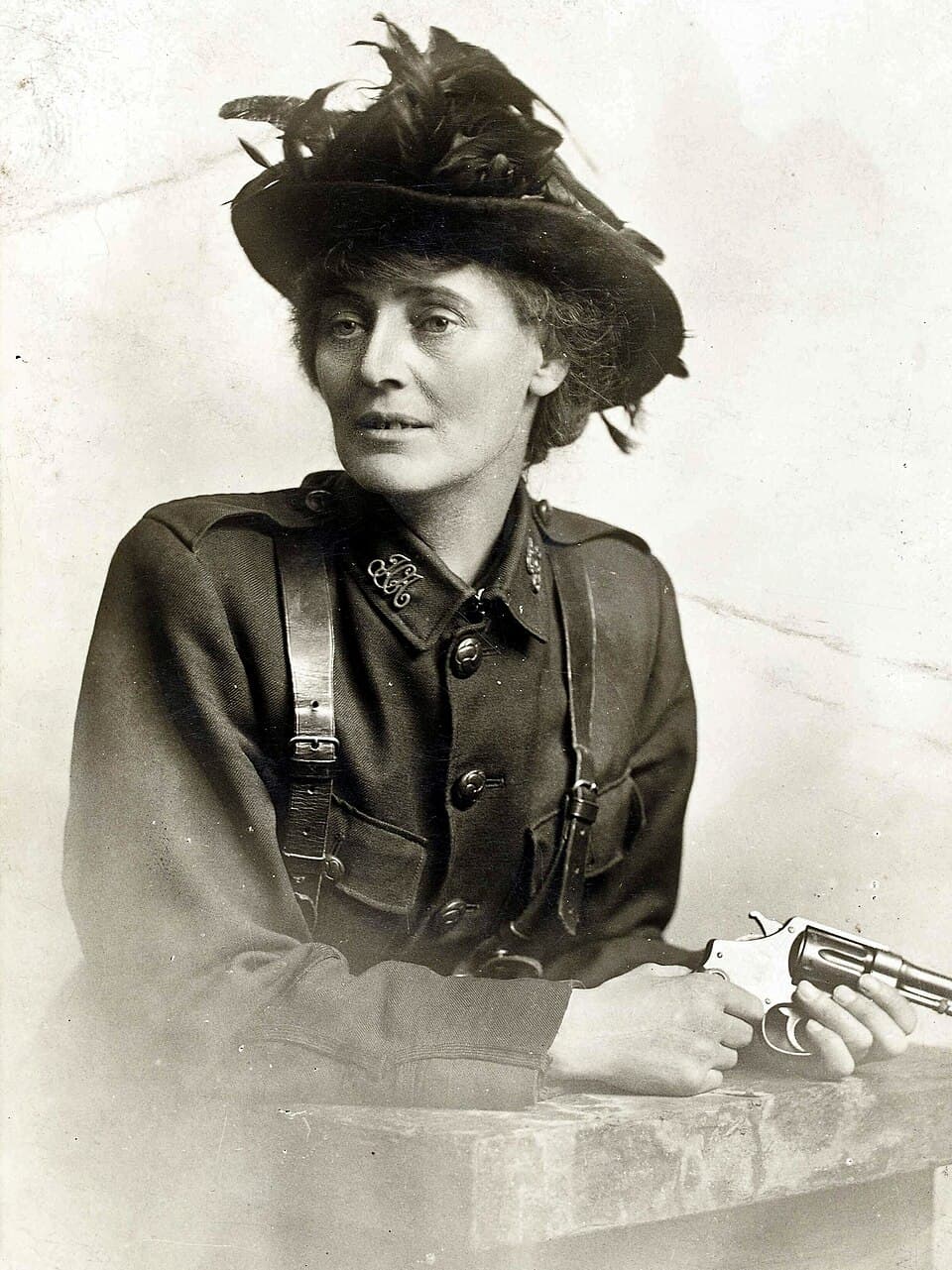
Irish, British · Politics · Activism · Arts
Constance Markievicz
February 4, 1868 – July 15, 1927
Early Life and Background
Constance Georgine Gore-Booth, later known as Countess Constance Markievicz, was born on 4 February 1868 at Buckingham Gate, London, the eldest of five children of Sir Henry Gore-Booth of Lissadell, County Sligo, and Georgina Mary Hill of Tickhill Castle, Yorkshire.[8][11] Her family belonged to the Anglo-Irish Protestant landowning elite, owning a large estate at Lissadell on the Sligo coast.[8] Sir Henry was noted as a philanthropist and explorer, remembered locally for his concern for tenants during the Great Famine, while Georgina brought literary and cultural interests to the household.[8][7]
Although officially born in London, Constance spent much of her childhood at Lissadell House in Sligo, amid a landscape that would deeply influence her imagination and politics.[1][8] She grew up in a setting of privilege, with private education and exposure to hunting, outdoor pursuits, and continental travel.[7][11] Her younger sister, Eva Gore-Booth, became a poet and social reformer; the sisters’ close relationship and shared concern for social justice shaped Constance’s developing worldview.[11]
The Gore-Booth household combined aristocratic comfort with a degree of social conscience, and Constance was aware of the contrast between her own circumstances and those of local tenants and labourers.[7][11] This tension between class privilege and empathy for the poor would later underpin her radicalisation. She was also raised in a milieu that valued adventure and unconventional women’s lives, which made it somewhat easier for her to push against late Victorian norms of female domesticity.
Artistic Training and Early Career
In the early 1890s, Constance turned towards a professional artistic path. In 1892 she studied at the Slade School of Art in London, where she joined the National Union of Women’s Suffrage Societies, marking her first organised engagement with the women’s movement.[12][1] Her artistic ambitions took her to Paris, where she attended the Académie Julian, one of the few institutions admitting women to serious training in painting.[1][11] Parisian bohemian life exposed her to new cultural currents and to radical politics.
It was in this artistic milieu that she met the Polish nobleman and painter Casimir Dunin-Markievicz (Kazimierz Dunin Markiewicz).[1][11] They shared interests in art and theatre, and their relationship developed rapidly. Constance adopted his surname, often using the French form "de Markievicz," and their later joint reputation as unconventional artists and radicals was explored in several biographies.[15][17] Her immersion in continental artistic circles further loosened ties to conventional Anglo-Irish society.
Marriage, Family, and Move to Dublin
Constance married Casimir Dunin-Markievicz on 29 September 1900Countess Markievicz, a title that she would later deploy and subvert in her political life.
The couple had one surviving child, Maeve Alys, born on 14 November 1901
By the early 1900s the Markievicz family had moved to Dublin, where Constance became involved in a rapidly developing cultural nationalism. She helped to found the United Arts Club, a gathering place for writers, artists, and political activists, including figures such as Douglas Hyde.[7] This club fostered networks between cultural revivalists and political nationalists, deepening her commitment to the Irish cause. During the first decade of the twentieth century, Markievicz moved decisively into nationalist and feminist organising. In 1900, she was associated with the founding of Inghinidhe na hÉireann (Daughters of Ireland), a nationalist women’s organisation led by Maud Gonne that promoted Irish culture, opposed British imperialism, and encouraged women’s active participation in politics.[1][11] Through Inghinidhe she organised cultural events, taught nationalist history, and helped mobilise women on public issues. In 1908 she helped found Fianna Éireann, a nationalist youth organisation designed to train boys in scouting, Irish history, and military skills.[1][11] Fianna Éireann served as a kind of republican boy-scout movement and later provided recruits and couriers for revolutionary activities. Markievicz’s work with Fianna reflected her belief that political education and disciplined organisation were essential for national liberation. Her engagement with the labour movement grew during the 1913 Dublin Lockout, when she supported striking workers and, according to several accounts, sold jewellery and took out loans to provide food for families.[7][11] This experience reinforced her sympathy for socialism and for the working class, adding an explicit class dimension to her nationalism. Throughout these years, she maintained connections with suffrage organisations and publicly defended women’s right to vote and hold office.[12][11] However, she increasingly linked women’s emancipation to the broader struggle against British rule, arguing that Irish independence must include social reform and gender equality. In 1913, amid industrial conflict and growing radicalisation, Markievicz joined James Connolly’s Irish Citizen Army (ICA), a workers’ militia originally formed to protect strikers from police brutality.[1][14] As an officer in the ICA, she underwent military training, learned to use firearms, and participated in planning for armed resistance. Her membership in the Citizen Army was significant from a gender perspective: the ICA, unlike many contemporaneous organisations, permitted women to serve as armed combatants and officers.[14] Markievicz embraced this egalitarian ethos, appearing in uniform and advocating that women should take an equal share in the struggle. Her involvement made her one of the most visible female figures preparing for insurrection. By 1916, she was deeply enmeshed in the network of organisations that led to the Easter Rising: the ICA, the Irish Volunteers, Sinn Féin, and various women’s nationalist groups.[1][2] She used her skills as a speaker and organiser to rally support, and her aristocratic title—"Madame de Markievicz"—became both a curiosity and an asset in mobilising publicity for the cause. On 24 April 1916, the Easter Rising began in Dublin. Markievicz served in the Irish Citizen Army garrison at St Stephen’s Green, acting as second-in-command to Michael Mallin.[2][14] Witness accounts describe her wearing a uniform, armed with a revolver, and involved in directing positions, sniping, and tending to the wounded.[2][14] When British forces took up positions in the surrounding buildings and at the nearby Royal College of Surgeons, the insurgents were forced to withdraw. After the Rising collapsed, Markievicz was arrested, imprisoned, and brought before a court martial. On 6 May 1916, she was sentenced to death for her role in the rebellion, but her sentence was commuted to life imprisonment "on account of her sex"
She was held first in Mountjoy Prison and then in Aylesbury Prison in England, experiencing confinement but also using her time to write and reflect.[1][11] The experience, combined with the executions of her comrades, intensified her conviction that Ireland required both independence and radical social change. Shifts in public opinion after the executions and wartime politics led the British government to declare a general amnesty. On 18 June 1917, Markievicz was released, along with many other prisoners convicted for the Rising.[1] She returned to Dublin to a transformed political landscape in which Sinn Féin was becoming the major vehicle for nationalist aspirations. Following her release, Markievicz became increasingly central to Sinn Féin. In 1917 she was elected vice-president of the party, reflecting her status as a veteran of the Rising and her appeal among rank-and-file activists.[1][11] She campaigned against conscription and for republican independence, combining fiery rhetoric with organisational work. Her activism brought renewed repression. On 8 March 1918, amid fears of German plots and Irish unrest, she was arrested under the Defence of the Realm Act and imprisoned in Holloway Jail in London.[1][10] Detained as a political prisoner, she nonetheless continued to influence events from within prison, corresponding with colleagues and preparing to stand in the impending general election. The Representation of the People Act 1918 had extended the parliamentary vote to women over 30 who met certain property qualifications.[3] Against this backdrop, the United Kingdom general election of December 1918 became a milestone in women’s political history. On 14 December 1918, while still incarcerated in Holloway, Constance Markievicz stood as a Sinn Féin candidate for Dublin St Patrick’s and won, becoming the first woman ever elected to the Parliament of the United Kingdom/House of Commons
Her victory also had a colonial dimension. Irish Sinn Féin MPs refused to recognise the legitimacy of British rule and instead used the mandate to convene a separate assembly. Markievicz’s status as a woman MP who refused Westminster encapsulated the intersection between gender emancipation and anti-imperial politics. On 21 January 1919, Sinn Féin MPs convened in Dublin as the First Dáil Éireann, declaring Ireland’s independence and issuing the Declaration of Independence and Message to the Free Nations of the World.[1] Markievicz, elected for Dublin St Patrick’s, was among them and thereby became the first woman elected to and sitting as a member of Dáil Éireann, the first female Teachta Dála (TD)
Her presence in the Dáil showed that women were not merely supporters or symbols of the revolution but full legislative participants. She took part in debates and supported measures aimed at international recognition and the construction of alternative institutions, including arbitration courts and local governance mechanisms.[1][9] On 2 April 1919, the Dáil appointed Markievicz as Secretary for Labour in the revolutionary government.[9][2] This made her the first Irish female cabinet minister, the first woman to hold a ministerial position in Great Britain and Ireland, and widely regarded as the first woman cabinet minister in Western Europe.[3][9] In this role she was responsible for labour affairs at a time when the Dáil was operating clandestinely and Ireland was entering the War of Independence. She advocated for workers’ rights, supported trade union agitation, and sought to embed social justice within the republican programme.[1][14] Her appointment was groundbreaking, as most European states at the time had not yet admitted women to cabinet-level positions. She served as Minister for Labour from 1919 to 1922, though the precise functioning of her department was constrained by the guerrilla war and the need for leaders to operate underground.[1][3] Nonetheless, the symbolic importance of a woman minister in a revolutionary government resonated across feminist and nationalist circles. During the Irish War of Independence (1919–1921), Markievicz remained active in political leadership, propaganda, and organisational work, while many male colleagues concentrated on military operations.[1][11] She continued to champion the poor and urged that the new Ireland being fought for must address inequalities of class and gender. In 1921, the Anglo-Irish Treaty ended the war and provided for the creation of the Irish Free State as a dominion within the British Commonwealth, with partition of six counties in the north.[1][3] Markievicz strongly opposed the treaty, viewing it as a betrayal of the republic declared in 1919 and a compromise that left imperial ties largely intact. She sided with Éamon de Valera and other anti-Treaty deputies in the bitter debates within the Dáil.[1] The treaty split led directly to the Irish Civil War (1922–1923). Markievicz supported the anti-Treaty side, involving herself in political work and propaganda rather than front-line fighting.[1][11] As the conflict intensified, the Free State government imprisoned many opponents, and she was among those detained for her role. Her incarceration in this period underscored that she was prepared to face repression from a government led by former comrades as well as from British authorities. Markievicz spent part of 1922–1923 imprisoned by the Free State authorities for her anti-Treaty activities.[1][11] Conditions in these prisons were often harsh, and detainees conducted hunger strikes and protests against their treatment. On 27 August 1923, she was released as part of the broader process of winding down emergency measures and reconciling political factions after the Civil War.[1] Her release allowed her to re-enter electoral politics and participate in debates about how republican ideals could be pursued within or against Free State structures. After the Civil War, the political landscape shifted. Sinn Féin remained abstentionist from the Dáil, but divisions emerged about strategy. In 1926, Éamon de Valera and others founded Fianna Fáil, a new party committed to entering the Dáil while seeking to dismantle Treaty constraints from within.[1][3] Markievicz left Sinn Féin and joined Fianna Fáil, reflecting her pragmatic willingness to use parliamentary channels while maintaining republican goals. As a Fianna Fáil figure, she campaigned vigorously, drawing on her long experience as a speaker and organiser. Her presence gave the party significant symbolic legitimacy among women and working-class voters. She continued to articulate a programme that married national independence with social reform, emphasising housing, employment, and welfare.[7][11] On 25 June 1927, she was elected to the 6th Dáil as TD for Dublin South.[1] This victory, however, came near the end of her life, and she would not live to take her seat. The election nonetheless confirmed her enduring appeal and the acceptance of women as parliamentary representatives in the young Irish state. Markievicz’s personal identity combined aristocratic background, artistic sensibility, and radical politics. She remained formally married to Casimir Dunin-Markievicz, though their lives often diverged geographically and professionally as he spent long periods abroad, including service in the Russian imperial army during the First World War.[1][11][15] Their relationship was complex, involving shared artistic projects but also strains caused by Constance’s immersion in Irish politics. Her daughter Maeve, often raised by relatives in England, maintained affection for her mother but was somewhat distant from the revolutionary world.[11] This distance has been discussed in biographical literature as one of the costs of Markievicz’s all-consuming activism. Politically, Markievicz embraced a synthesis of Irish nationalism, socialism, and a commitment to women’s emancipation.[1][14] She criticised class privilege, including that of her own background, and gave away much of her wealth over time.[7] She was known for living simply in later years, often among poor communities whose conditions she sought to improve. Her religious outlook is less central in most accounts, but she operated within a largely Catholic nationalist milieu despite her Protestant upbringing.[1][8] She maintained friendships across sectarian lines and stressed the inclusive potential of a republican Ireland. Markievicz did not accumulate formal honours in the conventional sense; instead, her "honours" lay in the unprecedented offices she held and the symbolic recognition accorded to her in political and historical narratives. Key distinctions include: These achievements have been commemorated in parliamentary exhibitions, museum displays, and centenary events. In 2018, the centenary of women’s suffrage and of her election as MP prompted renewed attention, including features by the UK Parliament and BBC acknowledging her pioneering status.[3][13] Constance Markievicz occupies a central place in both Irish political history and the global history of women’s political participation. As a leader in the Easter Rising, she helped demonstrate that women could be combatants and commanders in nationalist and socialist struggles, challenging Victorian constraints.[2][14] Her court-martial and commuted death sentence became part of the mythos of the Rising, symbolising female courage and the gendered double standards of imperial justice. Her election in 1918 as the first woman MP in the UK, and subsequent role as the first female TD and cabinet minister, opened institutional doors that had previously been closed to women.[1][3][9] While Nancy Astor is often noted as the first woman to sit in the House of Commons, parliamentary historians emphasise that Markievicz was the first woman elected and that this distinction matters in understanding the chronology of women’s representation.[3][13] In Ireland, her example has been invoked by later generations of women politicians and activists seeking to justify demands for greater gender equality in public life. The gap between her pioneering role and the long delay before another woman became a cabinet minister in Ireland—nearly six decades—illustrates both her exceptionalism and the structural barriers women continued to face.[7] Historians have also examined her as a case study in the intersection of class, gender, and nationalism. Her transformation from Anglo-Irish countess to republican and socialist activist complicates simplistic narratives of class allegiance.[1][11] She embodied the capacity of individuals from privileged backgrounds to reject their class interests and align with the oppressed, though not without personal and familial costs. Biographical reassessments, including multiple modern studies and critical reviews in outlets such as The Irish Times, have debated aspects of her personality and politics, from her tactical judgement to her relationships with contemporaries.[17] Nonetheless, there is broad agreement that her influence on the Irish revolutionary generation was profound and that she played a crucial role in normalising the idea of women as full political actors. In her last years, Markievicz continued to work tirelessly despite declining health. She campaigned for Fianna Fáil, represented republican and labour causes, and lived increasingly modestly, often among Dublin’s poor.[1][7] She is reported to have given away much of her wealth, in line with her socialist convictions. On 25 June 1927, she was elected TD for Dublin South to the 6th Dáil, but soon afterwards she fell seriously ill.[1] She was admitted to Sir Patrick Dun’s Hospital, where she died on 15 July 1927, aged 59, reportedly from peritonitis.[1][3][13] Accounts emphasise that she died in a public ward rather than a private room, reinforcing the narrative of her solidarity with ordinary people.[7][13] Her funeral in Dublin drew substantial crowds of republicans, workers, and admirers, though it occurred in a politically tense environment following the assassination of Kevin O’Higgins and the passage of new security legislation.[1] Markievicz’s death closed a chapter in Irish revolutionary politics but her memory remained potent in the decades that followed. Today, she is commemorated through portraits, statues, museum exhibits, and scholarly works. Institutions such as the Women’s Museum of Ireland, the National Portrait Gallery, and various archives showcase her image and story.[7][12] Her life continues to serve as a touchstone for discussions of women’s participation in nationalist movements and the integration of feminist and socialist aims within struggles for independence.Nationalist and Suffrage Activism
Joining the Irish Citizen Army and the Road to the Rising
Easter Rising, Trial, and Imprisonment
Sinn Féin Leadership and Imprisonment in 1918
First Woman Elected to the UK Parliament
First Dáil and the First Female TD
First Female Cabinet Minister in Ireland and Western Europe
Irish War of Independence and Treaty Split
Civil War Imprisonment and Release
Later Political Career and Fianna Fáil
Personal Life, Beliefs, and Identity
Awards, Honours, and Public Recognition
Legacy and Historical Impact
Later Life and Death
Dated achievements
11 indexed.
- Feb041868Science
Birth of Constance Georgine Gore-Booth
Constance Markievicz was born at Lissadell House, County Sligo, Ireland, into the Anglo-Irish landed gentry family of Gore-Booth.
View details Wikipedia: Constance Markievicz - Apr241916Science
Combat role in the Easter Rising begins
Markievicz took up arms with the Irish Citizen Army on 24 April 1916, helping occupy St Stephen's Green in the fight for Irish independence.