← All women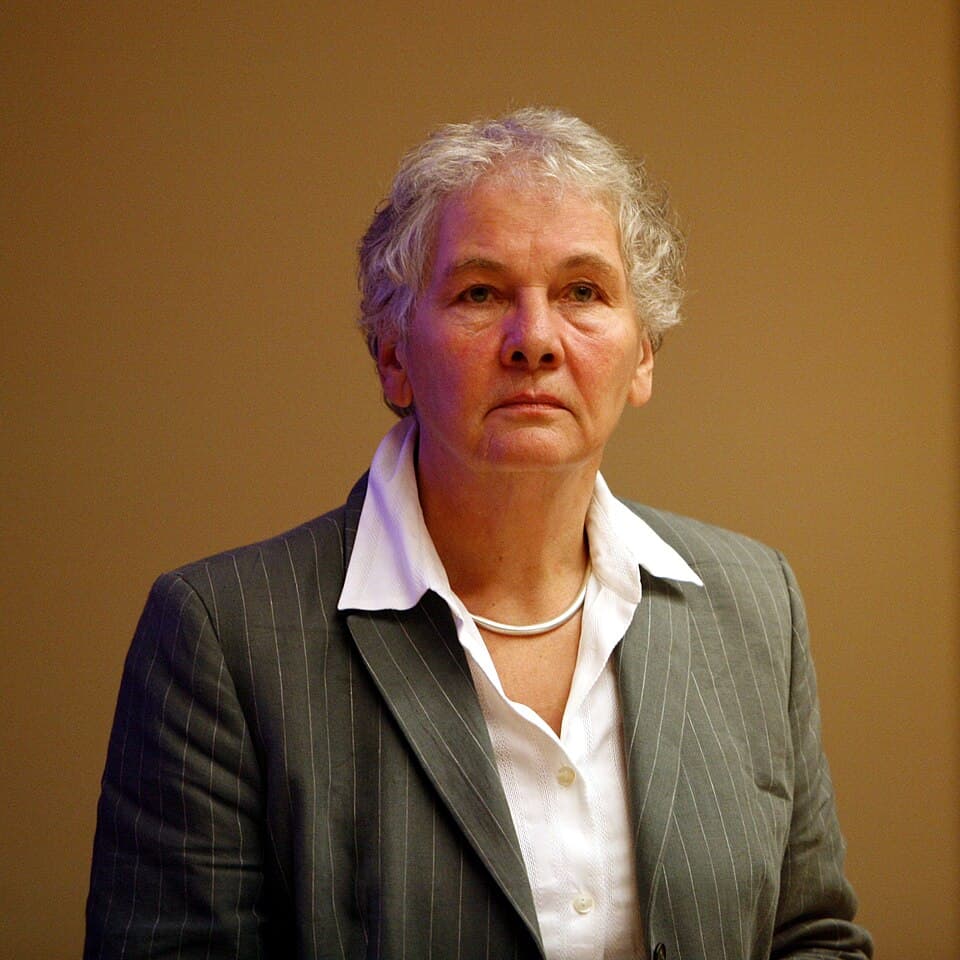
German · Science · Medicine
Christiane Nüsslein-Volhard
October 20, 1942 – present
Early Life and Background
Christiane (Janni) Nüsslein-Volhard, born Gertrud Elisabeth Christiane Volhard on 20 October 1942 in Heyrothsberge near Magdeburg, Germany, grew up in a large, culturally engaged family during the final years of World War II and the difficult postwar period.[7][1][2][8] Her father was an architect and her mother had artistic interests, and the household valued both music and literature, providing a rich intellectual environment.[14] She later recalled that this mix of art and nature—combined with ample freedom to explore fields and forests—shaped her curiosity and aesthetic sense, which would become integral to her scientific work.
After the war, the family moved to Frankfurt am Main, where Nüsslein-Volhard attended secondary school.[11][7] Though her teachers at times described her as undisciplined or lazy, she excelled in science and developed a strong fascination with the living world.[11] At around the age of twelve, she decided that she wanted to become a biologist, a choice that was unconventional for girls in 1950s West Germany, when scientific careers for women were rare and often discouraged.[7][14]
Her early interests extended beyond the laboratory. She learned classical singing and developed a lifelong passion for music, especially for performing lieder and choral works.[1][9] This combination of scientific curiosity and artistic practice later influenced her style of thinking about biological form and pattern, where she frequently drew analogies between aesthetic structure and developmental processes.
Education and Training
After finishing school, Nüsslein-Volhard enrolled at Goethe University Frankfurt to study biology.[7][3] She soon realized, however, that she wanted a stronger grounding in chemistry and biochemistry. She transferred to the University of Tübingen, where she studied biochemistry and gained laboratory experience in molecular biology and genetics.[6][7] In Tübingen, she came into contact with the Max Planck Institute and the emerging tradition of combining genetics with molecular approaches.
She pursued doctoral work in genetics under the supervision of Alfred Gierer at the Max Planck Institute for Virus Research (later the Max Planck Institute for Developmental Biology) and the University of Tübingen, completing her Ph.D. in 1973.[6][9][1] Her dissertation focused on the genetics of bacteriophage and laid the groundwork for her later shift to multicellular organisms. During her graduate years she absorbed both the rigorous theoretical style of German molecular biology and the experimental ethos of classical genetics.
By the mid-1970s, developmental biology was undergoing a transformation, with increasing attention to how genes control embryogenesis. Nüsslein-Volhard, seeking a model system where genetic perturbations could reveal developmental logic, chose the fruit fly Drosophila melanogaster. In 1975 she began postdoctoral work at the Biozentrum in Basel, one of Europe’s leading centers for molecular and cellular biology.[6][11] There she applied genetic approaches to developmental questions, marking the true beginning of her lifelong focus on embryonic pattern formation.
Career Beginnings and Development
After her postdoctoral period at the Biozentrum, Nüsslein-Volhard moved to the University of Freiburg, continuing to investigate Drosophila development.[6] In the late 1970s, she joined the newly founded European Molecular Biology Laboratory (EMBL) in Heidelberg, which was designed to foster collaborative, cutting-edge research across national boundaries.[6][7]
At EMBL, from 1978 to 1981, she co-led a research group with American developmental biologist Eric F. Wieschaus
This period was crucial for Nüsslein-Volhard’s career. Working in an international and comparatively egalitarian environment at EMBL allowed her to pursue high-risk, high-reward science. The infrastructure and support available there made possible the massive genetic screen that would define her scientific legacy. The collaboration with Wieschaus, characterized by shared intellectual responsibility and complementary strengths, evolved into one of the most productive partnerships in modern genetics.[3][11] In 1984, she returned to Tübingen as a director at the Max Planck Institute for Developmental Biology, heading the Department of Genetics.[7][6][9] She remained director until 2014, later becoming emerita while continuing to lead a research group.[13][9] At Max Planck, she built a vibrant program in developmental genetics that attracted students and postdocs from around the world, further consolidating her position as a central figure in the field. During her years at EMBL, Nüsslein-Volhard and Wieschaus carried out their famous genetic screen of Drosophila embryogenesis. Around 1980, they succeeded in identifying and classifying genes that control segmentation and other aspects of the body plan, eventually delineating around fifteen core segmentation genes and numerous additional loci involved in patterning.[7][6][14] Their work showed that the embryo’s segmented structure arises from an ordered hierarchy of gene functions, from maternal-effect genes to gap, pair-rule, and segment polarity genes. A key product of this research was the Nature paper "Mutations affecting segment number and polarity in Drosophila" published on 30 October 1980.[5] In this article, Nüsslein-Volhard and Wieschaus described the phenotypic consequences of mutations affecting the number and orientation of segments and provided a framework for classifying developmental genes based on mutant morphology. The paper is widely regarded as a cornerstone in the genetics of pattern formation. In the early 1980s, Nüsslein-Volhard extended her investigations to the embryo’s axes. On 20 September 1984, she co-authored with Kathryn V. Anderson the Nature paper "Information for the dorsal-ventral pattern of the Drosophila embryo is stored as maternal mRNA".[5] This work demonstrated that dorsal–ventral polarity is specified by maternal mRNA localized in the egg, revealing the importance of maternal-effect genes and asymmetrically distributed determinants in axis formation. It helped establish the concept that embryonic patterning begins before fertilization, with information encoded by the mother. She then turned to the embryo’s head–tail orientation. The Science paper "Determination of anteroposterior polarity in Drosophila", published on 18 December 1987, analyzed genetic systems that control anterior and posterior structures and clarified how gradients and localized gene products define the anteroposterior axis.[5] Together, these studies on segmentation and axis formation provided a comprehensive genetic account of how the fly body plan is established. Nüsslein-Volhard’s most celebrated work concerns the protein Bicoid. In 1988, she and Wolfgang Driever isolated the Bicoid protein, coded by the bicoid gene, and showed that it forms a concentration gradient across the embryo.[19][6] On 1 July 1988, their Cell paper "The bicoid protein determines position in the Drosophila embryo in a concentration-dependent manner" demonstrated that nuclei experiencing different Bicoid concentrations adopt distinct fates, proving that Bicoid functions as a morphogen.[5][19] This work provided the first clear experimental validation of the morphogen concept in Drosophila and linked molecular gradients to positional information and gene expression. Beyond flies, Nüsslein-Volhard later pioneered developmental studies in the zebrafish, using it as a vertebrate model for pattern formation, growth, and cell migration.[13][9] Her group investigated pigment patterning and other traits, exploring how similar genetic principles operate across phyla. By comparing flies and fish, she contributed to the broader understanding of evolutionary conservation in developmental pathways. Her research portfolio also includes conceptual and popular writing. She authored books and essays for general audiences that explain developmental biology and evolution in accessible language, reflecting her commitment to public engagement with science.[11][18] One notable work is a book on the beauty of animals and the genetic basis of form, indicative of her interdisciplinary interests. Nüsslein-Volhard’s contributions have been widely recognized. Among her many honors, she received the Leibniz Prize of the German Research Foundation in 1986, the country’s most prestigious research award.[9][1] In 1989 she was elected a member of the Academia Europaea, reflecting her standing in the European scientific community.[12] On 27 September 1991, she was awarded the Albert Lasker Award for Basic Medical Research, acknowledging the fundamental importance of her discoveries about genetic control of embryonic development.[9][4] The Lasker Prize is often seen as a precursor to the Nobel, and many of its recipients have later become Nobel laureates. For Nüsslein-Volhard, the award signaled international recognition that her work had reshaped developmental biology and had deep medical relevance. Her most famous honor came in 1995, when she shared the Nobel Prize in Physiology or Medicine with Edward B. Lewis and Eric F. Wieschaus "for their discoveries concerning the genetic control of early embryonic development".[7][3][2] The Nobel Assembly announced the decision on 9 October 1995, and she received the prize at the ceremony in Stockholm on 10 December 1995, delivering the Nobel Lecture "The Genetic Control of Development".[7][4] With this prize, Nüsslein-Volhard became the first German woman ever to win the Nobel in Physiology or Medicine and, as noted by several sources, the first woman from Germany to receive a Nobel Prize in the sciences.[3][13][15] She joined a very small group of women Nobel laureates in scientific fields, underscoring the gender imbalance in high-level recognition and the barrier-breaking nature of her achievement. In addition to these major awards, she has received numerous honorary doctorates, memberships in academies, and national and international prizes for science.[9][1] An asteroid, 15811 Nüsslein-Volhard, has been named in her honor, reflecting the broad cultural impact of her work.[12] Nüsslein-Volhard’s personal life has been shaped by her dual commitments to science and music. She is known for her classical singing and has performed extensively in choirs and as a soloist, treating music as an essential counterpart to research.[1][9] This artistic engagement reflects the aesthetic dimension of her thinking about biological pattern and form. Biographical sources note that she did not have children, a circumstance that has informed her reflections on the challenges faced by women scientists who do.[8][11][19] She has spoken publicly about the structural difficulties of combining motherhood with intensive laboratory work, emphasizing that her own path, while demanding, did not require balancing childcare responsibilities. Little is publicly documented about long-term romantic relationships, and she has tended to keep such aspects of her life private. In interviews, she has instead focused on intellectual influences, mentors, and the importance of supportive colleagues and institutions. Her personal narrative thus centers on her identity as a scientist and musician, and on her advocacy for women in science. Drawing on her experiences and observations, Nüsslein-Volhard became a vocal advocate for gender equality in scientific research. She has argued that talented women are often lost to science because of the combined pressures of family care and academic competition.[11][14] Rather than framing the issue solely in terms of individual choices, she has stressed the need for institutional support. In 2004, she established the Christiane Nüsslein-Volhard Stiftung (Christiane Nüsslein-Volhard Foundation) in Germany to address these issues practically.[6][12] The foundation provides financial grants to young female scientists with children, enabling them to pay for household help or childcare. By doing so, it aims to free time and energy for research, helping women remain in the scientific workforce during critical early-career stages. The foundation’s official start is recorded as 1 January 2004, symbolizing a new year dedicated to structural change.[17] Operating nationally, the Stiftung collaborates with universities and research institutes to identify promising candidates. Its existence has sparked discussion in German science policy about gender, work–life balance, and the value of targeted interventions. For Nüsslein-Volhard, this initiative represents a key part of her legacy: using the symbolic capital of the Nobel Prize to improve conditions for future generations of women scientists. Christiane Nüsslein-Volhard is widely regarded as one of the founders of modern developmental genetics.[3][13][14] Her systematic use of mutational analysis in Drosophila embryos transformed embryology from a largely descriptive discipline into a mechanistic science grounded in gene function. By identifying and classifying genes that control segmentation and axes, she helped build the conceptual framework—maternal-effect genes, gap genes, pair-rule genes, segment polarity genes, and homeotic genes—that now underlies textbooks on developmental biology. Her demonstration of morphogen gradients, particularly through the Bicoid protein, bridged theory and experiment.[19] It provided a clear mechanism by which continuous concentration gradients can produce discrete cellular identities, inspiring work on gradient formation, robustness, and scaling. These ideas have influenced fields ranging from systems biology to evolutionary developmental biology (evo-devo). Beyond her scientific contributions, Nüsslein-Volhard’s career has had deep symbolic significance. As the first German woman Nobel laureate in a scientific field, she challenged entrenched gender norms and offered a highly visible example of female excellence in experimental biology.[3][13][15] Her recognition has been highlighted in media and educational materials about women who changed science, underlining her role as a role model.[5] Her advocacy for women scientists through the Christiane Nüsslein-Volhard Foundation and her public commentary on gender and careers have further extended her impact from the laboratory into social structures.[6][11][12] She has argued that scientific institutions must adapt to the realities of caregiving, and her foundation represents a concrete measure toward that goal. Finally, her interdisciplinary sensibility—combining science and music, aesthetics and experiment—has influenced the culture of research in her groups. Students have noted her emphasis on both precision and elegance in experimental design, reflecting her view that scientific theories should not only be accurate but also beautifully structured.[11][18] In 2014, after nearly three decades as director, Nüsslein-Volhard transitioned to emeritus status at the Max Planck Institute for Developmental Biology.[9][13] She continued to lead a research group focusing on zebrafish pattern formation, growth, and cell migration, remaining scientifically active while taking on more mentoring and advisory roles. She has contributed to public understanding of science through interviews, essays, and books intended for lay audiences, explaining developmental biology, genetics, and evolution in accessible terms.[11][18] Her work has been featured in documentaries and digital stories produced by the Max Planck Society and other institutions, framing her career as "a life for science" and highlighting both her research and her advocacy.[17][18] As of the mid-2020s, Christiane Nüsslein-Volhard remains a living figure in German and international science, respected not only for her foundational discoveries but also for her efforts to support younger generations. Her ongoing presence in scientific and public discourse ensures that her legacy continues to evolve, inspiring new work at the intersection of genetics, development, and social responsibility.Major Works and Discoveries
Awards, Honors, and Recognition
Personal Life
Advocacy and the Christiane Nüsslein-Volhard Foundation
Legacy and Historical Impact
Later Life and Continuing Work
Dated achievements
9 indexed.
- Oct201942Science
Birth in Magdeburg, Germany
Christiane (Janni) Nüsslein-Volhard was born in Magdeburg, Germany, on 20 October 1942.
View details Christiane Nüsslein-Volhard – Facts, Nobel Prize - Oct301980Science
Landmark Nature paper on Drosophila segmentation genes
With Eric Wieschaus, published 'Mutations affecting segment number and polarity in Drosophila' in Nature, founding modern developmental genetics.