← All women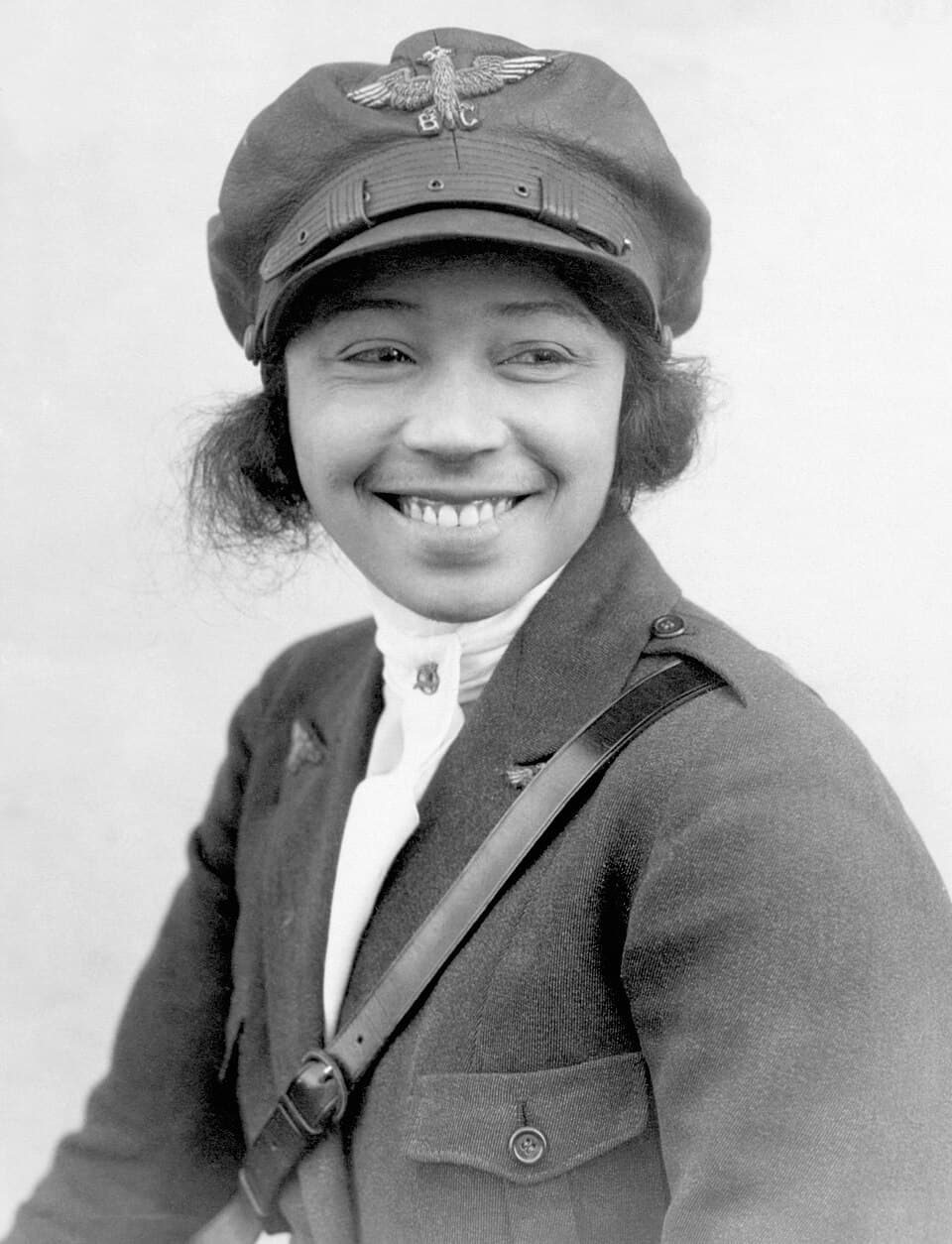
American · Aviation · Activism
Bessie Coleman
January 26, 1892 – April 30, 1926
Early Life and Background
Elizabeth “Bessie” Coleman was born on January 26, 1892, in Atlanta, Texas, the tenth of thirteen children born to George and Susan Coleman, sharecroppers of African American and Native American descent. Her father is generally described as African American with Cherokee or Choctaw ancestry, and her mother as African American.[2][4][10] Shortly after her birth, the family moved to Waxahachie, Texas, where Coleman grew up in a rural, segregated community dominated by cotton agriculture.[1][2][13]
As a child, Coleman worked in the cotton fields alongside her parents, contributing to the family’s subsistence while attending a segregated school for African American children. She walked several miles each day to reach the schoolhouse, where she showed particular aptitude for mathematics and an eagerness for reading.[1][2] Educational opportunities were limited; Black schools in Texas at the time were chronically underfunded and offered only basic instruction.
In 1901, frustrated by the entrenched racism and economic constraints of Texas, Bessie’s father left the family to move to Indian Territory (present-day Oklahoma), where he hoped his Native American ancestry would offer improved prospects.[1] Her mother remained in Texas with the children, and Bessie continued her schooling there. The departure deepened the family’s financial hardship and left her mother as a single parent, a common situation for Black families facing the pressures of Jim Crow-era migration.[1]
Despite poverty and the limited schooling available, Coleman completed all eight grades of her local school, a notable achievement for a Black girl in rural Texas at the time.[1][8] She briefly attended the Colored Agricultural and Normal University (now Langston University) in Oklahoma, taking one term of teacher training before financial difficulties forced her to return home.[1][8] These early experiences—combining labor in the fields, perseverance in education, and a keen awareness of racial injustice—formed the backdrop against which she later pursued aviation.
Migration and Early Working Life
By the 1910s, economic opportunities in Waxahachie were limited, and like many African Americans, Coleman looked northward. In 1915, she moved to Chicago, Illinois, joining two of her brothers in the city’s South Side Black community.[1][8][13] There she worked as a manicurist in a barber shop, a common occupation for women in urban Black service economies.
Chicago exposed Coleman to new ideas and social networks. Patrons at the barber shop included veterans and readers of the Chicago Defender, a leading African American newspaper. Through articles and conversations, she learned of European combat pilots from World War I and of the expanding field of aviation.[1][8] Stories of French women pilots and the daring feats of wartime aviators captured her imagination. At the same time, she confronted the stark reality that American flight schools categorically rejected students who were Black and female.
Coleman’s interest in aviation grew into a determined ambition. She articulated a goal of becoming a pilot not simply for personal achievement but to show that African Americans could excel in the new technology of flight. The Chicago Defender later became a crucial supporter of this project, framing her aspirations within the broader struggle for racial progress.[1][8]
Path to Aviation: Barriers and International Study
By 1919, Coleman’s dreams of flying had sharpened into a plan. She applied to American flight schools but was consistently turned away because she was an African American woman.[1][13] Recognizing that the United States aviation establishment would not admit her, she looked overseas. Robert S. Abbott, the influential publisher of the Chicago Defender, encouraged her to study abroad and offered financial backing, while banker Jesse Binga also provided support.[1][8]
On Abbott’s advice, Coleman resolved to pursue pilot training in France, whose aviation schools had trained many World War I pilots and were known to be more open to women. She enrolled in French language classes in Chicago to prepare for study overseas, teaching herself enough French to navigate daily life and instruction.[1][6]
In 1920, having secured funds and basic language skills, Coleman sailed from the United States to France.[1][7][15] She enrolled at the École d’Aviation des Frères Caudron (Caudron Brothers School of Aviation) in Le Crotoy, on the northern French coast, one of the country’s most respected civil flight schools.[1][6] She trained on Nieuport aircraft, including the Nieuport 82 dual-control trainer, learning takeoffs, landings, emergency procedures, and fundamental aerobatic maneuvers.[6][15]
Her path was arduous. As a Black woman from a poor background, she had to master technical content in a second language while integrating into a foreign culture. Yet she persisted, logging significant flight hours and demonstrating competence under the scrutiny of French instructors. Her presence itself was remarkable: few women, and even fewer people of color, attended such schools in the early 1920s.
Historic Pilot’s License and Early Career
On June 15, 1921, Coleman successfully completed the Fédération Aéronautique Internationale’s required exams and was granted pilot’s license no. 18310.[6][15] This made her the first African American woman and the first woman of Native American descent to hold a pilot’s license; she was also widely noted as the first Black person to earn an international pilot’s license and the first American woman to obtain such a license directly from the FAI.[3][7][9]
French and American press began to cover her achievement. The National Women’s History Museum notes that in 1921 she became the first American woman to obtain an international pilot’s license.[1] The Cradle of Aviation Museum and other institutions emphasize that she was the first African American woman to achieve a pilot’s license.[2][7] These overlapping characterizations reflect the multifaceted significance of her accomplishment in terms of race, gender, and nationality.
After receiving her license, Coleman remained in Europe briefly for advanced training. She undertook additional instruction in France and later in Germany to hone her stunt-flying skills, including dives, loops, and barrel rolls.[13] Recognizing that commercial airline opportunities were effectively closed to Black women, she decided to pursue a career as a barnstorming pilot, performing exhibitions and airshows.
Returning to the United States in late 1921, Coleman faced the challenge of turning her credential into an income and a platform. While her FAI license was prestigious, discrimination persisted in American aviation. She therefore positioned herself as an entertainer and educator, using stunt flying to attract audiences and publicity while speaking publicly about aviation and racial equality.[1][8]
Barnstorming Career and Major Exhibitions
Coleman’s barnstorming career developed rapidly. She sought opportunities to perform at airfields across the country, often in collaboration with local Black organizations and newspapers.
On September 3, 1922, she made her American airshow debut at Curtiss Field on Long Island, New York, in a show honoring veterans of the all-Black 369th Infantry Regiment.[15] Flying a borrowed Curtiss JN-4D Jenny, she executed loops, figure-eights, and other aerobatic maneuvers before a large crowd. The Smithsonian’s National Air and Space Museum identifies this performance as the first public flight by a Black woman in the United States, a milestone that firmly established her reputation.[15]
Newspapers reported enthusiastically on "Queen Bess," and Black communities celebrated her as proof that racial barriers could be challenged in modern technology and transport.[8][10] Her success in New York led to further bookings. On October 15, 1922, she performed a widely noted exhibition flight at Checkerboard Field in Chicago, thrilling an integrated crowd of about 2,000 with daring barnstorming stunts.[6] Chicago, the city where she had first dreamed of flying, now witnessed her return as a professional aviator.
Over the course of 1922, Coleman undertook additional advanced stunt training in Europe and then barnstormed at several U.S. airshows.[15] She quickly gained the nickname "Queen Bess" for her dramatic performances and fearless style. Her shows typically featured steep dives, sharp climbs, and tight circles, maneuvers that were particularly dangerous given the limited reliability of early aircraft and rudimentary safety gear.
Importantly, Coleman insisted on certain conditions for her appearances. She refused to perform at venues that enforced segregated spectator areas, leveraging her popularity to challenge Jim Crow practices.[1][8] When promoters demanded separate seating for Black audiences, she declined to fly, a stance that linked her aviation career explicitly to civil rights advocacy.
Accidents, Recovery, and Southern Tours
Barnstorming in the 1920s was inherently risky. Coleman experienced at least one serious accident during an exhibition in California, when her aircraft stalled and crashed, leaving her with broken bones and other injuries.[1][7] The incident sidelined her for a time and underscored the hazards of stunt flying.
After recovering, she resumed barnstorming in 1925, focusing on tours through the American South.[1][7] She visited Black communities in states such as Texas and Georgia, giving exhibitions and lectures that emphasized both the excitement of flight and the importance of aviation knowledge for African Americans. These tours also served a practical purpose: she aimed to raise funds toward her long-standing goal of opening a flight school for Black pilots.[1][7]
During these years, Coleman’s celebrity grew. She appeared in Black newspapers, was invited to speak at churches and civic organizations, and became a role model for young people interested in technology and adventure. Yet she remained financially precarious, relying on performance fees, lecture honoraria, and the support of community patrons.
Vision for an Aviation School and Advocacy
From early in her career, Coleman articulated a clear vision: to establish a flight school in the United States that would train African American aviators. She hoped to create opportunities that had been denied to her by American flight schools and to foster a cadre of Black pilots who could participate in commercial and military aviation.[1][8]
Her advocacy took multiple forms:
- She used interviews and speeches to urge African Americans to learn about aviation and to challenge its racial exclusivity.[1][8]
- She refused to participate in segregated events, thereby linking her performances to broader struggles against Jim Crow.[1][8]
- She cultivated relationships with Black newspapers and philanthropists to publicize her achievements and fund her ambitions.
Although she did not live to see her school established, her vision influenced later generations. Organizations such as the Bessie Coleman Aero Club, founded by Black aviator William J. Powell in the 1920s, explicitly drew on her legacy to promote training for Black pilots.[1][8] Her dream of institutionalizing African American participation in aviation thus continued beyond her lifetime.
Awards, Honors, and Recognition
During her life, formal awards within mainstream aviation institutions were limited, reflecting both the nascency of the field and entrenched racism and sexism. Nevertheless, Coleman received substantial recognition in the Black press and among community organizations, which portrayed her as a heroic figure.
Posthumously, her honors have multiplied:
- She has been commemorated by the National Women’s Hall of Fame, which highlights her as "the world’s first Black woman aviator" and celebrates her challenge to racial discrimination.[8]
- The National Women’s History Museum and other institutions have produced detailed biographies and educational materials emphasizing her pioneering status.[1]
- The Smithsonian National Air and Space Museum features her story as part of its exploration of diversity in aviation, marking the centennial of her license and her role as the first licensed Black pilot.[6][15]
- Streets, schools, and scholarships bearing her name exist in various U.S. cities, especially in Chicago and Texas, reflecting ongoing community recognition (noted across institutional biographies).[1][8]
These honors underscore the breadth of her impact, from women’s history and civil rights to technical innovation and popular culture.
Personal Life
Reliable sources provide limited information about Coleman’s intimate personal life. As a young woman in Waxahachie and then Chicago, she worked primarily in service occupations and focused on economic survival and professional advancement.[1][8] Some accounts mention that she briefly married a man named Claude Glenn in Texas around 1917, but they also note that the marriage ended and that she lived independently in Chicago; mainstream institutional biographies either omit this or treat it cautiously, suggesting that documentation is sparse.[1][8]
Most sources emphasize that she did not have children and that her primary commitments were to her aviation career and to advocacy for African American participation in flight.[1][8] Friends and contemporaries described her as determined, ambitious, and charismatic, with a strong sense of mission but also an appetite for adventure and risk.
Later Life and Death
By the mid-1920s, Coleman was an established barnstormer, known nationally within Black communities and increasingly visible in aviation circles. She continued to travel widely, performing in multiple states and seeking backers for her proposed flight school.
In April 1926, she traveled to Jacksonville, Florida, to perform in an airshow. On April 30, 1926, she undertook a rehearsal flight at Paxon Field in a Curtiss JN-4 Jenny biplane, with mechanic William Wills piloting.[2][7][10][15] The rehearsal was intended to test the aircraft for a parachute jump demonstration planned for the following day.
About ten minutes into the flight, at approximately 2,000–3,500 feet, the plane suddenly accelerated and entered a nosedive and tailspin, then flipped over.[15] Because Coleman was preparing for a jump, she was not strapped into her seat; when the aircraft inverted, she was thrown from the cockpit and plunged to the ground, dying instantly. Wills was killed when the plane crashed.
Subsequent inspection reportedly found a wrench lodged in the control mechanism, indicating that a mechanical problem rather than pilot error may have caused the accident.[2][7][15] Coleman was only thirty-four years old. Her death generated significant coverage in the Black press and drew mourning from communities across the country that had followed her career.
Legacy and Historical Impact
Although Coleman’s flying career lasted only a few years, her historical impact has been substantial. She is widely recognized as:
- The first African American woman to earn a pilot’s license.[2][3][7][9][13]
- The first woman of Native American descent to hold a pilot’s license.[3][7]
- The first Black person to earn an international pilot’s license from the FAI.[4][7][9]
- The first American woman to obtain an international pilot’s license directly from the Fédération Aéronautique Internationale.[1][15]
Her achievements demonstrated that Black and Native American women could master advanced technical skills and succeed in fields explicitly designed to exclude them. She expanded the imagined possibilities for women and people of color, particularly in aviation and engineering.
In the decades after her death, Black aviators cited her as an inspiration. William J. Powell, founder of the Bessie Coleman Aero Club in Los Angeles, wrote about her as a pioneer whose example encouraged him to continue advocating for Black participation in flight.[1][8] Organizations of Black pilots, including networks of Tuskegee Airmen and later associations, have invoked her name in ceremonies and educational programs.
Coleman’s story has also become central to women’s history narratives. Educational resources by the National Women’s History Museum and other institutions present her as a model of intersectional barrier-breaking—confronting both sexism and racism in a cutting-edge technological field.[1] Her insistence on nonsegregated events and her ambition to found a flight school align her with broader civil rights struggles that would later gain momentum in the mid-twentieth century.
In popular culture, books, documentaries, and children’s biographies retell her life for new generations, often emphasizing her famous remark that "you’ve never lived ‘til you’ve flown," cited in modern educational videos.[14] Commemorations of the centennial of her FAI license, such as those by the Smithsonian’s National Air and Space Museum, have renewed interest in her contributions to aviation and highlighted the historical exclusion of Black women from the field.[15]
Streets, schools, and scholarship programs bearing her name in Chicago, Texas, and elsewhere ensure that her legacy is woven into the fabric of local communities.[1][8] The continued celebration of her birthday and the anniversary of her license by museums and women’s history organizations underscores the enduring significance of her accomplishments.
In historical perspective, Bessie Coleman is not only a pioneering aviator but also a figure who connected technological modernity with racial justice. Her life illustrates how marginalized individuals used international travel, alternative institutions, and public performance to circumvent discrimination and claim space in emerging professions. As such, she remains a key figure in the global story of women—and especially women of color—who seized the skies as a domain of freedom and possibility.
Dated achievements
5 indexed.
- Jan261892Science
Birth in Atlanta, Texas
Elizabeth 'Bessie' Coleman was born in Atlanta, Texas, the tenth of thirteen children in a sharecropping family of African American and Cherokee descent.
View details Bessie Coleman | Chicago History Museum - Jun151921Science
Earns International Pilot's License from the FAI
Coleman became the first African American woman and first Native American woman to earn a pilot's license, issued by the FAI in France (license no. 18310).