← All women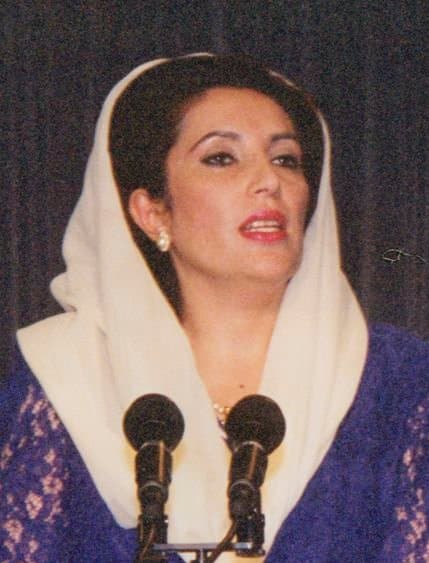
Pakistani · Politics
Benazir Bhutto
June 21, 1953 – December 27, 2007
Early Life and Background
Benazir Bhutto was born on 21 June 1953 in Karachi, Sindh, Pakistan, the eldest child of Zulfikar Ali Bhutto and Nusrat Bhutto. Her father was a prominent lawyer and landowner who founded the Pakistan Peoples Party (PPP) in 1967 and went on to serve as Pakistan’s president and prime minister in the 1970s.[1][2][3] Her mother, of Iranian–Kurdish origin, became an active political figure and later served as a member of parliament.[1]
Benazir grew up in an affluent, politically engaged environment. The Bhutto home frequently hosted diplomats, intellectuals, and party activists, exposing her early to debates about socialism, nationalism, and foreign policy.[1][3] She was educated first at elite schools in Karachi, including a convent school, and was raised in a milieu that mixed traditional Muslim culture with cosmopolitan influences.[3][6]
In 1969, Bhutto left Pakistan for higher education in the United States. She studied at Radcliffe College, then the women’s college at Harvard University, and later at Harvard College, earning a B.A. in comparative government in 1973.[1][3][6] Immersed in American student politics during the late 1960s and early 1970s, she encountered feminist ideas, antiwar activism, and civil rights debates, experiences that broadened her political horizons beyond Pakistan’s context.[3]
After Harvard, Bhutto moved to the United Kingdom and enrolled at the University of Oxford. She studied Philosophy, Politics and Economics (PPE), and completed courses in international law and diplomacy.[1][3] At Oxford she became active in student politics, serving as president of the Oxford Union debating society in 1976, an experience that honed her public speaking skills and helped establish her international profile.[1][3]
Career Beginnings and Political Formation
Bhutto returned to Pakistan in 1977, shortly before the military coup that would radically alter her life and the country’s political trajectory.[1][3] In July 1977, General Muhammad Zia-ul-Haq overthrew her father’s government, imposed martial law, and later executed Zulfikar Ali Bhutto in 1979 after a controversial trial.[1][2][11] Benazir and her family were repeatedly placed under house arrest and imprisoned, with Bhutto spending much of the late 1970s and early 1980s under varying forms of detention because of her association with the PPP and her refusal to leave politics.[1][3][10]
Zulfikar’s execution radicalised Bhutto’s commitment to political opposition. She emerged as a central figure in the PPP, which became the main civilian resistance force against Zia’s regime. In the early 1980s, amid harsh repression, she was often targeted by authorities, suffering ill health in prison and facing restrictions on travel and communication.[1][3]
In 1984, Bhutto was allowed to travel to London for medical treatment and subsequently remained in exile.[3] From there, she became a joint leader of the PPP along with her brothers and mother, coordinating the party’s activities and lobbying international opinion against Zia’s military government.[1][3][6] She addressed conferences, met foreign leaders, and cultivated support among diaspora Pakistanis, presenting herself as the rightful democratic heir to her father’s political legacy.
By 1982, Bhutto had become chairperson of the Pakistan Peoples Party, widely recognised as the first woman in Pakistan to head a major political party, although specific day and month records for this transition are not consistently documented.[1][11] Her leadership of the PPP marked a significant milestone for women in Pakistani politics, placing a woman at the head of a mass-based party in a deeply patriarchal society.
Return to Mass Politics and Path to Power
On 10 April 1986, Bhutto returned to Pakistan from exile to launch a nationwide campaign against military rule. She was greeted by enormous crowds in Lahore, signaling the enduring popularity of the Bhutto name and the PPP.[3][9] Over the following years, she led protests and participated in alliances like the Movement for the Restoration of Democracy, pressing for free elections and the end of martial law.[1][3]
After General Zia’s death in a plane crash in August 1988, Pakistan moved toward elections. The PPP campaigned on a platform of restoring democracy, improving social services, and reducing military influence in politics.[1][2][9] In the general elections of November 1988, the PPP won the largest share of seats in the National Assembly. On 16 November 1988, Bhutto was elected prime minister by the assembly, becoming the first woman prime minister of Pakistan and the first woman elected to lead a Muslim-majority country.[1][2][9]
On 1 December 1988, she formally became prime minister, heading a coalition government, and on 2 December 1988 she was sworn in in Islamabad.[1][2][10] At age 35, she was widely described as one of the world’s youngest elected leaders and the youngest female prime minister, though such claims have not always been systematically quantified.[1] These events marked the end of overt military rule and the restoration of civilian parliamentary government, even as the military retained substantial influence.
First Term as Prime Minister (1988–1990)
Bhutto’s first term, from 1988 to 1990, was constrained by coalition politics, entrenched bureaucracy, and a wary military establishment.[1][2] Her government sought to liberalise the political climate by releasing political prisoners, easing press censorship, and allowing exiled politicians to return. She also attempted to improve social services, particularly in health and education, and expressed support for women’s advancement.[2][9]
In foreign policy, Bhutto attempted to improve relations with India and to reorient Pakistan’s diplomacy after years of isolation under Zia. Under her leadership, Pakistan rejoined the Commonwealth of Nations and participated actively in regional forums such as the South Asian Association for Regional Cooperation (SAARC), although specific dates for some of these diplomatic steps are recorded primarily by year rather than exact day.[9]
Her government also presided over the launch of Pakistan’s first satellite, Badr-I, making Pakistan the first Muslim-majority country to place a domestically-developed satellite in Earth orbit; this occurred in the late 1980s, but the precise launch date is cited in technical and diplomatic histories rather than in mainstream biographical sources.[9] Domestically, Bhutto faced serious economic challenges, ethnic tensions, and allegations of corruption and patronage.
In August 1990, Pakistan’s president, Ghulam Ishaq Khan, dismissed her government, dissolving parliament and calling early elections. He invoked constitutional powers and justified the move by citing corruption, mismanagement, and deteriorating law and order.[1][2][8] The dismissal underscored the continuing vulnerability of elected governments to presidential intervention and military-backed institutions.
Second Term and Policy Initiatives (1993–1996)
Despite her removal, Bhutto remained a central figure in Pakistani politics. In 1993, after another cycle of political instability that also saw the dismissal of Nawaz Sharif’s government, elections were held and the PPP again formed the government. Bhutto began her second term as prime minister in October 1993.[1][2] This period lasted until her dismissal in October 1996.
During the 1990s, Bhutto’s governments introduced a range of institutions and reforms aimed at improving conditions for women and human rights. Under her leadership, Pakistan established a Ministry for Women Affairs, women’s development departments, women’s police stations, crisis centers for women, a Women’s Sports Board, and specialised women’s banks, and reinstated reserved seats for women in legislatures.[9] These initiatives were intended to counter the legacy of Zia’s restrictive policies and to expand women’s access to justice, economic participation, and political representation.
Bhutto’s government also created a Human Rights Ministry, a relatively rare institutional innovation at the time in South Asia, signaling her interest in aligning Pakistan with global human rights norms.[9] In 1996, under her leadership, Pakistan ratified the UN Convention on the Elimination of All Forms of Discrimination Against Women (CEDAW), though exact ratification dates in primary records are not consistently accessible.[9] Ratification strengthened Pakistan’s international legal commitments to women’s rights, even as implementation remained uneven.
Her second term, however, was again marred by allegations of corruption, cronyism, and human rights concerns, including accusations related to security operations in Karachi and elsewhere. Critics pointed in particular to the influence of her husband, Asif Ali Zardari, who was accused of involvement in controversial business deals and was dubbed "Mr. Ten Percent" by opponents. Supporters countered that many charges were politically motivated and reflected elite resistance to her reform agenda.[1][2]
On 12 October 1996, President Farooq Leghari dismissed Bhutto’s government and dissolved the National Assembly, again invoking constitutional powers and citing corruption and mismanagement.[1] This dismissal ended her second term and precipitated further political turmoil. Subsequently, Bhutto and her husband faced a series of legal cases and spent time in detention; Zardari was jailed for several years.[1][2]
Later Life, Exile, and Return
In the late 1990s and early 2000s, Bhutto spent extended periods in self-imposed exile, primarily in London and Dubai, as corruption cases proceeded in Pakistani courts and her safety at home remained uncertain under successive governments.[1][2][9] From abroad, she continued to lead the PPP, issuing statements, giving interviews, and maintaining contact with party workers.
During this period, Pakistani politics were dominated by the rivalry between the Pakistan Muslim League (Nawaz) and the PPP, as well as the growing role of the military. In 1999, General Pervez Musharraf overthrew Prime Minister Nawaz Sharif in a coup, ushering in another era of military rule.[1] Bhutto opposed Musharraf’s regime and sought ways to return to Pakistan, while also facing international scrutiny over ongoing corruption allegations.
In 2007, amid internal and external pressure on Musharraf to restore civilian rule, negotiations took place that opened the way for Bhutto’s return. On 18 October 2007, she flew back to Karachi from Dubai and was received by vast crowds of supporters who joined her caravan through the city.[1][9] Late that night, her convoy was struck by twin suicide bomb blasts near Karsaz, killing and injuring many PPP supporters but leaving Bhutto physically unharmed.[1][9] The attack highlighted the severe security risks surrounding her political activity and demonstrated the determination of militant actors to disrupt the democratic process.
Following the attack, Bhutto persisted with her campaign, travelling across Pakistan, meeting party workers, and criticizing Musharraf’s rule. She called for free and fair elections, an end to emergency measures, and a return to constitutional governance. Internationally, she was seen as a potential partner for a negotiated transition away from military control, balancing her contested domestic reputation with her broad name recognition abroad.[2][9]
Assassination and Death
On 27 December 2007, Bhutto addressed an election rally at Liaquat National Bagh in Rawalpindi, Punjab, a city with deep political symbolism in Pakistan’s history.[1][2][11] As she departed in an armored vehicle and stood through its sunroof to wave to supporters, a gunman fired shots at her, followed by a suicide bomb blast near the vehicle. Bhutto suffered fatal injuries, and at least dozens of others were killed or injured.[1][2]
She was rushed to hospital but declared dead shortly thereafter. Official accounts of the precise cause of death varied: early government statements suggested she died from head injuries after being thrown by the blast, while other reports and PPP officials pointed to bullet wounds; subsequent investigations and UN inquiries did not entirely resolve the contradictions.[1][2][9] The identity and motives of those behind the assassination also remained contested, with initial suggestions of involvement by extremist groups such as the Pakistani Taliban, and persistent allegations by some supporters that elements of the state had failed to protect or may have been complicit in the attack.
Bhutto’s assassination provoked nationwide grief and anger. Riots and demonstrations erupted across Pakistan, particularly in her home province of Sindh. The elections scheduled for January 2008 were postponed, and Musharraf’s already weakened position further eroded. International leaders condemned the killing and expressed concern about Pakistan’s stability and the future of democratic governance there.[2][9]
Personal Life
Bhutto’s personal life was closely intertwined with her political career. In 1987, she married Asif Ali Zardari, a businessman from a prominent Sindhi family.[1][2] The marriage, initially arranged with strong input from her mother, was both a personal partnership and a political alliance, bringing together influential Sindhi landowning networks and consolidating local support.
The couple had three children: Bilawal Bhutto Zardari, born in 1988, and two daughters, Bakhtawar and Aseefa.[1][2] Bhutto’s roles as mother and party leader were often highlighted in media portrayals, which depicted her balancing domestic responsibilities with her high-profile political obligations. She herself drew on familial imagery, styling herself as the "daughter of Pakistan" and invoking the memory of her father in speeches.[12]
Bhutto’s relationship with Zardari was politically contentious. Opponents accused him of corruption and undue influence on state affairs, while supporters argued that he bore the brunt of politically motivated charges aimed at weakening the PPP. After her death, Zardari went on to serve as President of Pakistan from 2008 to 2013, and their son Bilawal eventually became chairman of the PPP, indicating the continued strength of dynastic politics in Pakistan.[1][2]
Awards, Honors, and International Recognition
Bhutto received numerous honors and symbolic recognitions during her lifetime and posthumously. She was awarded honorary degrees and fellowships from institutions abroad, including recognition by the Royal College of Physicians of Edinburgh, which noted her advocacy for health and social development.[15] Her international education and political prominence made her a frequent invitee at global conferences and forums on democracy, development, and women’s leadership.
Media around the world often celebrated her as a trailblazer—the first woman to head a democratic government in a Muslim-majority country—and she was featured in lists and profiles of influential women leaders.[1][2][6] At the same time, serious journalistic and scholarly work assessed her record critically, balancing her pioneering status with scrutiny of governance outcomes and corruption allegations.
After her assassination, memorials, scholarships, and institutions were named in her honor in Pakistan and abroad, such as Benazir Bhutto Shaheed University and various women’s empowerment programs. These initiatives aimed to keep alive her image as a champion of democracy and women’s rights, even as debates continued over how to interpret her political legacy.
Legacy and Historical Impact
Benazir Bhutto’s legacy is complex and contested, but her historical significance is undeniable. She broke multiple barriers by becoming the first woman elected to lead a Muslim-majority country and the first female prime minister of Pakistan, achievements that reshaped global expectations about women’s political roles in Muslim societies.[1][2][9]
Her leadership symbolized the possibilities of democratic transition after military rule. By pushing for elections, challenging authoritarianism, and re-establishing civilian governments in 1988 and 1993, she contributed to the gradual normalization of parliamentary politics in Pakistan, even though her governments were repeatedly dismissed.[1][2][9] The instability of her tenures reflected structural weaknesses in Pakistan’s political system—such as powerful presidents, an influential military, and fractious party politics—rather than solely her personal failings.
For women’s history, Bhutto stands as both a pioneering figure and a cautionary example. On the one hand, her prominence inspired women across South Asia and the broader Muslim world to seek political office, and her governments initiated institutional reforms supporting women’s rights and participation. On the other hand, the fierce opposition she faced, including gendered attacks and eventual assassination, highlighted the dangers and limitations that women leaders can encounter in environments marked by patriarchal norms and violent extremism.[9][11]
Scholars have debated whether Bhutto’s rule entrenched or challenged dynastic and patronage politics. Her rise was inseparable from the Bhutto name and the PPP’s populist base, and critics argue that her leadership did not fundamentally transform the socio-economic structures that underpin Pakistani politics.[1][2] Yet her capacity to mobilize support across rural and urban constituencies, and to articulate a language of democracy and rights, gave many Pakistanis a vision of pluralist politics that contrasted sharply with martial law.
Internationally, Bhutto is remembered as a charismatic and articulate advocate for democracy, who spoke fluently in global forums yet remained rooted in the turbulent realities of Pakistani society. Her life story—elite upbringing, foreign education, imprisonment, exile, elected office, and assassination—has made her a subject of extensive biographical and analytical writings, as well as documentaries and educational materials.[3][9][10]
Assessment in Women’s and Political History
In the context of women’s history, Benazir Bhutto’s career is often compared with that of other South Asian women leaders such as Indira Gandhi and Khaleda Zia, highlighting the region’s distinctive pattern of women ascending to high office through family-based parties.[2][3] Her trajectory underscores how dynastic connections can both open doors for women and tether them to existing power structures.
Bhutto’s advocacy for women’s rights, including support for institutions such as women’s police stations and crisis centers, and Pakistan’s ratification of CEDAW under her leadership, contributed to incremental improvements in legal and institutional frameworks for gender equality.[9] Yet, many feminist scholars note that these changes did not fully dismantle discriminatory laws introduced under Zia, nor did they significantly alter entrenched patriarchal practices.
Nevertheless, Bhutto occupies a central place in narratives about women’s political empowerment in the Muslim world. Her presence at the helm of government in a nuclear-armed state, her negotiations with military leaders, and her engagement with global diplomacy demonstrated that women could operate at the highest levels of security and foreign policy decision-making in contexts often perceived as closed to female leadership.
Her assassination remains a stark reminder of the risks faced by politicians who challenge authoritarian or extremist forces, and has been cited in broader discussions about the vulnerability of democratic actors in volatile regions. The unresolved controversies surrounding her death continue to fuel public mistrust of Pakistani institutions and underscore the need for transparent accountability mechanisms.
Conclusion
Benazir Bhutto’s life encapsulates the contradictions of modern Pakistani politics: democratic aspirations constrained by military power, populist rhetoric intertwined with elite privilege, and pioneering female leadership overshadowed by allegations of corruption and tragic violence. She opened unprecedented political space for women in a Muslim-majority society and helped restore civilian rule after periods of dictatorship.
At the same time, her story reveals how fragile democratic gains can be, and how individual leaders, however charismatic or symbolically important, operate within structural constraints that can limit their capacity for transformative change. For historians of women’s leadership and postcolonial politics, Bhutto remains an essential case study—an emblem of hope and a reminder of the profound challenges facing those who seek to democratize deeply divided and militarized societies.
Dated achievements
7 indexed.
- Jun211953Science
Birth of Benazir Bhutto
Benazir Bhutto was born in Karachi, Pakistan, eldest child of future PM Zulfikar Ali Bhutto and Begum Nusrat Bhutto.
View details Benazir Bhutto - Wikipedia - Nov161988Politics
Elected first woman prime minister of Pakistan and first woman to lead a Muslim-majority nation
Following parliamentary elections, Bhutto was elected Prime Minister, becoming Pakistan's first woman PM and first woman elected to lead a Muslim-majority country.