← All women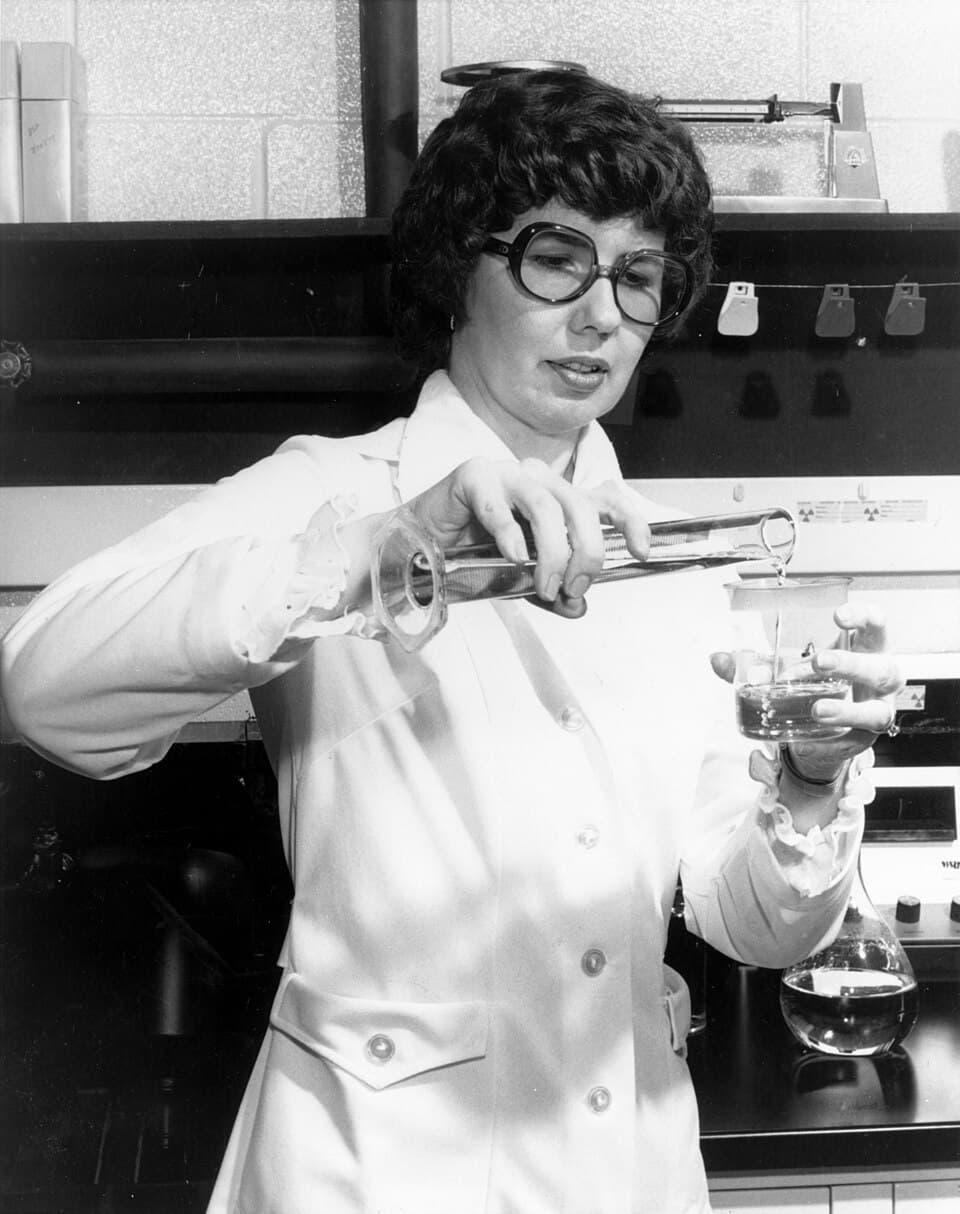
American · Science
Barbara Askins
1939 – present
Early Life and Background
Barbara S. Askins, born Barbara Scott in 1939 in Belfast, Tennessee, is an American chemist best known for her invention of a method to enhance underexposed photographic negatives.[1][10] She grew up in rural Tennessee at a time when opportunities for women in advanced science and technology were limited. Details of her parents, early schooling, and childhood environment are sparsely documented in publicly available sources, but secondary accounts emphasize her persistence in pursuing higher education after beginning a family life.[4][12]
Askins’s early working life was not in research laboratories but in the classroom. Several biographical sketches note that she began her career as a teacher, a common profession for college-educated women of her generation.[1][12] This period as an educator likely provided experience in explaining complex ideas clearly and in managing competing responsibilities—skills that would later support her work as a researcher within NASA.
After marrying and having children, Askins interrupted the typical early-career trajectory in science. Sources describe her consciously postponing advanced study in chemistry until after her two children were in school, reflecting both family commitments and the gendered expectations of mid-20th-century America.[4][12] Only then did she return to university to complete serious scientific training.
Education and Transition to Chemistry
Once her children reached school age, Askins decided to pursue formal education in chemistry. She completed a Bachelor of Science degree and then a Master’s degree in chemistry, though publicly accessible sources do not specify the institutions or exact years.[4][12] The decision to undertake demanding scientific coursework at this stage of life marked a significant turning point, showing her commitment to entering a research career despite the obstacles facing women, particularly mothers, in STEM fields.
Her graduate training focused on physical chemistry, the subfield concerned with the physical principles underlying chemical systems. This would prove important: the problems she later tackled at NASA involved the physics of radiation, photographic emulsions, and image formation, all grounded in physical chemistry. The combination of disciplinary expertise and practical orientation prepared Askins to contribute to applied research rather than purely theoretical work.
By the mid-1970s, Askins had completed her academic preparation and was positioned to enter the scientific workforce. Her experience as a teacher, her advanced degrees, and her willingness to balance family and professional life set the stage for her recruitment into one of the most visible science institutions in the United States.
Career Beginnings at NASA Marshall Space Flight Center
In 1975, Askins was hired by NASA’s Marshall Space Flight Center in Huntsville, Alabama.[1][4] As a physical chemist, she joined a research group tasked with improving the quality of images produced from astronomical and geological photographs taken by NASA researchers. These images, captured under challenging conditions in space or from remote sensing platforms, often reached Earth as underexposed negatives—rich in information but frustratingly faint and difficult to interpret.
At the time, NASA was expanding its observational capabilities, and accurate interpretation of photographic data was vital for understanding everything from planetary geology to space hardware performance. Conventional film-development techniques frequently left scientists with low-contrast prints in which subtle features were nearly invisible. Askins’s assignment was therefore not only technically demanding but strategically important for the agency’s broader scientific mission.[4][12]
As a woman chemist entering NASA’s research infrastructure in the mid-1970s, Askins navigated a workplace still heavily male-dominated, particularly in senior technical roles. Her position at Marshall represented both a personal achievement and a broader institutional shift toward including more women in scientific problem-solving related to space exploration.
Development of the Image-Intensification Process
While working at Marshall, Askins developed the innovation that would define her career: a method for intensifying images on developed photographic films and plates.[1][3][10] The core idea built on autoradiography, a technique where radioactive emissions create exposure patterns in photographic emulsions. Askins recognized that she could exploit this principle not at the moment of initial exposure, but during a secondary process applied to already developed, underexposed negatives.
Her method involved making the image silver in the original emulsion radioactive and then placing a second photographic emulsion in close contact with it.[1][3][10] As the radioactive silver decayed, it emitted radiation that exposed the second emulsion in a pattern corresponding to the original image. The resulting autoradiograph exhibited significantly increased density and contrast, revealing details that had been nearly invisible in the original print.
Technically, this approach required careful choice of radioactive compounds and control of exposure times. A later description of her work notes her use of thiourea labeled with a sulfur radioisotope as part of the process.[5] By calibrating the chemistry and physics involved, Askins was able to design a repeatable and practical technique rather than a laboratory curiosity.
Initially, the method was applied to astronomical and geological photographs from NASA missions. Researchers could now reprocess existing negatives to obtain enhanced images without the need for additional, costly data acquisition in space.[4][12] In essence, Askins turned faint, previously marginal photographs into robust datasets, expanding the scientific value of missions that had already flown.
Patent and Technical Impact
The importance of Askins’s work was formally recognized on 18 July 1978, when she was granted U.S. Patent No. 4,101,780 for her invention, titled "Method of Obtaining Intensified Image from Developed Photographic Films and Plates".[4] The patent documented the steps of her process and secured her intellectual property rights, reflecting NASA’s and the broader scientific community’s assessment that the technique was both novel and practically valuable.
Following the granting of the patent, Askins’s method found applications beyond its original astronomical context. Biographical accounts note that the technique was used to improve X-ray technology, allowing radiologists to obtain clearer images from existing films, and to aid in the restoration of old photographs.[4][12] In medical settings, enhanced clarity could assist in more accurate diagnoses, while in archival work, previously obscure details in historical photographs could be recovered.
The cross-domain adoption of her method illustrates the broader significance of her innovation. A solution developed for space-science imaging became a tool in hospitals and archives, demonstrating how applied physical chemistry can bridge seemingly separate fields. It also underscored the practical power of reprocessing existing data—whether negatives from a telescope or X-ray films in a clinic—rather than relying solely on new acquisitions.
Awards, Honors, and Recognition
In the same year as her patent, 1978, Askins received one of the highest distinctions available to an American inventor. The Association for Advancement of Invention and Innovation named her National Inventor of the Year, in recognition of her image-intensification method.[1][2][3][6][10][12][13] Multiple sources describe her as the first woman to be selected individually for this honor, marking a barrier-breaking achievement in the history of technical awards.[4][12]
Historically, invention awards had overwhelmingly gone to male innovators, particularly in fields related to engineering, space technology, and medicine. Askins’s selection signaled a shift in perception about who could be a principal inventor, emphasizing that women scientists could lead high-impact innovations within major institutions like NASA.
The award also increased public visibility of her work. Popular and educational accounts of women inventors often cite Askins as a landmark figure, especially in discussions about imaging technologies and women’s contributions to space-related research.[12][13] Her story has been featured in outreach materials and educational platforms that aim to inspire students—particularly girls—to pursue STEM careers.
Broader Career and Contributions
Beyond the specific invention for which she is best known, sources identify Askins primarily as a physical chemist at NASA’s Marshall Space Flight Center.[1][3][8][10] While detailed records of her subsequent research projects are not widely available, it is clear that her expertise lay at the intersection of radiation chemistry, photographic technology, and scientific imaging.
Her method exemplified an approach to research focused on increasing the value of existing data. By refining techniques for developing and reprocessing photographic films, she assisted not only NASA but also the medical industry and archival communities in extracting more information from images. This orientation toward practical problem solving, rather than solely theoretical discovery, made her work especially relevant to the needs of institutions that depend on visual data.
Several encyclopedic entries and biographical databases, including multilingual Wikipedia articles and women-focused legacy projects, continue to highlight her contribution decades after the initial patent.[1][3][6][10][13] This sustained attention indicates that her work has become part of the standard narrative of women’s achievements in science and invention.
Personal Life
Available biographical material presents only limited details about Askins’s personal life, but some elements are clear. She married and had two children, and she chose to delay advanced study in chemistry until after her children entered school.[4][12] This decision shaped the timing of her academic and professional development and is frequently mentioned in discussions of her career path.
The record does not provide names of family members or extensive commentary on her private experiences. However, the pattern of her life—teaching, parenting, then returning to obtain bachelor’s and master’s degrees before entering NASA—highlights the way many women scientists of her generation organized their careers around both family and professional aspirations.
Her ability to re-enter higher education and succeed in a demanding research environment after years devoted primarily to teaching and family responsibilities is often cited as inspirational for people considering mid-career transitions into STEM fields.
Legacy and Historical Impact
Barbara Askins’s legacy rests on several intertwined contributions. First, her image-intensification method remains an important historical example of how autoradiography can be harnessed to enhance photographic data after initial development.[1][3][4][10] The technique influenced practices in astronomical imaging, geological photography, medical diagnostics, and photographic restoration, showing that the chemistry of photographic emulsions could be manipulated in sophisticated ways to improve visibility and interpretability.
Second, her recognition as National Inventor of the Year in 1978 marked a milestone in the representation of women among highly honored inventors.[1][2][3][12][13] As the first woman to receive the award individually from the Association for Advancement of Invention and Innovation, Askins set a precedent that broadened expectations about who could lead patent-worthy innovations in technical fields.
Third, her life story underscores the possibility of non-linear scientific careers. Askins did not follow a straight path from undergraduate study to research; instead, she taught, raised children, then returned to complete advanced degrees and join NASA. Educational and advocacy organizations have highlighted this trajectory to encourage adults, particularly women, to consider returning to school for STEM training.[4][12][13]
Finally, Askins represents the often under-recognized interface between chemistry and visual technology. Her work reminds historians and practitioners that advances in imaging—whether in space exploration or medicine—depend not only on cameras and optics but also on the chemistry of films, plates, and processing methods. By innovating at that interface, she helped convert faint traces of light into usable knowledge.
Later Life and Current Status
Askins is described in multiple sources as living, with birth year 1939 and no recorded date of death.[1][3][6][10][11][13] Public information about her activities after the peak of recognition in the late 1970s is limited. There is no widely cited evidence in the provided sources of additional major patents or public roles, though it is reasonable to infer that she continued her professional involvement in scientific and technical work for some time.
Her name appears in various contemporary projects that document the contributions of women in science and invention, such as women-inventors compilations and women’s legacy catalogs.[12][13] These references help ensure that her achievements remain visible to new generations of students and researchers.
Because detailed accounts of her later career and personal life are not readily available in major reference sources, editorial profiles focus primarily on her NASA-era work and its enduring implications. Nonetheless, as of the latest accessible information, Barbara S. Askins stands as an influential figure whose mid-20th-century innovation continues to shape how historians and educators narrate women’s roles in the development of imaging technology.
Dated achievements
3 indexed.
- Jan011975Science
Hired by NASA Marshall Space Flight Center
After completing graduate studies in chemistry, Askins joined NASA's Marshall Space Flight Center as a chemist.
View details Barbara Askins Important Events Timeline - Jan011978Science
Granted U.S. Patent for Image-Intensification Process
Askins received U.S. Patent No. 4,101,780 for her method of intensifying images from developed photographic film using radioactive material.