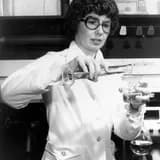
Askins received U.S. Patent No. 4,101,780 for her method of intensifying images from developed photographic film using radioactive material.
In 1978, Barbara Askins was granted U.S. Patent No. 4,101,780, titled "Method of Obtaining Intensified Image from Developed Photographic Films and Plates." This patent formalized her groundbreaking chemical process, developed during her work at NASA's Marshall Space Flight Center, which used radioactive sulfur-35 to bind to silver particles in underexposed photographic negatives, making faint images far more visible without loss of detail.
The invention solved a persistent and costly problem for NASA: many photographs taken in space, particularly of celestial bodies or during low-light mission conditions, came back too faint to analyze properly. Askins's autoradiographic technique allowed scientists to recover images once thought unusable, saving enormous costs associated with re-shooting or discarding valuable photographic data collected during expensive space missions.
Beyond its aerospace application, the process proved remarkably versatile. It was soon adopted in medical diagnostics for enhancing X-ray images, in archaeology and art restoration for recovering faded historical images, and even in criminal forensics for enhancing evidence photographs. The patent represented a landmark moment for women inventors in a field then overwhelmingly dominated by men, and it cemented Askins's place in the history of American innovation. Her invention is frequently cited as one of the most commercially and scientifically significant patents to emerge from NASA-funded research in the 1970s.