← All women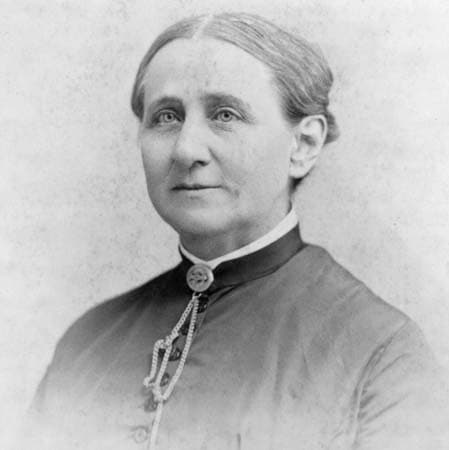
American · Activism · Literature
Antoinette Brown Blackwell
May 20, 1825 – November 5, 1921
Early Life and Family Background
Antoinette Louisa Brown Blackwell was born on May 20, 1825, in a log cabin in Henrietta, near Rochester, New York.[4][7] She was the seventh of ten children born to Joseph Brown, a prosperous farmer and justice of the peace originally from Thompson, Connecticut, and Abby (Morse) Brown, from Dudley, Massachusetts.[4][7][8] Her mother was a descendant of the Puritan Samuel Morse, a heritage that linked the family to New England Congregational traditions and a culture of serious religious inquiry.[7]
Brown grew up in a rural environment where hard work and self‑reliance were expected. Yet she showed early signs of intellectual curiosity and religious intensity. According to later biographical sketches, she began to preach informally as a young girl in her local Congregational church, insisting on participating in worship and religious discussion in ways not typical for girls of her time.[9][11] Her determination to study and speak publicly would become a defining feature of her life.
Education for girls in the 1830s was often limited, but Brown’s parents did support her schooling to a degree. She attended the Monroe County Academy between 1838 and 1840, gaining the kind of preparatory education more commonly provided to boys.[13] These experiences introduced her to classical studies and theology, subjects she would pursue more fully at college.
Education and Theological Training
Brown’s most significant educational step was her decision to enroll at Oberlin College in Ohio, one of the few American institutions at the time that admitted women and African Americans.[1][7][8] She entered Oberlin’s literary course and completed the requirements for the Bachelor of Arts degree, graduating in 1847.[8][13] This placed her among the earliest cohorts of women to receive a full collegiate education in the United States.
Driven by a desire to preach, Brown persisted in pursuing theological study despite institutional opposition. She enrolled in Oberlin’s theological program and completed the coursework by 1850, effectively finishing the seminary curriculum.[8][12][13] However, Oberlin refused to grant her a preacher’s license or permit her to participate fully in graduation exercises, citing her sex as the reason.[10][12][13] One account notes that she faced three years of poverty, ridicule, and discrimination during these studies, underscoring the barriers confronting women seeking theological training.[12]
Brown’s theological qualification was initially denied formal recognition, but its significance was acknowledged belatedly. Oberlin later awarded her an honorary Master of Arts in 1879 and an honorary Doctor of Divinity in 1908, retroactively affirming the seriousness of her theological work and her contribution to religious thought.[10][13] These honors reflected changing attitudes toward women’s education and religious leadership at the turn of the twentieth century.
Career Beginnings: Lecturing and Reform Work
Denied immediate ordination after Oberlin, Brown turned to public speaking and social reform. She contributed articles to Frederick Douglass’s newspaper, the North Star, engaging with abolitionist perspectives and demonstrating her ability to articulate moral arguments in print.[11] She also began speaking at early women’s rights gatherings; sources note that she participated as a speaker in the first women’s rights conferences, linking her to the core group of mid‑19th‑century feminists.[11]
During this period Brown lectured on women’s rights, temperance, abolition, and the plight of the urban poor.[1][7][9] She spent time working in New York City tenements, where she witnessed harsh conditions and incorporated social justice concerns into her religious message.[7] Her moderate feminist views emphasized equal educational opportunities and argued that men and women were equal but distinct in experiences and roles, a stance that sought to reconcile gender equality with contemporary understandings of gender difference.[7]
Brown’s early lecturing career brought her into contact with other reformers, including Lucy Stone, with whom she would later co‑found a suffrage organization. It also established her as an eloquent and persuasive public speaker at a time when women addressing mixed audiences were often criticized as immodest or unfeminine.[1][9][11]
Ordination and Ministry in South Butler
Brown’s most celebrated breakthrough came in 1853. On July 4, 1853, she delivered an Independence Day address in South Butler, Wayne County, New York. The county’s historical record identifies her as the first woman ever to give such an address there, underscoring her willingness to claim civic as well as religious speaking roles.[12] The same community soon called her to serve as pastor of its Congregational church.
On September 15, 1853, Brown was formally ordained as pastor of the South Butler Congregational Church.[12] Reference works including Britannica and major women’s history compilations describe this event as making her the first woman to be ordained a minister of a recognized denomination in the United States.[2][7][10][13] Other sources phrase the achievement as being the "first ordained female minister in the U.S." or the "first American woman to become a Protestant minister," reflecting a broad consensus that her ordination was unprecedented in mainstream Protestantism.[6][7][11][13]
As pastor, Brown preached regularly, performed pastoral duties, and engaged in the administration of the sacraments, roles long reserved to men. She served in South Butler for roughly a year. Wayne County’s historical narrative states that she served the congregation until June 1854, while other sources simply note that she left in July 1854.[12][0] The pastorate was marked by theological tensions; Brown’s liberal views on doctrine and her emphasis on social reform did not always align with the expectations of some parishioners.
In addition to her ordination, Brown achieved another "first" in 1853 when she became, according to several reference sources, the first woman in the United States to officiate at a marriage ceremony.[13][0] While the exact day is not documented, the act itself was notable because the legal and religious responsibilities associated with marriage ceremonies had been tightly guarded by male clergy and civil officials.
Shift from Congregationalism and Ongoing Religious Work
Brown’s ministry in South Butler was brief, but its impact was lasting. After leaving the pastorate in 1854, she increasingly questioned aspects of Congregational doctrine and eventually affiliated with Unitarianism, whose more liberal theological stance better matched her views.[9] Her move reflected broader debates among reform-minded Protestants about biblical interpretation, the role of women, and social ethics.
Even without a settled pastorate, Brown continued to function as a visiting minister and preacher. The National Women’s Hall of Fame notes that she served later as a "visiting pastor," providing spiritual leadership and serving as a role model for young women considering ministry as a vocation.[10] She combined religious work with lecturing on women’s rights and other reforms, illustrating a vocation that blended pastoral care, public advocacy, and philosophical reflection.
Marriage and Family Life
On January 24, 1856, Brown married Samuel Charles Blackwell in Geneva, New York.[13][12] Samuel was the brother of Elizabeth Blackwell, the first woman to graduate from a medical school, and Emily Blackwell, another pioneering woman physician.[12][13] Through this marriage, Antoinette became sister‑in‑law to Elizabeth, Emily, and the leading suffragist Lucy Stone, placing her at the center of a notable reform‑oriented family network.[13]
Brown Blackwell and her husband had a large family. Wayne County’s account states that she had five daughters, while other sources note that she had seven children, reflecting some variation in the record.[10][12][13] Her first daughter was born in 1856, marking a transition into motherhood that required adjustments to her public schedule.[13] Brown Blackwell curtailed but did not abandon lecturing; she continued to speak and write, striving to balance domestic responsibilities with activism and intellectual work.
She openly challenged the idea that women must choose between family and public life. Biographical entries emphasize that she "successfully combined a career with marriage and motherhood," making her an early example of a woman negotiating professional and domestic roles.[13] Her family connections also placed her within overlapping reform networks, as relatives participated in campaigns for medical education, abolition, and woman suffrage.
Women’s Rights and Suffrage Activism
Throughout her adult life, Brown Blackwell was closely associated with the women’s rights movement. She spoke at early women’s rights conventions in the 1850s and advocated for reforms including property rights, educational access, and suffrage.[11][13] Her speeches emphasized the moral and social benefits of women’s public participation and argued that Christian principles supported gender equality.
Brown Blackwell’s activism extended into organizational work. Together with Lucy Stone and other reformers, she helped form the American Woman Suffrage Association (AWSA) after disagreements with Susan B. Anthony and Elizabeth Cady Stanton over strategy and priorities.[11] The AWSA took a more state‑by‑state approach to securing voting rights, contrasting with the tactics of the rival National Woman Suffrage Association. Brown Blackwell’s involvement demonstrated her preference for broadly inclusive and moderate strategies.
In addition to suffrage, she worked on temperance and abolition, seeing these causes as interconnected moral issues.[7][13] Her religious background informed her activism; she often framed women’s rights and social reform as matters of Christian conscience, arguing that women’s experiences gave them particular insight into ethical questions.
Brown Blackwell’s commitment to suffrage lasted into advanced age. In 1920, after the ratification of the Nineteenth Amendment, she cast her first vote in a U.S. election on November 2, 1920, despite being elderly, deafened, and blind.[11][0] Some biographical sources underscore that she was the only member of the first generation of suffragists still alive to exercise the newly won voting right, making her ballot a symbolically powerful moment in suffrage history.[0][10]
Philosophical and Scientific Writings
Brown Blackwell was not only a minister and activist but also a philosophical thinker and author. Over her lifetime she published multiple books and essays that engaged with questions of religion, science, and gender. The National Women’s Hall of Fame notes that she published eight books and many essays, while Wayne County’s biography counts ten books along with poems and hundreds of articles, suggesting a substantial body of work.[10][12]
Her writings often sought to construct a theoretical foundation for sexual equality grounded in both theological and scientific concepts.[1][9] She read contemporary scientific literature and corresponded with figures such as Charles Darwin, positioning herself in dialogue with emerging theories of evolution.[9] The Darwin Project describes her as a keen philosopher and scientist who published scientific works and challenged aspects of Darwin’s interpretations, especially where they appeared to support male superiority.[9]
Brown Blackwell’s books included explorations of Christian ethics, social philosophy, and gender. She argued that religious faith and scientific discovery need not be in conflict, and that both could be used to advance women’s status. Her moderate feminist stance insisted on equal opportunities while recognizing that men and women had differing social experiences. This approach aimed to persuade readers who might be wary of more radical arguments, thereby broadening the appeal of feminist ideas.[7]
Her election to the American Association for the Advancement of Science (AAAS), noted by the National Women’s Hall of Fame, reflected recognition of her intellectual engagement with scientific questions, although details of the date and circumstances of her election are not widely documented.[10] This affiliation further underscored her unusual combination of roles as minister, activist, and science‑interested philosopher.
Honors and Institutional Recognition
Brown Blackwell received formal recognition from institutions later in life. As noted above, Oberlin College awarded her an honorary Master of Arts degree in 1879 and an honorary Doctor of Divinity in 1908, belatedly honoring the theological studies that had originally been marginalized because of her gender.[10][13] These honors acknowledged her pioneering role in religious education and ministry.
Her broader historical significance has been recognized by various organizations. She has an entry in major reference works such as Britannica, which emphasizes her status as the first woman minister of a recognized denomination in the United States and highlights her suffrage and women’s rights advocacy.[2] The German, Portuguese, and French editions of Wikipedia similarly present her as a pioneering ordained woman pastor and feminist.[3][5][6]
In modern times, she has been inducted into the National Women’s Hall of Fame, which honors her as the first woman minister of a recognized denomination and as a leader in the women’s rights movement.[10] Local commemorations, such as Wayne County’s historical page and community celebrations in Henrietta, New York, further highlight her legacy and educate new generations about her contributions.[12][14]
Personal Views and Theological Positions
Brown Blackwell’s theology and social views were shaped by her attempt to reconcile faith and reform. She argued that women’s participation in religion could improve women’s status in society, seeing the pulpit as a platform for articulating egalitarian ethics.[9] Her sermons and writings often emphasized the moral responsibilities of both sexes and called for reforms in marriage, education, and social policy.
Her moderate feminist perspective distinguished her from some contemporaries. While she firmly supported women’s suffrage and equal educational opportunities, she sometimes adopted a more conciliatory tone than other activists, aiming to persuade rather than confront. EBSCO’s research starter notes that she advocated equal education and understood men and women as equal but distinct, hoping to maintain social harmony while transforming gender roles.[7]
Brown Blackwell also engaged with scientific debates, particularly evolution. She criticized interpretations of Darwinism that treated women as biologically inferior, proposing instead that evolutionary theory could be read in ways that supported mutual development and cooperation between the sexes.[9] Her scientific engagement reflected a broader 19th‑century trend of religious thinkers grappling with new scientific ideas, but her insistence on women’s intellectual and moral equality gave her work a distinctive feminist character.
Later Life
In her later years, Brown Blackwell remained intellectually active even as physical limitations increased. Oberlin records and biographical accounts refer to her continued interest in education, religion, and social reform well into old age.[1][7] The honorary degrees awarded in 1879 and 1908 came when she was already widely regarded as a veteran of the women’s rights and reform movements.[10][13]
By the time the Nineteenth Amendment was ratified in 1920, Brown Blackwell was elderly, deafened, and blind, yet she made efforts to participate in the new political reality by voting on November 2, 1920.[11][0] This act, given her lifelong advocacy for suffrage, was symbolically powerful, and contemporary and later accounts often mention it as a capstone to her activism.[10][0]
Death
Antoinette Brown Blackwell died on November 5, 1921, in Elizabeth, New Jersey.[2][3][6][7][13] She was ninety‑six years old. Her long life spanned the period from the early republic through World War I, and her experiences reflected the dramatic changes in American religious, social, and political life during that century.
At the time of her death, she was remembered as a pioneering ordained woman minister, a suffrage activist, a writer, and a thinker who had attempted to bridge faith and science. Later historians and institutions have kept her legacy alive, ensuring that her contributions to women’s public roles in church and society are recognized.[1][2][10]
Legacy and Historical Impact
Antoinette Brown Blackwell’s legacy is multifaceted. As a religious pioneer, her 1853 ordination in South Butler stands out as a landmark in the history of women in ministry. It demonstrated that mainstream Protestant congregations could accept women as spiritual leaders, providing a precedent that later women seeking ordination would cite.[2][7][10][12][13]
As a women’s rights and suffrage activist, she contributed to early conventions, organizational efforts, and public discourse, helping to build the foundation for the eventual success of the suffrage movement. Her vote in 1920 served as a symbolic link between the movement’s inception and its legislative victory.[0][10][11]
As an author and thinker, she produced books and essays that engaged theology and science in support of gender equality. Her correspondence with Darwin and her election to the AAAS underscore her participation in intellectual currents that extended beyond strictly religious circles.[9][10]
Modern institutions—such as the National Women’s Hall of Fame, Oberlin College, and major encyclopedias—continue to present her as one of the most "outspoken and remarkable women" of her era, emphasizing her roles as minister, leader in women’s rights and suffrage, published author, public speaker, and philosophical thinker.[1][10] Her life story illustrates the possibilities and challenges faced by women who sought to cross boundaries in education, religion, and politics in the 19th century.
Brown Blackwell’s efforts did not immediately transform institutional structures, and many denominations only began ordaining women decades after her death. Nonetheless, her presence in the pulpit, her writings, and her activism disrupted assumptions about women’s capabilities and helped make later changes imaginable. For historians of women’s history, religious studies, and feminist philosophy, her biography remains a key case study in how individual determination and intellectual work can reshape cultural norms over time.
Dated achievements
6 indexed.
- May201825Science
Birth of Antoinette Brown
Antoinette Louisa Brown was born in Henrietta, New York, later becoming a pioneering minister and reformer.
View details Oberlin College: Antoinette Brown Blackwell - Jul041853Science
First Woman to Deliver an Independence Day Address at South Butler
Brown became the first woman to deliver a Fourth of July address in South Butler, New York, breaking a significant public-speaking barrier for women.