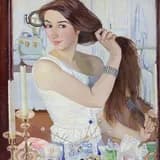
Serebriakova's self-portrait 'At the Dressing-Table' (1909) was exhibited in 1910 in Saint Petersburg, launching her into national recognition and immediate purchase by the Tretyakov Gallery.
In 1910, Zinaida Serebriakova's self-portrait At the Dressing-Table (painted in 1909) was shown at a major exhibition of the Union of Russian Artists in Saint Petersburg. The luminous, intimate self-portrait depicts the artist at her mirror, radiant and joyful, surrounded by the everyday trinkets of her toilette table, rendered with a freshness that immediately captivated critics and the public alike.
The painting's success was extraordinary for a young, largely self-taught woman artist working in a field still dominated by men. It was purchased directly by the Tretyakov Gallery, one of Russia's most prestigious cultural institutions, an honor that instantly established Serebriakova's reputation as a major new talent in Russian art.
The work is celebrated for its psychological warmth, technical brilliance, and its unusually candid, unidealized yet joyous depiction of female self-regard, a rare and pioneering perspective at the time when women were far more often subjects than authors of such intimate imagery. It remains one of the most beloved and reproduced works of early twentieth-century Russian painting, and is frequently cited as the work that secured Serebriakova's place among Russia's foremost artists.
This breakthrough moment came at a time when women were largely excluded from formal academic art training in Russia, making her rapid ascent to critical acclaim all the more remarkable and historically significant for women in the arts.