← All women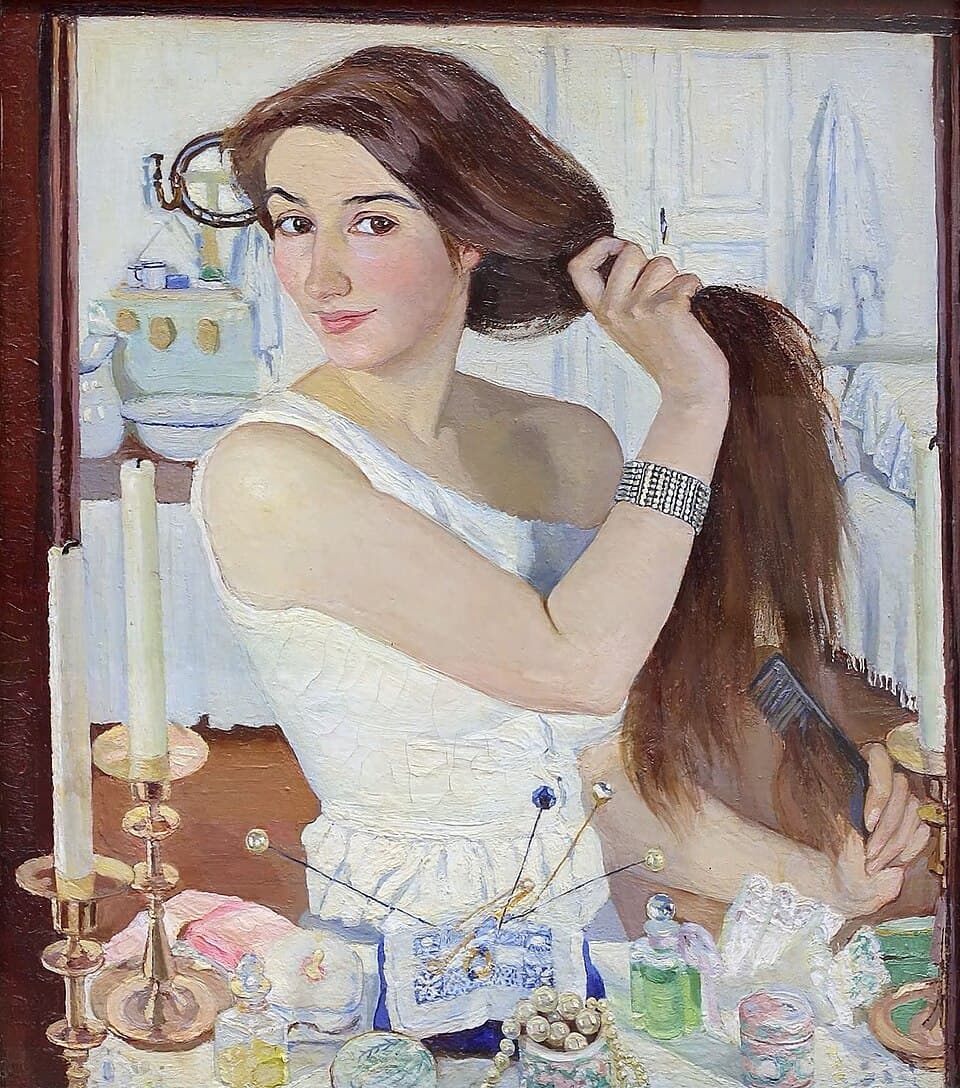
Russian, French · Arts
Zinaida Serebryakova
December 10, 1884 – September 19, 1967
Early Life and Family Background
Zinaida Yevgenyevna Serebriakova (née Lanceray) was born on December 10, 1884 (November 28 by the Old Style calendar), at Neskuchnoye, her family's country estate near Kharkov in what is today Ukraine. She was born into one of the most distinguished artistic families in Russian history: the Benois-Lanceray clan, whose members over several generations produced painters, architects, sculptors, and set designers who left an indelible mark on Russian culture.
Her father, Yevgeny Lanceray, was a respected sculptor, while her mother, Ekaterina Nikolayevna Benois, was herself a talented graphic artist. Zinaida's grandfather, Nicholas Benois, was a celebrated architect who had designed the Mariinsky Theatre, and her uncle, Alexandre Benois, was a painter, art critic, and one of the founders of the seminal Mir Iskusstva (World of Art) movement and journal, which sought to revitalize Russian art through engagement with both national tradition and European modernism. Her brother, Yevgeny Lanceray, also became a noted painter and graphic artist.
Zinaida's father died when she was only two years old, prompting the family to relocate permanently to Saint Petersburg, the imperial capital and cultural heart of Russia. There, surrounded by the intellectual and artistic ferment of her extended family, young Zinaida was exposed from earliest childhood to painting, music, theater, and literature. The Benois family's country house at Peterhof and their social circle, which included many of the leading cultural figures of the era, provided an unusually rich, if informal, artistic education.
Education and Formative Influences
Unlike many male artists of her generation, Serebriakova did not have access to formal academic training at institutions such as the Imperial Academy of Arts, which for most of her early life restricted enrollment for women. She briefly attended a private art school run by Princess Maria Tenisheva in Saint Petersburg in 1901, studying there under the guidance of the great portraitist Ilya Repin, whose realist technique left a lasting impression on her approach to figure painting. She also spent time studying in Italy, absorbing the lessons of Renaissance masters, and in 1905 traveled to Paris, where she studied briefly at the Académie de la Grande Chaumière.
These experiences, combined with the informal mentorship of relatives steeped in both Russian traditions and Western European art movements, shaped a style that fused academic realism with the decorative sensibilities of Art Nouveau and the classicizing tendencies favored by the Mir Iskusstva circle. Serebriakova was essentially self-taught in the sense that she synthesized her own artistic language from these varied influences rather than following a single prescribed academic curriculum.
Marriage and Personal Life
In 1905, Zinaida married her first cousin, Boris Serebriakov, a railway engineer. Their union, though eventually complicated by the political and economic turmoil of the Russian Revolution, was a source of deep personal happiness in its early years and produced four children: Yevgeny, Alexandre, Tatiana, and Ekaterina, several of whom would themselves go on to notable creative or professional careers. The couple divided their time between Saint Petersburg and the Neskuchnoye estate, where much of Serebriakova's early work, particularly her depictions of peasant life and the Russian countryside, was created.
Career Beginnings and Breakthrough
Serebriakova began exhibiting her work in the first decade of the twentieth century, quickly gaining attention for her sensitive, luminous portraits and her ability to capture both grandeur and intimacy in her subjects. Her breakthrough came with the 1909 painting At the Dressing-Table, a self-portrait showing the artist at her mirror, radiant with life and surrounded by the everyday objects of her toilette. Exhibited in 1910 at a major exhibition of the Union of Russian Artists in Saint Petersburg, the painting was an instant sensation, praised for its freshness, technical mastery, and unusually joyful, self-possessed depiction of a woman's inner life. It was purchased by the Tretyakov Gallery, cementing Serebriakova's reputation as one of the most promising painters of her generation, male or female.
This success was particularly remarkable given the structural barriers facing women artists in early twentieth-century Russia. Women were largely excluded from the Imperial Academy of Arts and had few avenues for professional recognition. Serebriakova's rapid rise to critical and institutional acclaim, achieved largely outside the traditional academic system, marked a significant moment for women's participation in Russian visual arts.
Major Works and Artistic Themes
Throughout the 1910s, Serebriakova produced some of her most celebrated works, often centered on rural life, the female body, and domestic intimacy. Paintings such as The Bathhouse (1912) and various depictions of peasant women threshing grain or engaged in agricultural labor combined ethnographic observation with a monumental, almost sculptural sense of form, reflecting both her family's classical training and her own deep affection for the Russian countryside and its people.
She became associated with the Mir Iskusstva group, exhibiting alongside artists such as Léon Bakst, Konstantin Somov, and her uncle Alexandre Benois, though she maintained a distinctive personal style less concerned with theatrical fantasy and more grounded in direct, sympathetic observation of everyday life and the human figure. Her nudes, in particular, were notable for their unidealized honesty and psychological presence, a marked departure from more academic or eroticized treatments of the female body common at the time.
Revolution, Loss, and Emigration
The Russian Revolution of 1917 and the ensuing Civil War brought devastating upheaval to Serebriakova's life. The family estate at Neskuchnoye was destroyed, and in 1919 her husband Boris died of typhus contracted while imprisoned by Bolshevik forces, leaving Zinaida a widow with four children and no income, in a country wracked by famine, violence, and political repression. To support her family, she took work at the Kharkov Archaeological Museum, producing drawings for scholarly purposes.
In 1920, the family returned to a Petrograd (formerly Saint Petersburg) transformed by revolution, where Serebriakova struggled with poverty and limited opportunities for exhibiting or selling her work under the new Soviet cultural order. In 1924, she traveled to Paris, ostensibly for a temporary commission, but political conditions in the Soviet Union, combined with the difficulty of securing exit permissions for her children, meant that she never returned to Russia. Her two younger children, Alexandre and Ekaterina, were eventually able to join her in Paris years later, but her elder son and daughter, Yevgeny and Tatiana, remained in the Soviet Union, and Serebriakova would not see them again for decades.
Life in Emigration
Settling permanently in Paris, Serebriakova continued to paint prolifically despite chronic financial insecurity, working as part of the broader community of Russian émigré artists and intellectuals who had fled the Soviet Union. She undertook significant travels to Morocco in 1928 and again in the early 1930s, commissioned in part by Baron Jean de Brouwer, producing a vivid series of Orientalist-inflected works depicting Moroccan landscapes, markets, and people, rendered with the same warmth and observational precision that characterized her Russian subjects.
During her decades in France, she produced numerous portraits of the Russian émigré community, still lifes, and further explorations of the female nude, continuing to refine her distinctive fusion of classical composition and tender, humane observation. Despite her considerable output, she remained relatively obscure to the broader French public, overshadowed by the more avant-garde movements dominating the Parisian art world of the interwar and postwar periods.
Later Recognition and Death
Recognition in her native country was long withheld due to her emigrant status and the political climate of the Soviet Union, which was often hostile toward artists who had left after the Revolution. However, as Soviet cultural policy relaxed somewhat in the 1960s, renewed interest in Serebriakova's work emerged. A major retrospective exhibition of her paintings was organized in Moscow, Leningrad, and Kiev in 1965–1966, allowing her, in the final years of her life, to witness a significant revival of appreciation for her art in the land of her birth, and permitting a poignant reconnection with her legacy among Soviet audiences and, to some extent, with her estranged children.
Zinaida Serebriakova died on September 19, 1967, in Paris at the age of 82. She was interred at the Sainte-Geneviève-des-Bois Russian Cemetery outside Paris, a burial ground for many notable figures of the Russian emigration.
Legacy
Today, Zinaida Serebriakova is recognized as one of the most important Russian women painters of the twentieth century and a significant figure in the broader history of European art. Her self-portraits, especially At the Dressing-Table, are celebrated as masterworks of psychological intimacy and technical brilliance, while her depictions of Russian peasant life are valued both for their artistic merit and their ethnographic sensitivity. Major retrospectives, including exhibitions at the State Tretyakov Gallery, the State Russian Museum, and international venues, have cemented her reputation, and her paintings are held in prestigious collections across Russia, France, and beyond. Her life story, marked by extraordinary talent, personal tragedy, political displacement, and eventual posthumous acclaim, has come to symbolize the broader fate of the Russian artistic emigration of the twentieth century, while her body of work continues to be celebrated for its humane, luminous vision of women, family, and everyday life.
Dated achievements
3 indexed.
- Dec101884Science
Born in Neskuchnoye, Russian Empire
Zinaida Serebriakova was born on December 10, 1884, at the Neskuchnoye estate near Kharkov into the artistically distinguished Benois-Lanceray family.
View details Zinaida Serebriakova - Wikipedia - Jan011910Science
Self-Portrait 'At the Dressing-Table' brings acclaim at the 1910 exhibition
Serebriakova's self-portrait 'At the Dressing-Table' (1909) was exhibited in 1910 in Saint Petersburg, launching her into national recognition and immediate purchase by the Tretyakov Gallery.