← All women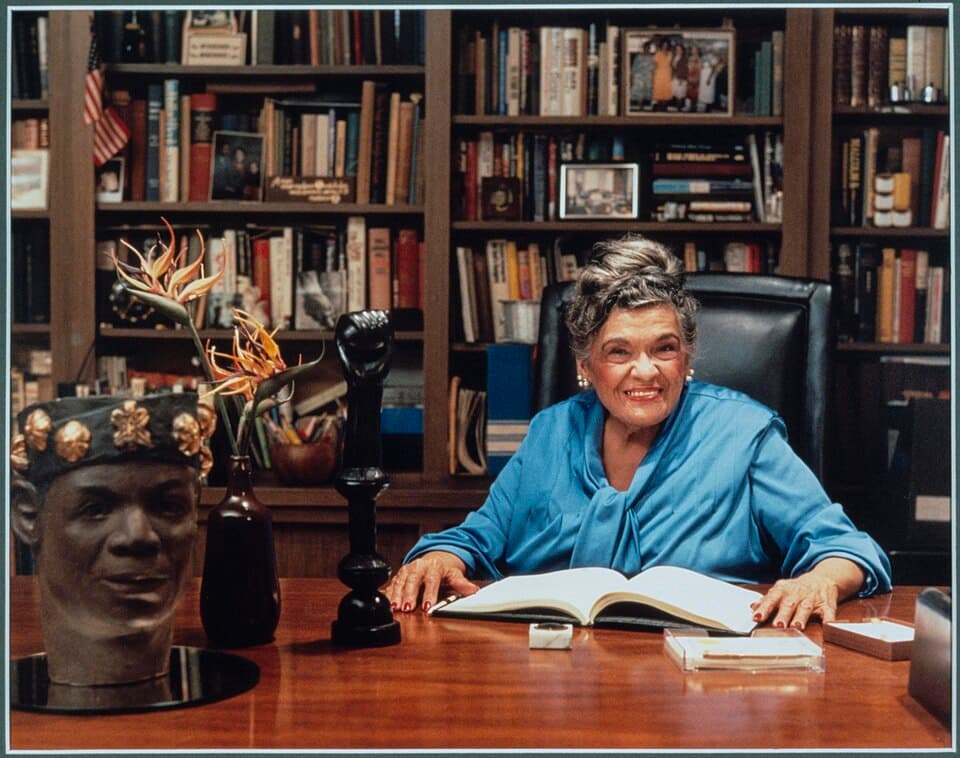
American · Arts · Activism
Zelma Watson George
December 8, 1903 – July 3, 1994
Early life and family background
Zelma Watson George was born on December 8, 1903, in Hearne, Texas, to the Rev. Samuel E. J. Watson and Lena Thomas Watson. She grew up in a family shaped by Baptist religion, education, and Black community leadership. Accounts of her childhood describe a household that welcomed prominent Black figures, including W. E. B. Du Bois and Mary Church Terrell, when they visited her father’s church. Her family later left Texas after threats from vigilantes, an early experience that reflected the racial violence and insecurity faced by Black families in the South.
George’s upbringing helped form the habits that would define her adult life: discipline, intellectual ambition, religious faith, and a commitment to public service. Her father’s death in 1925 also left her with a family responsibility that she carried for years, helping to support and educate younger siblings. That obligation shaped the practical seriousness with which she approached education and work.
She spent part of her youth outside Texas before settling in Chicago, where she pursued higher education and the arts. Her early experiences placed her at the intersection of Black migration, community uplift, and the expanding but still limited opportunities available to Black women in the early twentieth century.
Education and intellectual formation
George attended the University of Chicago, earning a sociology degree in 1924, and later studied voice at the American Conservatory of Music in Chicago. She also pursued additional study in music and public service-oriented fields, eventually completing a master’s degree in personnel administration from New York University in 1943 and a Ph.D. in sociology from New York University in 1954.
Her academic path was unusual even within elite Black educational circles. Sociology gave her a framework for understanding institutions, inequality, and community life, while her musical training prepared her for a career that would combine performance and scholarship. She developed a deep interest in Black musical traditions and later used her research to document and interpret them.
According to Harvard’s Black Women Oral History Project biography, George also became the first Black person to earn a bachelor’s degree from Western Michigan College in 1927, completing the degree in three years. That achievement reflected both her ability and the persistence required to succeed in predominantly white institutions during an era of rigid racial exclusion.
Early career in social work and community administration
Before becoming widely known as an opera singer, George worked in social work and administration. She held posts in Illinois and at Tennessee State University and later moved to Los Angeles, where she founded and directed the Avalon Community Center from 1937 to 1942. That work placed her among the generation of Black women who built social-service institutions in response to segregation, poverty, and uneven public provision.
Her first marriage ended in divorce, after which she obtained a Rockefeller Foundation grant to study African American music. That research became central to her later scholarship and also helped establish her as a serious interpreter of Black cultural history rather than simply a performer. She later moved to Cleveland to examine the John G. White Collection at the Cleveland Public Library, where she met attorney Clayborne George, whom she married in 1944.
In Cleveland she became increasingly active in civic and cultural life. She worked with organizations such as the Girl Scouts, the League of Women Voters, and the NAACP, and she developed a public profile that linked local community work with national cultural leadership.
Breakthrough in opera
George’s most famous artistic breakthrough came in 1949, when she sang the title role in Gian Carlo Menotti’s The Medium in an all-Black production at Karamu Theatre in Cleveland. Menotti later invited her to New York, and she debuted on Broadway in the same opera at the Arena at the Hotel Edison around 1950. She became the first Black woman to sing a leading operatic role on Broadway, a landmark that challenged the racial assumptions of American opera and commercial theater.
The significance of this achievement extended beyond the stage. Opera in the United States had long been racially exclusive, especially in leading roles that were imagined as white and Eurocentric. George’s performance disrupted that expectation by showing that a Black woman could embody a lead role with authority, vocal command, and dramatic seriousness. Her work also highlighted the importance of Black theaters such as Karamu, which created space for artists who were otherwise excluded from mainstream stages.
Her Broadway success made her a symbol of artistic integration, but it also reflected her own determination to use excellence as a form of argument. In a period when Black women performers were often confined to stereotyped roles, George entered one of the most prestigious cultural arenas in the country and changed what audiences could imagine.
Scholarship and musicology
George’s doctoral work centered on Black music, and her dissertation, A Guide to Negro Music, completed in 1954, catalogued thousands of compositions. That research gave her a distinctive place among mid-century Black intellectuals, who increasingly used scholarship to preserve cultural memory and challenge dismissive narratives about Black artistic production.
Her work as a musicologist was important because it treated Black music as a serious subject of historical study rather than as a marginal or folkloric curiosity. By documenting compositions and analyzing the field systematically, she helped create a basis for later scholarship in African American music history. The dissertation also connected her academic life to her performance career: she was not only singing Black and cross-racial roles, but also documenting the cultural traditions from which such performances emerged.
Her scholarship reinforced a pattern visible throughout her life: she moved between practice and interpretation, using each to strengthen the other. That combination made her especially influential in educational and cultural settings.
Diplomatic and international work
George’s public career expanded beyond music in the late 1950s and 1960s. Harvard’s biography states that her diplomatic career was launched in 1959 by a six-month world lecture tour funded by the State Department. In 1960, President Dwight D. Eisenhower appointed her as the only Black member of the U.S. delegation to the Fifteenth United Nations General Assembly, an appointment that reflected both her reputation and the federal government’s interest in projecting a more inclusive image abroad during the Cold War.
Her most memorable U.N. moment came on December 16, 1960, when she applauded a resolution calling for the end of colonialism. The gesture was small in physical scale but large in symbolic meaning. It aligned her with anticolonial movements at a moment when African and Asian nations were pressing for self-determination and when the United States was attempting to manage its global image amid racial segregation at home.
In 1961 she received the United Nations Dag Hammarskjöld Award for peace and international understanding. She also attended a “ban-the-bomb” conference in Ghana in 1963, showing that her internationalism was not limited to formal diplomacy but extended to peace activism and solidarity with newly independent nations.
Later career, honors, and civic leadership
George continued to hold influential positions in civic administration. From 1966 to 1974 she served as director of the Cleveland Job Corps, the oldest Job Corps center in the United States. In that role she worked within a federally sponsored job-training system that aimed to open pathways for young people facing economic and educational barriers.
Her contributions were recognized through a series of honors. She received the Dag Hammarskjöld Award in 1961, the Edwin T. Dahlberg Peace Award in 1969, the Mary McLeod Bethune Gold Medallion in 1973, and an Ohio “Zelma George Day” in 1974. These honors reflected different parts of her public life: peace work, educational leadership, Black women’s history, and civic achievement.
She remained active late in life. Reports from the early 1990s note that she participated in a march against nuclear weapons while riding in a motorized wheelchair, underscoring her continuing commitment to peace activism even in advanced age. That persistence made her a notable elder figure in Black public life.
Personal life
George married Baxter Duke in 1937; that marriage ended in divorce in 1942. In 1944 she married Clayborne George, a Cleveland attorney who encouraged and supported her operatic career. Their marriage linked her to Cleveland’s professional Black middle class and anchored her later civic work in the city.
Her religious life remained important throughout. She was a Baptist and a member of Alpha Kappa Alpha sorority, affiliations that connected her to enduring Black women’s networks of faith, service, and leadership. These relationships reinforced her role as a public woman whose identity was shaped by community institutions as much as by individual accomplishment.
Legacy
Zelma Watson George is remembered as a rare twentieth-century figure whose influence reached across arts, scholarship, civic administration, and international politics. She was a pioneering Black opera singer, a serious music scholar, a community builder, and a diplomat whose U.N. service carried special meaning for African Americans during the civil-rights era.
Her legacy lies partly in her barriers crossed: she became the first Black person to earn a bachelor’s degree from Western Michigan College, the first Black woman to sing a leading operatic role on Broadway, and the only Black member of the U.S. delegation to the 1960 U.N. General Assembly. But her importance also rests in the way she connected those achievements to broader public service. She did not treat accomplishment as personal prestige alone; she used it to widen access, create visibility, and defend ideas of cultural seriousness and racial equality.
In Cleveland especially, George became a symbol of Black achievement and civic leadership. Her life offers an unusually rich example of how Black women in the twentieth century built authority through education, performance, institutional service, and international engagement. She died on July 3, 1994, leaving behind a record of accomplishment that continues to matter in the histories of music, diplomacy, and women’s leadership.
Dated achievements
8 indexed.
- Dec081903Arts
Birth in Hearne, Texas
Zelma Watson George was born in Hearne, Texas, to Samuel E. J. Watson and Lena Thomas Watson.
View details BlackPast Biography - Jun011927Arts
First Black graduate of Western Michigan College
Zelma Watson George was the first Black graduate of Western Michigan College.