← All women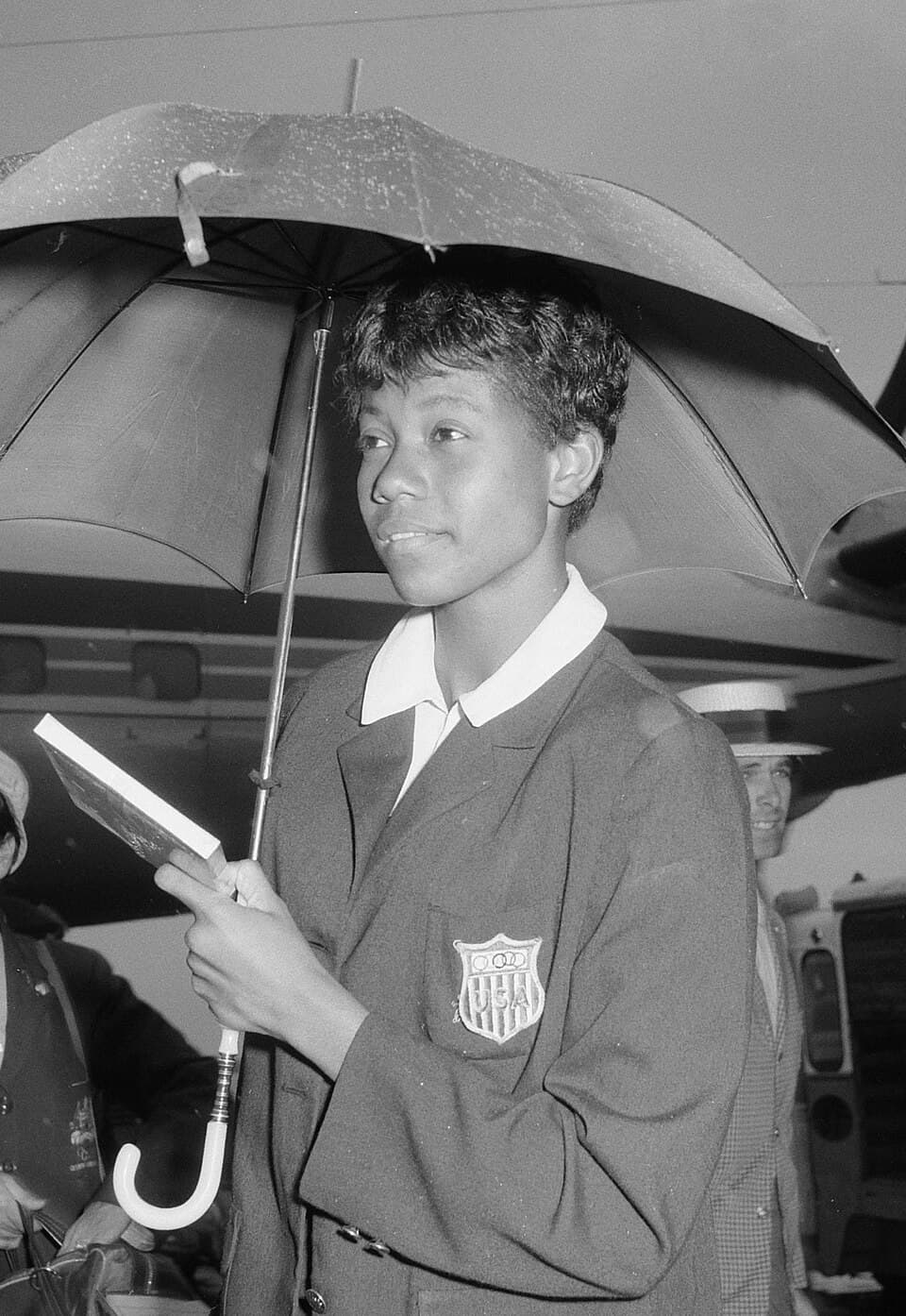
American · Sports
Wilma Rudolph
June 23, 1940 – November 12, 1994
Early Life and Background
Wilma Glodean Rudolph was born on June 23, 1940, in St. Bethlehem, near Clarksville, Tennessee, into a large African American family living under Jim Crow segregation.[2][3][1] She was the twentieth of twenty-two children in a household headed by her father, Ed Rudolph, a railway porter, and her mother, Blanche Rudolph, a maid.[3][6] Born prematurely and weighing only about four and a half pounds, she faced serious health challenges from the beginning.[6]
Rudolph’s childhood was marked by a series of illnesses, including pneumonia, scarlet fever, and, most consequentially, poliomyelitis (polio), which left her left leg weakened and twisted.[2][6][15] Because local hospitals in Clarksville were segregated and either refused Black patients or offered minimal care, her mother took her regularly to Meharry Medical College in Nashville, one of the few institutions serving Black patients.[6] At home, Blanche Rudolph led a rigorous routine of massage and physical therapy, involving Wilma’s siblings as helpers.[1][6]
For several years Rudolph wore leg braces and special shoes, and doctors doubted she would ever walk normally.[4][15] Through family support, determination, and constant practice, she gradually regained strength. By about age twelve she was able to walk and then run without braces, a transformation that became the foundational legend of her athletic biography.[4][15] Her experience with disability and recovery would later shape her empathy for underprivileged children and her belief in the power of opportunity.
Education and Formative Influences
Rudolph attended segregated schools in Clarksville, including Burt High School, where she initially distinguished herself in basketball rather than track.[3][6] Her coach, Clinton Gray, recognized her speed on the court and encouraged her to try sprinting. She soon became a standout in local and state competitions. Despite limited facilities and resources for Black schools, she developed competitive resilience by training on improvised tracks and playing multiple sports.[1][6]
A pivotal figure in Rudolph’s development was Ed Temple, head coach of the women’s track program at Tennessee State University (TSU). In the mid-1950s Temple scouted Black high school athletes across Tennessee and neighboring states. In 1955 he saw Rudolph compete and invited her to join TSU’s summer track training program.[1][6][19] She began traveling regularly to Nashville, training with the TSU Tigerbelles while still in high school, and later earned a scholarship to attend the university.
Temple’s coaching philosophy combined strict discipline with academic emphasis. Under his guidance, Rudolph learned advanced sprint mechanics, race strategy, and the importance of education. The Tigerbelles program, one of the few serious pipelines for Black women in track and field, provided her with competition against national-level athletes and exposure to integrated meets, which contrasted sharply with the segregated environment of her hometown.[4][19]
Career Beginnings and the 1956 Melbourne Olympics
By her mid-teens Rudolph had become a state champion in basketball and track, attracting national attention.[6] In 1956, at age sixteen, she qualified for the U.S. women’s track-and-field team for the Melbourne Olympic Games, becoming its youngest member.[1][3][20] She competed in the 200 m and the 4×100 m relay, racing against seasoned international sprinters.
On November 24, 1956, Rudolph ran in the women’s 4×100 m relay final and helped the U.S. team win the bronze medal.[20][4] This was her first Olympic medal and her introduction to global competition. The experience of traveling abroad, facing international fields, and racing under pressure was formative. It gave her a sense of the possibilities of elite sport and the preparation required to succeed at the highest level.[6]
After Melbourne, Rudolph returned to Tennessee with elevated status as an Olympian. She continued to compete for TSU’s Tigerbelles, refining her technique and building strength. In 1959 she won a gold medal in the 4×100 m relay and a silver in the 100 m at the Pan American Games in Chicago, confirming her rise as a world-class sprinter.[1][9] These achievements set the stage for her historic breakthrough in Rome.
Rome 1960: Breakthrough to Global Icon
Rudolph’s defining moment came at the 1960 Summer Olympics in Rome. By then a TSU student and Tigerbelles star, she had matured into a powerful sprinter with a long, fluid stride and exceptional acceleration. The Rome Games were among the first Olympics to receive extensive international television coverage, magnifying the visibility of her performances.[4]
On September 2, 1960, Rudolph won the women’s 100 m final in 11.0 seconds.[20][2] In the semifinal earlier that day, she had tied the existing world record of 11.3 seconds, underscoring her dominance.[4] European journalists dubbed her "The Black Gazelle," while American media hailed her as the "fastest woman in the world."[4][7]
Three days later, on September 5, 1960, she captured the 200 m title in 24.0 seconds, setting an official world record.[2][4] Her controlled, powerful run demonstrated not only raw speed but efficient technique and race management, reflecting Ed Temple’s training. The double victory in the 100 m and 200 m established her as the leading female sprinter of her era.
On September 9, 1960, Rudolph anchored the U.S. women’s 4×100 m relay team to gold, with the squad setting a world record of 44.5 seconds in the final.[2][20] Taking the baton on the last leg slightly behind, she surged ahead to secure victory, completing her sweep of three gold medals at the Games.
By the end of her track events, widely noted around September 7, 1960 as her triple-gold narrative crystallized, Rudolph was recognized as the first American woman to win three track-and-field gold medals in a single Olympics.[2][10][6] She was also the first American female Olympian to secure three golds in athletics at one Games and the first U.S. woman to win the sprint double and relay gold at the same Olympics.[6][10] Contemporary accounts and later retrospectives further describe her as the first woman, and specifically the first Black woman, to claim three track-and-field gold medals at a single Olympics.[16][19]
These achievements had deep cultural resonance. As a Black woman from a segregated Southern town who had overcome polio, Rudolph’s triumphs challenged entrenched stereotypes about race, gender, and disability. Her success contributed to the broader civil rights narrative by showing Black excellence on a global stage and demonstrating that Black women could be central figures in international sport.[5][13]
Awards, Honors, and Recognition
Following the Rome Olympics, Rudolph received extensive recognition. She was celebrated in parades and banquets in Clarksville, where she insisted that public events in her honor be integrated, a significant stance in a city still governed by segregation.[3][4] Her homecoming parade and banquet became among the first major integrated municipal events in Clarksville, underlining her influence beyond athletics.
Rudolph was widely acclaimed as the "fastest woman in the world" in the early 1960s.[4][7][10] She received numerous awards from sports organizations, civic groups, and media outlets. In later years she was inducted into the National Women’s Hall of Fame, which emphasized her role as the first American woman to win three Olympic gold medals and highlighted her overcoming of polio.[5]
She also became part of the inaugural class of the U.S. Olympic Hall of Fame in 1983, formally recognizing her Rome achievements and her impact on U.S. Olympic history.[19] Various halls of fame and local honors in Tennessee—such as facilities and streets named after her—further embedded her legacy in institutional memory.[5][13]
Rudolph authored an autobiography, Wilma, which recounted her journey from illness and poverty to Olympic glory and later work with youth.[5][18] The book amplified her story for wider audiences and has been used in classrooms to teach about perseverance and civil rights-era history.
Post-Competition Career: Teaching, Coaching, and Public Life
Rudolph retired from amateur athletics in 1962, shortly after the Rome Olympics, and focused on completing her education at Tennessee State University.[1][15] She graduated and began working as a teacher and coach, consistently emphasizing the importance of education for young athletes. She taught and coached track in Tennessee and later in other states, often working with underprivileged children.[4][6]
She founded the Wilma Rudolph Foundation, which was dedicated to training and supporting young athletes, particularly those from disadvantaged backgrounds.[5][6] Through clinics, camps, and community programs, the foundation reflected her belief that sport could be a vehicle for opportunity, discipline, and personal growth.
Rudolph became a sought-after public speaker, appearing at schools, universities, and civic events. On April 27, 1963, she was honored as a special guest at DePauw University’s Little 500 track meet in Greencastle, Indiana, an early example of her engagement with predominantly white academic institutions.[13] A decade later, on October 20, 1973, she returned to DePauw as a keynote figure for the university’s Old Gold celebration, demonstrating her sustained influence as an Olympic champion and role model.[13]
She also worked as a national sports commentator and remained involved in track and field through clinics and mentorship.[15] Her post-competition career emphasized service, especially to youth who, like her younger self, faced limited resources and structural barriers.
Personal Life
Rudolph’s personal life unfolded alongside her public career. She married and had four children, balancing family responsibilities with teaching, coaching, and public speaking.[3] Sources note that she navigated the challenges of maintaining personal privacy while being a visible symbol of Black female success in a period when media attention to women athletes was expanding.
Her experiences with motherhood and community work informed her advocacy for children’s education and health. Having relied on family support to overcome illness and poverty, she sought to replicate that support structure for youth through her foundation and coaching, underscoring the continuity between her private values and public commitments.[5][6]
Legacy and Historical Impact
Wilma Rudolph’s legacy operates at multiple levels: athletic, social, and symbolic. Athletically, she helped transform women’s sprinting into a high-profile, record-rich domain of Olympic competition. Her triple-gold performance in Rome set new standards for excellence and demonstrated that U.S. women could dominate in track and field as decisively as their male counterparts.[2][4][10]
Socially, Rudolph’s story of overcoming polio, poverty, and segregation to become an international star resonated with broader civil rights struggles. Her insistence on integrated celebrations in Clarksville, and her visible presence as a successful Black woman in integrated spaces such as universities and television broadcasts, contributed to the normalization of Black excellence in mainstream American culture.[3][13]
Symbolically, she became an enduring icon of resilience and possibility. Children’s biographies and educational materials, including resources from the National Women’s History Museum and Britannica, consistently present her as a model of determination, discipline, and courage for young readers.[1][15] She is frequently invoked in discussions of disability history because her recovery from polio challenged assumptions about permanent limitations and highlighted the importance of community-based care and rehabilitation.
Her influence extended to subsequent generations of sprinters and track athletes, including prominent Black women who cited her as inspiration. In many historical accounts, Rudolph is positioned as a precursor to later stars of women’s track and field and as a key figure in the broader evolution of women’s sports in the United States.[4][19]
Later Life and Death
In her later years, Rudolph continued to work with youth, focusing on coaching and motivational speaking. She remained closely tied to Tennessee, where institutions and communities honored her achievements. Despite her fame, she maintained a relatively modest lifestyle, emphasizing service over celebrity.[4][5]
In 1994 she was diagnosed with brain cancer.[2][14] On November 12, 1994, she died at her home in Brentwood, Tennessee, at the age of 54.[2][3][15] Her death prompted tributes from sports organizations, civil rights leaders, and media outlets, many of which underscored her dual legacy as an athlete and humanitarian.
Even after her passing, Rudolph’s name continues to appear in halls of fame, museum exhibits, classroom curricula, and media retrospectives. Institutions such as the National Women’s Hall of Fame and the U.S. Olympic & Paralympic Museum highlight her story as central to understanding both women’s sports history and the broader trajectory of Black achievement in the twentieth century.[5][19]
In sum, Wilma Rudolph’s life—from a premature birth in segregated Tennessee through polio, Olympic triumph, and decades of service—offers a powerful narrative of how individual determination, family support, and community investment can overcome structural barriers. Her achievements at the 1960 Rome Olympics remain among the most significant milestones in women’s athletic history, and her legacy endures as a touchstone in the editorial almanac of women’s history.
Dated achievements
13 indexed.
- Jun231940Sports
Birth of Wilma Rudolph
Birth of Wilma Glodean Rudolph in St. Bethlehem near Clarksville, Tennessee, U.S.
View details Encyclopedia Britannica – Wilma Rudolph - Nov241956Sports
First Olympic medal – bronze in 4×100 m relay, Melbourne 1956
At age 16, Rudolph wins Olympic bronze in the 4×100 m relay at the Melbourne 1956 Games.