← All women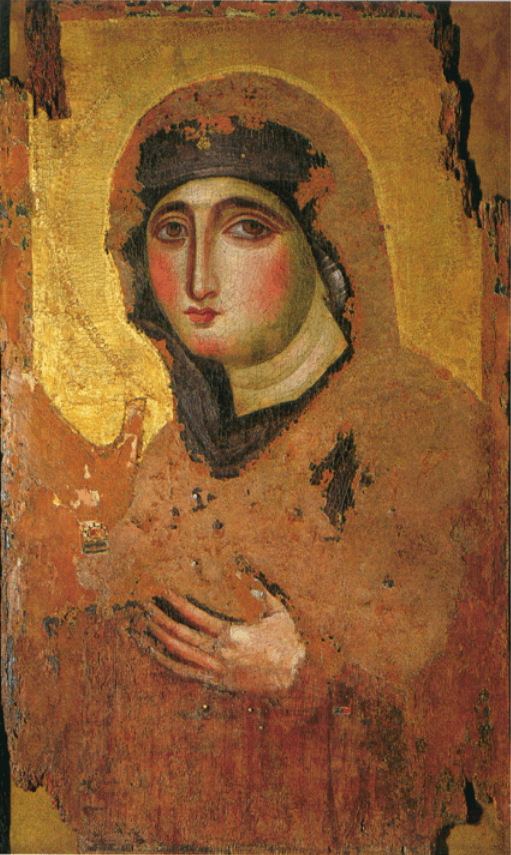
Jewish, Roman · Activism · Science
Virgin Mary
-20 – 40
Overview
Mary, mother of Jesus—often called the Virgin Mary—was a first‑century Jewish woman from Nazareth, remembered as the mother of Jesus of Nazareth and venerated across Christian and, to a significant extent, Islamic traditions.[1][7] The canonical Gospels provide only limited historical detail about her life, but over two millennia she has become the most influential female figure in Christian history, a focus of theology, devotion, art, and culture.[1][7][18] Christian traditions honor her under titles such as Mother of God, Theotokos (God‑bearer), Queen of Heaven, and Mother of the Church, while the Qur’an presents Mary (Maryam) as a uniquely chosen and exemplary woman.[1][7]
Historical reconstruction distinguishes between the sparse data about the woman Mary of Nazareth and the extensive doctrinal and devotional developments surrounding her. Scholars generally situate her life in Roman‑occupied Judea during the early first century CE, within the context of Galilean Jewish village culture.[1][15][18] Later Christian reflection—ranging from the second‑century Protevangelium of James to medieval Marian cults and modern papal teaching—has gradually built a rich, sometimes contested, portrait of her character and significance.[10][8][7]
Early Life and Background
The canonical New Testament gives minimal information about Mary’s birth, childhood, or family background. The Gospels identify her primarily by her relationship to Jesus and to Joseph, describing her as a young woman "of Nazareth" betrothed to Joseph of the house of David.[1][7] Nazareth at that time was a small village in Galilee, characterized by agrarian life, kin‑based social structures, and observance of Jewish law under Roman imperial rule.[15][18] Within such a setting, Mary would likely have participated in household labor, religious observance, and village networks typical of Jewish women of her social class.
Later Christian tradition, represented in sources like the second‑century Protevangelium of James, names her parents as Joachim and Anna and narrates an elaborate story of her miraculous conception, temple upbringing, and dedication to God.[10][16] These accounts, while not considered historical by critical scholarship, illustrate how early Christian communities sought to interpret Mary’s holiness and vocation by extending her biography back into childhood. They also show that, by the second century, Mary herself had become an object of devotion in Eastern Mediterranean Christianity, with imaginative narratives crafted to express her purity and special status.[10]
Modern historical summaries often estimate that Mary lived roughly between c. 20 BCE and 40 CE, based on chronological reconstructions of Jesus’s life and the socio‑political context of early Roman Judea, though her exact birth and death dates are unknown.[18][1] In women’s history, this approximate lifespan marks her as a contemporary of major shifts in Mediterranean religion and empire, even as her own historical voice remains largely unrecorded.
Betrothal, Annunciation, and Motherhood
According to the Gospels of Matthew and Luke, Mary was betrothed to Joseph, a carpenter or craftsman, when she learned that she would bear a son conceived by the Holy Spirit.[1][7] Luke’s narrative of the Annunciation emphasizes her consent—"Let it be to me according to your word"—and portrays her as a model of obedient faith.[1] Matthew focuses on Joseph’s decision to accept Mary and the child after angelic reassurance, indicating the social complexity and potential stigma surrounding her pregnancy in a traditional village environment.[1][5]
Christians believe Mary conceived Jesus miraculously while still a virgin, a claim that has shaped her title "Virgin Mary" and extensive doctrinal debates.[1][5][7] The Gospels place Jesus’s birth during this early first‑century period, likely in the reign of Herod the Great or shortly thereafter, situating Mary as a young Jewish mother navigating the challenges of Roman rule, tax burdens, and occasional political violence.[1][15] While most historical details of Jesus’s childhood remain unknown, Mary is depicted as present at key moments: presenting the child at the Temple, searching for him when he teaches there as a boy, and later accompanying him during his ministry.[1][7]
In Islamic tradition, the Qur’an also narrates Mary’s conception and motherhood, emphasizing her chastity, her reception of divine messages, and the miraculous birth of Jesus (Isa) under God’s command.[1] These texts, though distinct from Christian doctrine, similarly present Mary as a uniquely favored woman whose maternity is central to God’s interaction with humanity.
Mary’s Role in Jesus’s Public Life
The canonical Gospels mention Mary at several points during Jesus’s public ministry. In the Gospel of John, she appears at the wedding at Cana, where her request regarding the lack of wine prompts Jesus’s first recorded miracle, turning water into wine.[3] This episode has been interpreted as the beginning of Mary’s role as intercessor, mediating between human need and divine power.
Synoptic traditions note Mary’s presence among Jesus’s relatives who seek him while he is teaching, as well as her proximity to the group of disciples.[1] Luke describes her as one who "treasured" and pondered words and events in her heart, indicating a contemplative engagement with the unfolding mission of her son.[1] In many Christian readings, Mary thus emerges as both mother and disciple—someone who both gives biological life and receives spiritual teaching.
The Gospels also position Mary at the crucifixion, where John’s account depicts Jesus addressing her and the beloved disciple, entrusting them to one another.[1][7] This scene has been foundational for later interpretations of Mary as mother of all believers, standing at the heart of salvation history as a witness to suffering, death, and the promise of resurrection.
Later Life and Death
After the crucifixion, Mary appears in the Acts of the Apostles among the disciples gathered in Jerusalem, awaiting the coming of the Holy Spirit at Pentecost.[1][7] This suggests that she remained part of the early Jesus movement and the nascent Christian community.
Beyond this, the New Testament is silent about her subsequent life, movements, or death. Various later traditions claim that she lived in Jerusalem (associated with the site of the Dormition) or in Ephesus (connected with the "House of Mary" near the city), but these are not historically verifiable.[7][15] Christian belief in her Assumption—the conviction that she was taken into heavenly glory at the end of her earthly life—is a theological assertion rather than a dated historical event.[7][16]
Critical historians therefore treat statements about Mary’s manner of death or bodily translation as doctrinal developments. Nevertheless, these beliefs have profoundly shaped perceptions of her dignity and destiny, especially in Catholic and Orthodox traditions.[7][8]
Development of Marian Doctrine: Theotokos and Early Councils
Mary’s theological prominence expanded significantly in the centuries after her lifetime. A key turning point came in 431 CE at the Council of Ephesus, where bishops affirmed her title Theotokos ("God‑bearer," often rendered "Mother of God").[8][3] This definition was primarily aimed at clarifying Christ’s identity as one person in whom divine and human natures are united, but it necessarily elevated Mary’s status as the mother of this incarnate Word.
By declaring Mary Theotokos, the council anchored her role at the center of Christological debate and gave formal sanction to growing devotion that saw her as a powerful intercessor and protector.[8][7] In subsequent centuries, especially in Byzantine spirituality, she was revered as guardian of cities like Constantinople and as a compassionate mediator between suffering humanity and Christ.[8]
These developments show how theological reflection on Jesus’s nature inevitably shaped perceptions of Mary. As doctrines of incarnation and salvation were defined, Mary was increasingly understood as a pivotal human participant in God’s plan, setting the stage for later dogmas about her conception and assumption.
Medieval Cult of the Virgin Mary
During the Middle Ages, especially between the 11th and 13th centuries, the cult of the Virgin Mary intensified dramatically in Western Europe.[8][7][18] Mary became one of the most important religious figures, depicted as Queen of Heaven, tender mother, and powerful intercessor. Her image permeated illuminated manuscripts, sculpture, panel painting, and stained glass, while her name appeared in prayers, hymns, and liturgical poetry.
Major pilgrimage shrines dedicated to Mary emerged or grew in prominence, including sites later known as Guadalupe, Loreto, and, in subsequent centuries, Lourdes and Fatima.[7][8] Pilgrims sought healing, protection, and spiritual favors through her intercession, and countless miracle stories associated with her shrines circulated in medieval and early modern Europe.
Mary’s medieval cult also shaped gender ideals. She was presented simultaneously as humble servant and exalted queen, virgin and mother, compassionate helper and stern judge.[8][13] These paradoxes offered complex models of femininity, influencing expectations of women’s piety and behavior while also providing many women with a powerful heavenly patroness.
Immaculate Conception and 19th‑Century Developments
By the 19th century, Marian devotion and theology had become deeply embedded in Catholic life. Long‑standing belief in Mary’s exceptional holiness was crystallized in the dogma of the Immaculate Conception, defined on 8 December 1854 by Pope Pius IX in the bull Ineffabilis Deus.[7][5] This teaching asserts that Mary, from the first instant of her conception, was preserved from original sin by God’s grace in view of Christ’s merits.[7]
The dogma lacked direct historical basis and emerged from theological debate and popular piety rather than empirical evidence, as even non‑Catholic commentators note.[5] Nevertheless, its definition expanded Mary’s theological centrality, presenting her as uniquely graced and as a sign of the redeemed human condition.[7]
The period following 1854 saw new Marian congregations, apparitions (such as Lourdes), and intensified lay devotion. Mary’s image appeared in processions, medals, and domestic altars, and she became a focal point of both conservative and revolutionary religious narratives in Europe and the Americas.[7][3] Her Immaculate Conception became an emblem for discussions about purity, national identity, and the special vocation of women in Catholic cultures.
Assumption and 20th‑Century Papal Teaching
In the 20th century, Marian doctrine was further systematized, culminating in the dogma of the Assumption, defined in 1950.[7][16] The Apostolic Constitution Munificentissimus Deus proclaimed that Mary was taken into heavenly glory with her whole person, a belief long present in liturgy but now elevated to dogmatic status.[7] This teaching, like the Immaculate Conception, concerned a theological judgment rather than a dateable historical occurrence, yet it had immense impact on devotional and doctrinal life.
Papal documents of this era, including encyclicals and apostolic letters, integrated Marian themes into reflections on the Church, humanity, and modernity.[7][9] Pope Paul VI’s proclamation of Mary as "Mother of the Church" during Vatican II and the liturgical reforms of 1969 confirmed her central place in Catholic worship and identity.[7][9]
Pope John Paul II’s writings, such as Redemptoris Mater and Rosarium Virginis Mariae, presented Mary as a model of feminine dignity, faith, and concern for the marginalized.[7][9][16] His introduction of the Luminous Mysteries into the Rosary in 2002 reconfigured a major Marian devotion, inviting believers to meditate more deeply on Christ’s public ministry through Mary’s contemplative gaze.
Personal Life: Marriage, Children, and Kinship
Historically, Mary’s personal life can be reconstructed only in outline. The Gospels present her as wife of Joseph and mother of Jesus, within a wider kinship network that includes relatives described as Jesus’s "brothers" and "sisters."[1][7] Scholarly interpretations of these terms vary: they may refer to siblings, step‑siblings, or cousins, and Christian traditions differ on whether Mary had other children.
Roman Catholic and Orthodox doctrines of Mary’s perpetual virginity maintain that she remained a virgin before, during, and after Jesus’s birth, understanding references to brothers in broader familial terms.[11][13] Many Protestant scholars regard these as ordinary siblings and see Mary as a mother of a larger family.[1][11] The New Testament itself does not offer explicit clarification.
In any case, Mary’s personal life unfolded within the constraints and expectations of first‑century Jewish village society, where marriage, child‑rearing, religious observance, and economic contribution formed the fabric of women’s daily existence.[15][18] Her later portrayal as Queen of Heaven and universal mother reflects theological developments more than direct historical evidence.
Mary in Art, Literature, and Culture
Over two millennia, Mary has inspired a vast corpus of art, music, and literature. Western artists from Giotto and Botticelli to Michelangelo, El Greco, and modern painters have depicted scenes such as the Annunciation, Nativity, Pietà, and Assumption, often using Mary’s figure to explore themes of grace, suffering, and beauty.[7][8] In icons of the Eastern churches, she is frequently shown holding Christ while pointing to him, embodying her role as "Hodegetria"—the one who shows the way.[8]
Poets and composers have honored Mary in hymns like the Ave Maria, the Magnificat, and numerous litanies. Her image also appears in vernacular ballads, miracle stories, and devotional literature that permeated medieval and early modern European culture.[8][9] In modern times, Mary features in novels, films, and visual media that reinterpret her story for contemporary audiences, sometimes in feminist or critical perspectives.[3][9]
Mary has also been associated with national and regional identities. Titles such as Our Lady of Guadalupe or Our Lady of Częstochowa link her to particular peoples and struggles, making her a patroness of liberation movements, cultural resilience, and social justice.[7][3] These diverse images show how a first‑century woman has been continually reimagined to speak to changing historical contexts.
Mary in Theology, Gender, and Feminist Interpretation
The figure of Mary occupies a complex place in discussions of gender and religion. On one hand, her exalted status as Mother of God and Queen of Heaven has given Christianity a powerful female symbol at the heart of its narrative, offering women a revered exemplar and spiritual ally.[9][18] On the other hand, traditional ideals of Marian humility, obedience, and purity have sometimes been used to prescribe restrictive roles for women.
Modern theologians and feminist scholars have revisited Mary’s story, emphasizing her agency in consenting to the divine plan, her endurance amid suffering, and her presence in the early Christian community.[9][16] Some interpret her as a figure of resistance, a poor Jewish woman navigating empire, persecution, and instability.[15] Others highlight how doctrines such as the Immaculate Conception and Assumption affirm the dignity of the female body and the possibility of women’s participation in divine life.
Contemporary scholarship also stresses the need to distinguish theological claims—such as Mary’s freedom from sin or bodily assumption—from historical evidence. It examines how these beliefs emerged, whose interests they served, and how they continue to shape gender norms within religious communities.[5][9] In Islam, Mary’s portrayal as a chaste, devout woman chosen above all other women adds another dimension to her global significance.[1]
Mary Beyond Christianity: Islamic Veneration
Mary is unique among Christian figures in that she also holds a central place in Islamic tradition. The Qur’an dedicates an entire chapter (Sura Maryam) to her story and mentions her by name more often than the New Testament does.[1] She is described as chosen and purified by God, receiving messages from angels, and miraculously giving birth to Jesus by divine command.
Islamic sources emphasize her piety, chastity, and trust in God, presenting her as a model believer rather than as Mother of God in the Christian sense.[1] In many Muslim cultures, Maryam serves as a symbol of modesty and faith, inspiring devotional practices, naming traditions, and artistic representations.
The cross‑religious veneration of Mary underscores her extraordinary position as a woman whose story bridges doctrinal divides and invites shared reflection on themes of motherhood, revelation, and obedience to God.[1][17]
Legacy and Historical Impact
Historically, Mary’s impact far exceeds what can be reconstructed about her concrete life. As National Geographic observes, "no other woman has been as exalted" as Mary in global religious history.[3] She has shaped Christian understandings of incarnation, grace, and the Church, influenced Catholic and Orthodox worship, and become a touchstone for debates about femininity and sanctity.[7][9]
Mary’s legacy includes:
- Her central role in major Christian dogmas (Theotokos, Immaculate Conception, Assumption), which define aspects of Christology and anthropology.[7][8][16]
- Her prominence in liturgical calendars and feast days that structure the devotional year for millions of believers.[7]
- Her presence in art, music, and literature as the most depicted and sung female figure in Christian culture.[8][9][18]
- Her function as a symbol of maternal compassion, suffering, and hope for the marginalized and oppressed.[3][12]
- Her importance in Islamic piety and interreligious dialogue, highlighting shared narratives across faiths.[1][17]
In women’s history, Mary represents both a challenge and an opportunity: she is a woman whose historical voice is nearly silent yet whose image has profoundly affected women’s lives, spiritualities, and social roles. Scholars continue to explore how the "historical Mary"—a Jewish woman of Nazareth—relates to the Mary of doctrine and devotion, and how recovering her context can enrich understanding of early Christianity and gender.[2][15]
Modern Critical Perspectives and Ongoing Study
Modern historians and theologians approach Mary with critical tools, distinguishing between text, tradition, and later interpretation. They note that many statements about her, such as being conceived without sin or assumed body and soul into heaven, are theological claims rather than empirically verifiable historical events.[5][8] At the same time, they acknowledge her influence on religious practice, cultural imagination, and social structures.
Recent scholarship, including work summarized by National Geographic, argues for viewing Mary as a real Jewish woman navigating Roman violence, poverty, and political instability, whose faith and resilience contributed materially to the emergence of the Jesus movement.[15] Some researchers suggest that Mary may have had a more formative role in early Christianity than the New Testament explicitly records, though such theses remain debated.[15][2]
Libraries, academic guides, and research collections continue to catalogue biographies and studies of Mary, reflecting the breadth of interest in her as a historical, theological, and cultural figure.[7][16] As interpretations evolve, Mary remains a focal point for discussions about women, sanctity, embodiment, and divine–human relations in both scholarly and devotional contexts.
Conclusion: Mary in Women’s History
In a critical historical sense, Mary of Nazareth was a first‑century Jewish woman whose exact dates and daily experiences are largely unrecoverable. Yet her remembered identity as mother of Jesus has made her, according to many commentators, the most influential woman in Christian history and one of the most significant female figures globally.[7][3][18] Across centuries, she has been venerated, contested, reinterpreted, and loved as virgin, mother, disciple, queen, and intercessor.
For women’s history, Mary’s story illustrates how a woman can become central to religious imagination and institutional life even when direct records of her voice are absent. Her evolving image reflects changing attitudes toward women, bodies, and holiness, and her ongoing study invites careful distinction between the historical realities of a Galilean mother and the theological edifice built around her.
Dated achievements
6 indexed.
- Dec081854Activism
Dogma of the Immaculate Conception of Mary defined
Pope Pius IX defined the dogma of the Immaculate Conception.
View details Mary, Mother of Jesus - Britannica - Nov011950Activism
Dogma of the Assumption of Mary defined
Pope Pius XII declared the Assumption of Mary as dogma.
View details