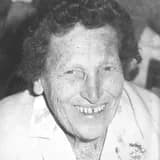
Produced key evidence that the scrapie infectious agent lacks nucleic acid, an early foundation for prion theory.
In the 1960s and 1970s, Tikvah Alper produced experimental evidence that the infectious agent in scrapie did not contain nucleic acid. This was one of the earliest lines of evidence pointing toward what later became known as prion theory, and it stands as her most historically influential scientific contribution.
The importance of this work lies in the fact that it challenged the dominant assumption that all infectious agents must rely on nucleic acid for replication. Alper’s experiments helped open the possibility that a transmissible disease could be caused by a protein-based agent, an idea that was initially controversial. Her findings later gained renewed relevance in the era of bovine spongiform encephalopathy, or “mad cow disease,” and in related human and animal neurodegenerative conditions.
As a woman scientist working in a field that was still heavily shaped by male authority and entrenched theory, Alper had to establish credibility through careful experiment and persistence. Her research did not end the debate on its own, but it provided a crucial foundation for later scientists developing prion theory. In the history of biology and medicine, this was a barrier-breaking contribution because it helped reshape understanding of infectious disease itself.