← All women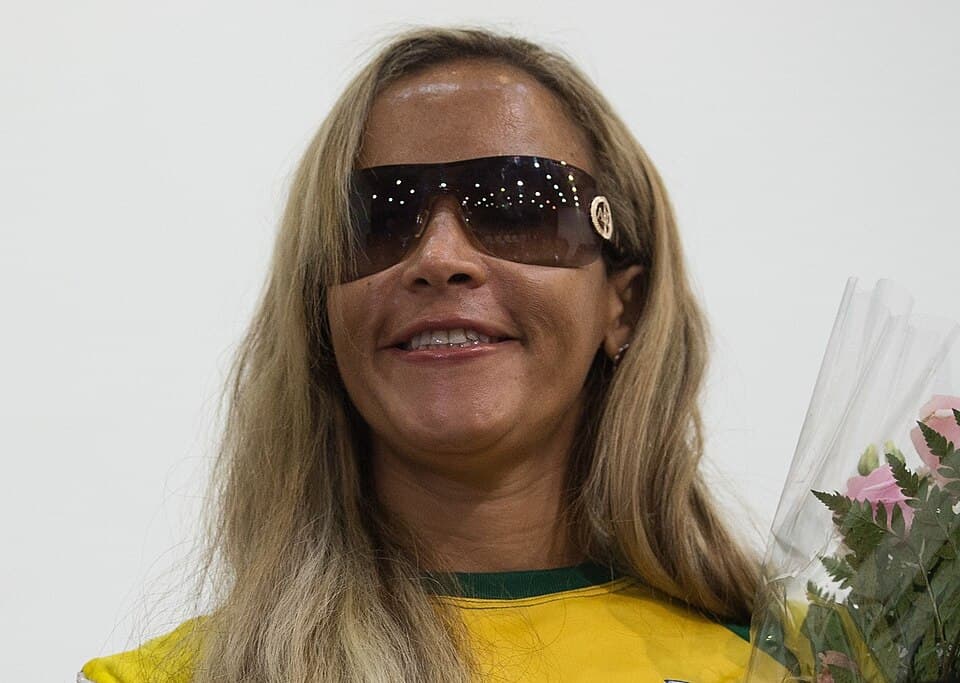
Brazilian · Sports · Activism
Terezinha Guilhermina
October 3, 1978 – present
Early life and background
Terezinha Aparecida Guilhermina was born on 3 October 1978
Guilhermina was born with retinitis pigmentosa, a congenital degenerative eye disease that causes progressive loss of vision.[1][4][5][6][14] She initially retained some sight, but her vision deteriorated through adolescence until she became totally blind, placing her in the T11 classification for Paralympic athletes, reserved for those with no functional vision.[5][10][18] According to Brazilian cultural agency Fundação Palmares, she was born in a cart, lost her mother at the age of nine, and was abandoned by her father soon afterward, circumstances that sharpened both her economic vulnerability and her determination to seek autonomy.[6] Despite these hardships, she completed basic schooling and pursued vocational education. A profile from MS Notícias notes that before becoming a professional athlete she studied and completed a course in administration techniques; later, she undertook university studies in psychology.[8][9] These educational paths are frequently highlighted in Brazilian media to underscore that her story encompasses both academic and sporting achievement, and that she has used psychological training in her motivational speaking and mentoring of young athletes.[9][13] Growing up as a poor, Black, disabled girl in Minas Gerais, Guilhermina faced layered barriers in access to sport and education. She discovered her diagnosis of retinitis pigmentosa only in her mid‑teens, around sixteen, which reshaped her understanding of her own body and future.[9] Her family’s experience—with multiple siblings sharing visual impairment and some later becoming athletes—provided a collective framework through which she interpreted disability not solely as individual tragedy but as a shared condition that could also generate solidarity and new forms of achievement.[7][11][18] Guilhermina’s path into sport was neither linear nor guaranteed. According to Rede do Esporte, when she first attempted to enter athletics she did not have a pair of running shoes, and for a period she switched to swimming because pool training required less equipment.[4] Only later, with support from local programs and coaches, was she able to transition back to track and field, where she found her true specialty in sprinting. Her international debut came at the 2002 IPC Athletics World Championships in Lille, France, an event where she first encountered the full scale of global Paralympic competition.[12] Although specific race results from Lille are less frequently cited, this appearance marked the beginning of her presence on the world stage and introduced her to athletes, coaches, and organizational structures that would shape her career. In 2005, she made a major breakthrough at the IBSA Parapan American Games in São Paulo, where she reportedly won gold medals in the 100m, 200m, 400m, and 4x400m events, sweeping the sprint program.[11][13] Her success at this regional championship established her as a leading para‑athlete in the Americas and drew attention from national selectors. By 2004, she had already stepped onto the most prominent stage, making her Paralympic debut at the Athens Games. There she competed in the women’s 400m T12, the classification for athletes with severe visual impairment but some residual vision, and won a bronze medal, her first Paralympic podium.[4][12] This result was a turning point: it confirmed that she could compete with and defeat many of the world’s best, and it secured her position within Brazil’s Paralympic program. Following Athens, Guilhermina continued to refine her technique and reclassified into T11 as her visual impairment progressed to complete blindness.[5][10][18] In this class, athletes must run with blindfolds and compete with sighted guides tethered to them by a short cord. She formed a lasting and highly successful partnership with guide runner Guilherme Soares de Santana, whose synchronization with her stride was crucial to her later world records and titles.[7][8][13] Her growing prominence led to national recognition. In 2006, the Brazilian Olympic Committee (COB) named her Paralympic Athlete of the Year, honoring her results and leadership.[7][13] Around 2007, reports indicate that she set a world record in the 100m for her class, signaling her imminent rise to global dominance in blind sprinting.[3][7] Guilhermina’s competition record spans four Paralympic Games—Athens 2004, Beijing 2008, London 2012, and Rio 2016—and multiple World Championships, making her one of Brazil’s most decorated Paralympians.[4][10][12] Her major accomplishments reflect both individual and team successes. At Athens 2004, she competed in the women’s 400m T12 and won bronze.[4][12] This first Paralympic medal signaled Brazil’s emerging strength in women’s visually impaired sprinting and established her as a serious contender on the world stage. At the Beijing 2008 Paralympics, now competing in the T11 class for totally blind athletes, Guilhermina produced a remarkable set of performances. She won gold in the 200m T11, silver in the 100m T11, and bronze in the 400m T11, leaving Beijing with a complete set of sprint medals.[4][14] These results confirmed her as a dominant figure in blind sprinting and demonstrated her range across all three core sprint distances. Guilhermina’s success extended beyond Paralympic competition. At the 2011 IPC Athletics World Championships in Christchurch, New Zealand, she had one of the most dominant campaigns of her career. She won gold in the 100m, 200m, and 400m T11, and anchored Brazil to gold in the women’s 4x100m T11–13 relay.[1][12] This sweep of sprint distances and relay underscored her status as the preeminent blind sprinter of her era. The London 2012 Paralympic Games represent the pinnacle of Guilhermina’s athletic achievements. On 3 September 2012, she won gold in the women’s 100m T11 and set a world record of 12.01 seconds, a performance widely described in Brazilian media as "recorde histórico".[4][7] Running with guide Guilherme Santana, she became the fastest blind woman in the world, a title later echoed by official profiles and sponsors.[3][6][9][18] Two days later, on 5 September 2012, she won gold in the 200m T11, clocking 24.82 seconds and breaking her own previous mark.[4][8][18] These victories gave her a Paralympic sprint double in the premier events for totally blind athletes and significantly raised her international profile. On 8 September 2012, she competed in the 400m T12
At the IPC Athletics World Championships in Lyon in 2013, Guilhermina continued her dominance. She won three gold medals and set championship records in the 200m and 400m for her classification.[18] These performances demonstrated that her London achievements were not isolated peaks, but part of sustained excellence across multiple seasons. In the same period, she entered the Guinness World Records 2013/2014 edition, which listed her as the fastest totally blind female athlete, based on her 12.01s in the 100m T11.[7][11][18] Brazilian profiles and event organizers frequently refer to this Guinness recognition when describing her as "a atleta cega mais rápida do mundo".[6][9][18] The listing extended her visibility beyond sports audiences and into popular culture worldwide. By 2015, Guilhermina’s performances were recorded in mainstream athletics databases. World Athletics lists personal bests of 12.11 seconds in the 100m and 58.15 seconds in the 400m, times that reflect her continued speed late in her elite career.[15] These metrics sit alongside her world record performances and contribute to the statistical record of Paralympic sprinting. At the Rio 2016 Paralympic Games, competing on home soil, she added to her medal collection. She won silver in the women’s 4x100m T11–13 relay and bronze in the 400m, bringing her total Paralympic medals to eight: three gold, two silver, and three bronze.[4][10] Brazilian institutional profiles highlight this tally, noting that she is among the country’s most decorated Paralympians.[10][18] Across her career, Guilhermina has also accumulated numerous medals at World Championships and Parapan American Games. The Brazilian Paralympic Committee reports that she has won at least twelve medals at World Championships (including eight golds and four silvers) and nine at Parapan American Games (eight golds and one silver).[10] Other speaking agency profiles cite even higher totals, reflecting ongoing competition beyond the major events usually covered in international media.[18] Beyond her medals, Terezinha Guilhermina has received significant recognition from sporting and cultural institutions. In 2006, the Brazilian Olympic Committee named her Paralympic Athlete of the Year, acknowledging her results and her role in elevating Paralympic sport’s profile in Brazil.[7][13] This award placed her alongside leading Olympic athletes in national prestige. Her Guinness World Records listing as the fastest totally blind female athlete in the 2013/2014 edition is one of her most widely cited honors.[7][11][18] This recognition has been reiterated by sponsors such as Visa and by Brazilian media outlets that present her as "tricampeã paralímpica" and "recordista mundial" in the main sprint events.[3][6][18] Public agencies have also celebrated her story. Fundação Cultural Palmares, an institution linked to Brazil’s Ministry of Culture that promotes Afro‑Brazilian heritage, published a profile titled "Terezinha Guilhermina, a atleta cega mais rápida do mundo," emphasizing her trajectory from poverty and abandonment to global success.[6] This framing situates her within larger narratives about Black women’s achievements in Brazilian history. Her achievements have entered educational materials. The Brazilian ENEM (national high school exam) included questions referencing her as one of the most decorated Paralympic athletes in Brazilian history, thereby introducing her story to millions of students.[9] This presence in exam content underscores the cultural significance of her career beyond sport. Guilhermina’s personal life is closely intertwined with her athletic career and advocacy work. She has openly discussed her experiences of poverty, disability, and race in interviews and motivational talks.[3][6][9][11] Although detailed information about marital status and children is less prominent in public sources, her identity as a sister within a large family of twelve siblings—and as one of five visually impaired siblings—is central to how she narrates her journey.[5][7][11] She pursued psychology studies at university after establishing herself as an elite athlete, a choice that has informed her approach to motivation, resilience, and the mental aspects of performance.[8][9] Brazilian profiles highlight that she combines academic knowledge with lived experience when speaking to youth, corporate audiences, and sports programs. Guilhermina is an active motivational speaker. Agencies such as "Contratar Palestrante" and "Lantana Produções" present her as a reference in Paralympic athletics and emphasize themes of courage, optimism, and self‑confidence in her presentations.[13][18] Her talks often include practical demonstrations of running with blindfolds to give sighted participants a sense of the coordination required in T11 sprinting.[18] She also participates in campaigns against capacitismo (ableism), using her story to challenge discriminatory attitudes toward people with disabilities.[19] In video interviews and public events, she frames her achievements not only as individual triumphs but as evidence that society must remove structural barriers and expand accessibility. Terezinha Guilhermina’s legacy is multifaceted, encompassing her sporting records, her representation of disabled Black women, and her influence on public discourse about disability and gender in Brazil. As an athlete, she is recognized as one of the greatest sprinters in Paralympic history. The Brazilian Paralympic Committee credits her with eight Paralympic medals, numerous World Championship titles, and multiple Parapan American golds.[10] Her 12.01s world record in the 100m T11, combined with championship records and sustained medal‑winning performances, has set benchmarks for future generations of blind sprinters.[4][7][18] Her Guinness World Records listing as the fastest totally blind female athlete has had particular symbolic power. It inserted a blind, Black, poor woman from Minas Gerais into a global register of human extremes, challenging narrow conceptions of who can be the "fastest" or "best" in any domain.[7][11][18] This visibility has contributed to greater public recognition of Paralympic sport as high‑performance competition rather than solely inspirational spectacle. For women’s history, Guilhermina’s career exemplifies how disabled women can become central figures in national sporting narratives. She is frequently cited as the "maior medalhista paralímpica da história do Brasil" or among the country’s most decorated Paralympians.[8][10] Her story intersects with issues of race, class, and disability, making her a key figure in discussions of intersectionality in Brazilian sport. In disability rights and activism, her visibility and speaking engagements have helped bring concepts such as ableism into mainstream conversation. By demonstrating the technical complexity and physical intensity of T11 sprinting, she challenges assumptions that disabled athletes compete at a fundamentally different level from their Olympic counterparts.[16][19] Her narrative is used in media and educational contexts to advocate for accessible infrastructure, inclusive education, and broader support for disabled children. Her influence also extends to family and community dynamics. The fact that multiple siblings share visual impairment and that some have become athletes along with her underscores a collective dimension to her achievements. She often speaks of her family’s role in supporting her career, and of the importance of community networks in enabling disabled people to navigate environments that are often inaccessible.[7][11] As of the mid‑2020s, available sources continue to describe Terezinha Guilhermina as a living athlete and public figure.[1][5][10][18] While she no longer competes at the same frequency or intensity as during her peak years, she remains involved in Paralympic sport through mentoring, public speaking, and occasional events that showcase blind running. Corporate and educational speaking agencies list her as an active lecturer and workshop leader, emphasizing her status as a Paralympic champion and Guinness record holder.[13][18] She participates in programs such as "Sesc Verão" and television series like "Vida de Atleta," where she recounts her journey and reflects on psychological and social aspects of high‑level sport.[11][17] Media pieces on topics such as "combate ao capacitismo" continue to feature her story, indicating an ongoing role in activism and awareness‑raising around disability.[19] Her legacy therefore is not fixed in the past but is actively maintained through dialogue with new generations of athletes, students, and activists. While future developments in her life and career will add new dimensions to her biography, the existing record already secures Terezinha Guilhermina an enduring place in the history of women’s sport and disability rights—both in Brazil and internationally.Career beginnings and development
Major accomplishments and competition history
Athens 2004
Beijing 2008
Christchurch 2011 World Championships
London 2012 Paralympic Games
Lyon 2013 World Championships and Guinness recognition
Later career and Rio 2016 Paralympics
Awards, honors, and recognition
Personal life and off‑track activities
Legacy and historical impact
Later life and ongoing activities
Dated achievements
18 indexed.
- Oct031978Sports
Birth of Terezinha Guilhermina
Terezinha Aparecida Guilhermina is born in Betim, Brazil.
View details Terezinha Guilhermina Wikipedia - Sep212004Sports
First Paralympic medal in Athens 2004
Wins bronze in 400m T12 at Athens 2004, her first Paralympic medal.
View details