← All women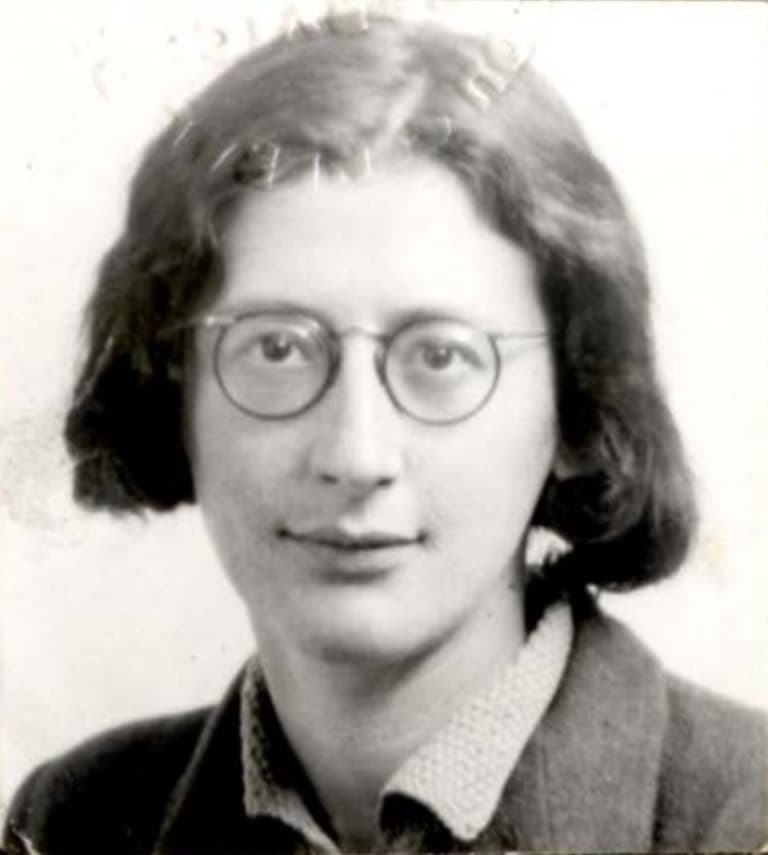
French · Activism · Literature
Simone Weil
February 3, 1909 – August 24, 1943
Early Life and Background
Simone Adolphine Weil (1909–1943) was a French philosopher, mystic, and political activist whose brief life and posthumously published writings have exerted lasting influence on 20th‑century thought.[1][3] She was born on 3 February 1909 in Paris, France, the second child of Bernard Weil, a physician, and Salomea (Selma) Reinherz WeilAndré Weil, would become an eminent mathematician, later a founding figure of the Bourbaki group.[1]
The Weil household was intellectually rich and socially comfortable. Simone learned to read early, showed a precocious mastery of languages, and absorbed the classics of French and Greek literature.[7][16] As a child she was sickly and sensitive, prone to migraines, yet fiercely determined. Several accounts describe an incident in which, during World War I, she refused sugar because soldiers at the front lacked it—a gesture that prefigures the ascetic solidarity she would practice throughout her life.[12][16]
Weil attended elite Parisian schools, including Lycée Victor‑Duruy and later Lycée Henri‑IV, where she studied philosophy under prominent teachers.[16] She excelled in philosophy and the humanities, earning a baccalauréat in 1925 and displaying an intense concern for justice and the suffering of workers.[16] During her secondary‑school years she reportedly helped lead a student strike to protest cuts in philosophy teaching hours, an early sign of her willingness to confront institutional authority in defense of intellectual and moral values.[16]
Education and Intellectual Formation
In the late 1920s, French higher education was slowly opening to women. The prestigious École Normale Supérieure (ENS), long a bastion of male training for university and lyceé posts, had only recently begun admitting women.[2] In 1928, Simone Weil sat the highly competitive entrance examination for ENS and ranked first, with Simone de Beauvoir second.[2][9] This remarkable achievement placed her among the leading young intellectuals of her generation and gave her access to the institution that shaped much of France’s philosophical elite.
At ENS, Weil studied philosophy and mathematics, immersing herself in the history of ideas from ancient Greece through modern Europe.[2][14] She was influenced by Plato, the Stoics, and by contemporary thinkers such as Alain (Émile Chartier), whose emphasis on attention and moral seriousness resonated deeply with her.[2] However, she remained independent and critical, developing her own views on the nature of necessity, grace, and affliction.
In 1930, she passed the agrégation in philosophy, the competitive examination required to teach at the secondary level.[16] Her success in this rigorous exam confirmed her status as one of the foremost young women philosophers in France. She did not pursue a traditional academic career in universities, choosing instead to enter the lycée system, where she could earn a living while staying close to ordinary students and the social realities she felt philosophy should address.[14][16]
Career Beginnings: Teaching and Early Activism
Weil’s primary profession was teaching. In the early 1930s she held short‑term posts in various lycées. In October 1931, she took up her first full‑time appointment as a philosophy teacher at a girls’ lycée in Le Puy, a provincial town in central France.[16] There she taught adolescent girls, encouraging them to think critically about ethics, politics, and the meaning of work and justice.
Weil’s teaching was intertwined with activism. She supported trade‑union causes and showed sympathy for revolutionary socialism, though she never joined a political party.[14] Her concern for workers’ conditions led her to participate in local political discussions and labor meetings. During the early 1930s she also taught at a lycée in Auxerre, continuing to publish articles on labor, Marxism, and the rise of fascism.[16]
Weil’s early writings analyzed the failures of existing political movements to address the moral dimensions of oppression. She was critical of both capitalist exploitation and the authoritarian tendencies she perceived in communist organizations.[2][10] Her distinctive contribution was to insist that questions of power, force, and hierarchy must be understood not only economically but also spiritually—as matters of human attention, dignity, and the capacity to consent.
Immersion in Labor: Factory and Farm Work
Weil believed that authentic understanding of social injustice required direct personal experience. In December 1934, she undertook one of the most radical experiments in modern philosophy by leaving her secure teaching job to work incognito as an unskilled laborer at the Alsthom and Renault factories in Paris.[2][10] For several months she performed monotonous, physically demanding tasks, suffered accidents and exhaustion, and lived on a worker’s wages.
This immersion profoundly shaped her analysis of industrial society. She observed how factory organization fragmented attention, reduced workers to instruments, and imposed a regime of time and necessity that crushed meaning and freedom.[2] Her notebooks and essays from this period—later collected in Oppression and Liberty—explored themes of mechanization, bureaucracy, and the depersonalizing effects of large‑scale production.[10] She argued that modern oppression was rooted not simply in ownership of the means of production, but in the impersonal application of force within hierarchical organizations.
After the factory experience, Weil’s health deteriorated, and she returned to teaching at a lycée in Roanne in 1935, continuing to write about workers’ suffering and the moral failings of political ideologies.[16] In 1941, during wartime displacement, she also worked on farms near Marseille, again seeking to understand manual labor and rural poverty from within.[14][16] These experiences reinforced her conviction that philosophical reflection had to be grounded in lived solidarity with the marginalized.
Spanish Civil War and Political Disillusionment
The rise of fascism in Europe sharpened Weil’s political engagement. When the Spanish Civil War broke out in 1936, she resolved to support the Republican cause against General Franco. In August 1936, despite being a pacifist and physically fragile, she traveled to Spain and joined an anarchist militia on the Aragon front.[2][16]
Weil’s time in Spain was short. Unsuitable for combat and untrained in weaponry, she experienced confusion and danger in the trenches. She suffered a severe accident when she stepped into a pot of boiling oil, badly burning her leg.[16] This injury forced her evacuation and return to France. Yet the encounter with war left a deep mark. She witnessed cruelty, disorder, and the erosion of ideals under the pressure of violence.
Following Spain, Weil grew increasingly skeptical of all political movements, including those she had earlier supported. She criticized the way parties and ideologies demand total allegiance, treating individuals as means rather than ends. Her famous essay on the Iliad as a "poem of force" analyzed how war transforms human beings into things, influenced by what she had seen in Spain.[2] This disillusionment paved the way for her later call for the abolition of political parties, which she viewed as mechanisms of collective suggestion undermining truth and justice.[2]
Turn to Mysticism: The Solesmes Experience and Religious Thought
While deeply engaged in social and political questions, Weil also pursued what she called the "search for God." Her spiritual trajectory was gradual and complex. In 1937, she met the Dominican priest Father Joseph‑Marie Perrin, who became an important interlocutor, introducing her to Catholic theology.[16] Yet she remained outside the formal life of the Church.
A decisive moment came in May 1938, during a visit to the Benedictine abbey of Solesmes in western France. Attending the liturgy, Weil was deeply moved by Gregorian chant and the beauty of worship.[2][10] She later wrote that while reciting the poem "Love (III)" by the 17th‑century Anglican poet George Herbert during a church service, she had a powerful experience of Christ’s presence and felt herself "forced" to kneel in prayer.[2]
This mystical encounter did not lead her to baptism, partly because she felt compelled to remain in solidarity with non‑Christians and those excluded from the Church. Instead, it inaugurated a form of Christian‑inspired mysticism marked by themes of decreation—voluntary emptying of the self—attention, and the redemptive acceptance of affliction.[2][10] She wrote of God as a divine absence that makes room for human freedom, and of "metaxu"—mediating realities such as beauty or friendship that bridge the gap between God and the world.[1]
Weil’s religious thought was eclectic, drawing on Greek tragedy, Plato, the Gospels, and Hindu and Buddhist texts. She remained critical of institutional Catholicism’s historical compromises and insisted that authentic Christianity required radical compassion for sufferers and outsiders.[2][10] These reflections, initially scattered in notebooks, later appeared in English and French collections such as Gravity and Grace, profoundly influencing theologians, philosophers, and writers.
Exile, Resistance, and Major Works
World War II uprooted Weil’s life. When Germany invaded France in 1940, she and her parents fled Paris, eventually reaching Marseille in the unoccupied zone.[14] There she worked on local farms and contributed essays to the underground resistance press, addressing questions of labor, education, and the moral collapse produced by occupation.[14][16]
Weil sought ways to participate more directly in resistance activities but was constrained by health and circumstances. In 1942, with the situation deteriorating, she and her parents left France via Casablanca for the United States. On 7 June 1942, she arrived in New York City as a refugee.[14] Although the United States offered safety and potential academic opportunities, Weil declined long‑term settlement. She believed her vocation lay in contributing to the spiritual and social renewal of France.
In November 1942, she departed New York for London, joining the Free French authorities under General Charles de Gaulle.[2][14] In London she worked for the Commissariat de l’Intérieur, drafting memoranda on post‑war reconstruction. Her writings from this period addressed topics including:
- the need to root individuals in meaningful communities and traditions, later developed in The Need for Roots (published posthumously in 1949);[10][14]
- the moral primacy of obligations over rights, arguing that rights become empty without the recognition of obligations toward others;[2]
- proposals for reforming education and labor to avoid reproducing the structures of oppression she had studied in factories;[10]
- the abolition of political parties, which she claimed distort attention and truth.[2]
During this time she wrote in French under her own name and sometimes under the pseudonym Émile Novis, addressing both philosophical and practical questions.[16] Her memoranda were not fully adopted by Free French officials, who often found her proposals impractical or too radical. Nevertheless, they laid the groundwork for the influential texts edited from her papers after her death.
Major Works and Intellectual Contributions
Weil did not publish a systematic philosophy book during her lifetime; most of her writings were essays, notes, letters, and internal memoranda. Key collections were assembled posthumously, including:
- La Pesanteur et la grâce (Gravity and Grace), a selection of spiritual and philosophical aphorisms arranged by Gustave Thibon, presenting her reflections on decreation, attention, suffering, and divine absence.[1][10]
- Oppression et liberté (Oppression and Liberty), which gathers her social and political essays on factory work, Marxism, war, and the nature of modern oppression.[10]
- L’Enracinement (The Need for Roots), based on her London memoranda, offering a wide‑ranging critique of uprootedness and proposing a charter of obligations for post‑war society.[10][14]
Among her notable ideas are:
- Decreation: the voluntary surrender of self‑centeredness, allowing attention to be directed wholly toward God and others.[1][2]
- Uprootedness: the condition of individuals and communities severed from meaningful traditions and places, which she saw as a central pathology of modern society.[1][10]
- Patriotism of compassion: a form of love for country grounded in compassion and justice rather than nationalist pride.[1]
- Critical analysis of affliction (malheur) as suffering that destroys a person’s sense of self and meaning, requiring special forms of attention and solidarity.[2]
- The concept of metaxu, mediating structures that both separate and connect the human and the divine.[1]
Her work straddles philosophy, theology, political theory, and literature. She wrote essays on ancient Greek texts, particularly Homer and Sophocles, interpreting them as explorations of force and justice. She also engaged with mathematics and formal reasoning, influenced by her brother André and by her own early studies.[1][14]
Awards, Honors, and Recognition
During her lifetime, Weil did not receive major public honors or academic chairs. Her radical positions, social marginality, and early death limited institutional recognition. She held respected teaching posts, passed elite examinations, and was valued by some contemporaries, but remained largely an outsider.[2][14]
Posthumously, her reputation grew steadily. Her writings, edited by figures such as Gustave Thibon and published in French and English, attracted philosophers, theologians, and writers across ideological lines.[1][10] Though she did not receive formal awards, she has been the subject of extensive scholarly commentary, biographies, and conferences. Some within the Catholic Church have considered her a candidate for sainthood, despite her refusal of baptism, and she is frequently invoked as a modern spiritual exemplar.[11]
University courses, research centers, and societies now study her work worldwide. She appears in reference works such as the Stanford Encyclopedia of Philosophy, Britannica, multiple national encyclopedias, and specialized directories of women philosophers, attesting to her recognized place in the canon of 20th‑century thought.[2][3][14]
Personal Life and Relationships
Weil’s personal life was marked by austerity and independence. She never married and had no children.[16] Her relationships were primarily intellectual and spiritual, involving teachers, colleagues, and religious interlocutors. She maintained a close bond with her family, especially her parents and her brother André, though her radical choices often worried them.[16]
Father Joseph‑Marie Perrin was a key spiritual advisor, as were other clergy and lay friends. Weil’s correspondence reveals deep friendships with those who shared her concerns about justice and faith, but she resisted emotional ties that might compromise her vocation of universal attention.[2][10]
Her lifestyle was consistently ascetic. She limited her material possessions, practiced dietary restraint, and refused comforts she believed were denied to others, especially during war.[12][16] This radical ethical consistency inspired some and disturbed others, raising questions about the line between exemplary solidarity and self‑harm.
Later Life, Illness, and Death
Weil’s health, fragile since childhood, worsened in exile. In London she adopted a severe rationing of food to match what she believed her compatriots in occupied France were receiving. Combined with tuberculosis and prior physical strains, this led to drastic weight loss and exhaustion.[16]
In April 1943, she was admitted to the Grosvenor Sanatorium in Ashford, Kent, for treatment of tuberculosis and malnutrition.[16][10] Even in the sanatorium, she maintained her ascetic outlook, continuing to reflect on affliction and responsibility. Medical staff struggled to secure her cooperation with diets necessary for recovery.
On 24 August 1943, Weil died of heart failure, with tuberculosis and self‑imposed malnutrition recognized as contributing factors.[1][3][16] A coroner’s report described her death as suicide, but interpretations differ: some see martyrdom, others a tragic consequence of uncompromising ethics.[11] She was only 34 years old.
Legacy and Historical Impact
Despite her early death and limited publications, Simone Weil has become one of the most distinctive voices in 20th‑century philosophy and religious thought. Her posthumously edited works, particularly Gravity and Grace, Oppression and Liberty, and The Need for Roots, continue to be read and debated.[1][10] Scholars from diverse fields—philosophy, theology, political theory, literary studies—engage with her ideas on attention, affliction, decreation, and the critique of ideology.
Weil’s impact is especially notable in the history of women’s intellectual life. She stands as a paradigmatic figure of a woman philosopher who refused institutional power, chose solidarity with workers and refugees, and articulated a spiritual vision outside the confines of church membership.[14][16] Her life demonstrates how women in the 20th century navigated elite education, labor activism, war, and mysticism, often at great personal cost.
Her critique of political parties and her emphasis on obligations have influenced contemporary debates about democracy, civil society, and human rights.[2][10] The concept of "uprootedness" has been taken up in discussions of migration, colonialism, and cultural dislocation. The notion of attention as a moral and spiritual act has affected educational theory and psychology, inspiring approaches that treat concentrated, compassionate attention as central to ethical formation.
Weil’s writings also speak to interreligious dialogue. Her engagement with Christian, Greek, and Eastern sources positions her as a bridge figure, exploring common themes of suffering, detachment, and grace across traditions.[2][10] Her refusal to be baptized, despite profound attraction to Christ, remains a provocative challenge to institutional boundaries and a symbol of solidarity with outsiders.
In sum, Simone Weil occupies a unique place in modern intellectual history: a woman of rigorous mind and radical empathy whose life and thought resist easy categorization. Her combination of philosophical depth, political engagement, and mystical insight ensures that her work continues to be rediscovered by new generations seeking responses to the enduring problems of force, injustice, and spiritual hunger.
Dated achievements
10 indexed.
- Feb031909Activism
Birth of Simone Weil in Paris
Simone Adolphine Weil is born in Paris on 3 February 1909 into an agnostic Jewish physician’s family, beginning the life of a major 20th‑century philosopher, mystic, and activist.
View details Simone Weil – Wikipedia - Jul011928Activism
First place in ENS entrance examination
Simone Weil ranks first in the July 1928 entrance examination to the École Normale Supérieure, ahead of Simone de Beauvoir, in one of the earliest cohorts of women admitted.