← All women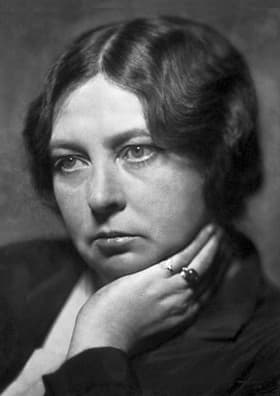
Norwegian, Danish-born · Literature · Arts · Politics
Sigrid Undset
May 20, 1882 – June 10, 1949
Early life and family background
Sigrid Undset was born on 20 May 1882 in Kalundborg, Denmark, to Norwegian parents. Her father, Ingvald Martin Undset, was an archaeologist and scholar, and her mother, Charlotte Gyth, came from a Danish background. When Undset was two years old, the family moved to Kristiania (now Oslo), where she grew up in an intellectually active environment that later shaped her sensitivity to history, culture, and social life. Sources note that she had to leave formal education early after her father’s death, a circumstance that made her largely self-educated and pushed her into office work while she continued reading and writing on her own.[4][5]
Undset’s early life was marked by the practical constraints common to women of her generation. Rather than pursuing a university education, she worked as a secretary, including in an engineering office, while developing her literary ambitions in spare time. That experience later informed her fiction, which often showed close attention to labor, class, and the economic realities of women’s lives. Her upbringing in Norway, combined with a Danish birthplace and a scholarly household, gave her a broad Nordic perspective that would remain important throughout her career.[4][18]
Early literary career
Undset’s first publications appeared in the early twentieth century, beginning with Fru Marta Oulie in 1907, a novel that brought her attention for its startlingly candid portrayal of marriage and female emotional life.[15][18] She followed it with works such as Gunnar’s Daughter in 1909 and Jenny in 1911, the latter of which further established her reputation as a serious novelist of modern women’s experience.[15] These early books are important because they show Undset developing a sharp realist style before turning more fully to historical fiction.
In these novels, Undset confronted themes that were still controversial for a woman writer: sexual autonomy, guilt, domestic dissatisfaction, moral conflict, and the constraints placed on women by social convention. Her frankness helped distinguish her from many contemporaries. She was writing during a period when European literature was changing rapidly, and her early work placed her among the modern psychological realists of her generation.[18][20]
Turn to historical fiction
Undset’s lasting fame rests largely on her historical novels, especially the medieval trilogy Kristin Lavransdatter, published between 1920 and 1922.[2][15] The trilogy—Kransen (The Wreath), Husfrue (The Wife), and Korset (The Cross)—follows the life of Kristin from youth to death in fourteenth-century Norway.[2][4][15] The books combine detailed research into material culture, religion, social custom, and landscape with intense psychological realism.
The trilogy became central to Undset’s international reputation because it did more than recreate a medieval world; it used that world to examine universal human questions about love, duty, sin, family, and faith. Critics and readers alike recognized that she had made medieval Norway vivid without reducing it to romance or simple nationalism. The novels also stood out for the centrality of women’s experience, showing how marriage, motherhood, and moral choice shaped a woman’s life within a rigid social order.[2][14][20]
Undset continued her medieval project with the four-volume cycle Olav Audunssønn (The Master of Hestviken), published from 1925 to 1927.[15][20] This work deepened her exploration of conscience, guilt, and redemption, and it further demonstrated her skill at combining historical scholarship with narrative power. Together, these books confirmed her as one of the great historical novelists of the twentieth century.
Religious conversion and personal life
Undset was married to painter Anders Castus Svarstad and had three children.[4][13] The marriage ended in divorce, a difficult personal experience that coincided with some of her most introspective writing. In 1924 she converted to Catholicism, a significant step in her life and thought, and later became a lay Dominican.[4][13] Her conversion was not simply a private event; it shaped the themes and moral imagination of her later work, especially her attention to sin, grace, sacrifice, and spiritual struggle.
Her Catholic faith made her an unusual public intellectual in predominantly Protestant Norway, and it also contributed to the complexity of her reputation. Yet she remained deeply respected as a literary figure because her fiction was grounded in intellectual seriousness rather than polemic. The same moral seriousness informed her nonfiction and public commentary, especially in the turbulent political climate of the 1930s and 1940s.[4][13][20]
Nobel Prize and international recognition
In 1928, the Swedish Academy awarded Undset the Nobel Prize in Literature for her vivid and historically rich depictions of life in medieval Scandinavia.[2][4][14][15] She received the prize on 10 December 1928 in Stockholm, and the recognition confirmed her place among the major literary figures of her era.[4][18] NobelPrize.org identifies the award as being given for “principally” her powerful descriptions of Northern life during the Middle Ages, especially in Kristin Lavransdatter and Olav Audunssønn.[4]
The award was especially notable for women’s literary history. Undset became the first Norwegian woman to win the Nobel Prize in Literature and only the third woman overall to do so, a barrier-breaking achievement in a field where women had long been underrepresented at the highest levels of recognition.[13][18] Her Nobel Prize reflected not only the excellence of her books but also the broader legitimacy of women’s serious historical and philosophical fiction.
War, exile, and public resistance
During the Second World War, Undset became a visible opponent of Nazism. When Germany invaded Norway in 1940, she was forced to flee the country and eventually went to the United States, where she continued to support the Norwegian resistance movement.[3][4][7][13] Her exile underscored the political risks faced by prominent intellectuals under occupation and the role that exiled writers played in sustaining national morale and international attention.
Undset’s wartime conduct strengthened her standing as a moral public figure. She did not retreat into literary celebrity; instead, she used her visibility to speak against tyranny and to support the country she had come to represent culturally and ethically. In that sense, her public life during the war extended the same seriousness that characterized her fiction.[3][4][13]
Honors, later life, and death
After the war, Undset returned to Norway and was awarded the Grand Cross of the Order of St. Olav in recognition of her literary work and patriotic efforts.[3][13] This honor reflected both gratitude for her wartime stance and the continuing prestige of her books. By the late 1940s, she was recognized as one of the central figures in Norwegian cultural history.
Undset died on 10 June 1949 in Lillehammer, Norway.[1][2][3] Her death marked the end of a life that had traversed major literary, religious, and political transformations in modern European history. Yet her novels continued to circulate widely, and her reputation remained strong in Norway and abroad.
Legacy
Sigrid Undset’s legacy rests on several enduring achievements. She expanded the possibilities of historical fiction by combining rigorous research with psychological depth. She wrote with unusual authority about women’s lives, marriage, motherhood, spiritual conflict, and moral responsibility. Her work also helped establish medieval Norway as a compelling literary landscape for international readers. Because she achieved this while navigating the constraints imposed on women writers in the early twentieth century, her career remains especially significant in women’s history.
Her Nobel Prize, her conversion to Catholicism, her resistance to Nazism, and her postwar honors all contributed to her status as more than a novelist: she became a cultural and moral reference point. Readers continue to value Kristin Lavransdatter and her other books for their emotional intensity, historical richness, and ethical seriousness. In Norwegian literature, and in the broader history of women writers, Undset remains a figure of lasting importance.
Dated achievements
5 indexed.
- May201882Literature
Birth of Sigrid Undset
Birth of Sigrid Undset in Kalundborg, Denmark, who became one of Norway’s greatest novelists and a 1928 Nobel laureate.
View details Britannica biography of Sigrid Undset - Jan011907Literature
Publication of Fru Marta Oulie
Year of publication of <em>Fru Marta Oulie</em>, Undset’s early breakthrough novel and the beginning of her literary career.