← All women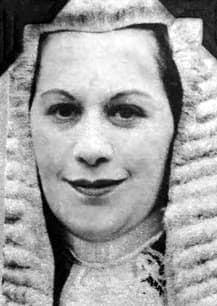
British · Law
Rose Heilbron
August 19, 1914 – December 8, 2005
Early life and background
Rose Heilbron was born on 19 August 1914 in St James Road, near Liverpool’s Anglican Cathedral, into a Jewish family of modest means.[3][5][9] Her father, Max Heilbron, worked as an emigration agent, helping migrants navigate the complex processes of relocation, while her mother, Annie, maintained the household and strongly encouraged her daughter’s education.[3][5][14] Growing up in Liverpool during the First World War and its aftermath, Rose was exposed to economic hardship, sectarian tensions, and the social realities of working-class life. These experiences later informed her sensitivity to individuals caught up in the criminal justice system.
Heilbron attended Belvedere School, a girls’ school in Liverpool known for its academic standards.[5][14] At a time when few girls were expected to pursue professional careers, she showed exceptional ability in languages and analytical subjects and developed an early interest in law. Multiple biographical sources emphasise that her mother’s determination and the school’s rigorous environment played crucial roles in sustaining her ambitions in a male-dominated field.[3][14]
In the early 1930s she entered the University of Liverpool to read law, becoming one of a very small number of female law students in Britain.[3][9] She excelled from the outset, working long hours and participating fully in the intellectual life of the law faculty. The social context was challenging; the English Bar and judiciary remained almost entirely male, and many senior lawyers doubted whether women possessed the temperament or stamina for courtroom advocacy. Nonetheless, Heilbron was determined to pursue a career at the Bar.
Education and academic distinction
Heilbron’s academic achievements at Liverpool were pioneering. In 1935first-class honours degree in law, at a time when women were only just beginning to appear in university law programmes.[3][9][14] Institutional accounts from the University of Liverpool describe her as one of the first two women to obtain a first-class law degree there, and frequently as the first woman to do so.[3][5] This distinction was widely noted in later retrospectives, which portray her success as an early breach in the gendered hierarchy of legal education.
She continued her studies and in 1937 obtained an LL.M., becoming one of the first women reported to hold a Master’s degree in Law from the University of Liverpool.[3][9] Some sources also record that she later received an LL.D. from Liverpool in 1975, a further marker of her scholarly and professional esteem.[3] Unlike many contemporaries who left academia after an initial degree, Heilbron treated advanced legal study as a foundation for serious practice, using it to deepen her understanding of substantive law and procedure.
Her academic success opened doors beyond Liverpool. In February 1936, she won a scholarship to Gray’s Inn, one of the four historic Inns of Court in London.[3][9] The Inns of Court controlled access to the English Bar, and scholarships were crucial supports for students from outside affluent metropolitan circles. Gray’s Inn’s records and later institutional histories identify Heilbron as the first woman ever to win a scholarship at the Inn, marking a clear institutional recognition of female excellence.[3][9] This scholarship enabled her to undertake professional training for the Bar at a time when few women could afford to do so.
Call to the Bar and early career
Heilbron was called to the Bar in 1939, shortly before the outbreak of the Second World War.[11][14] She joined the Northern Circuit around 1940, becoming one of only a handful of women practising there.[13][5] Initially, work was scarce. Established male barristers often monopolised the best briefs, and solicitors were hesitant to instruct women in serious criminal matters. However, the war years brought unexpected opportunities. As many male barristers enlisted or undertook war-related service, courts turned to available advocates, including women.
On the Northern Circuit, Heilbron quickly earned a reputation as a skilled and fearless advocate.[3][9] She handled a wide range of cases, from civil disputes to criminal trials, and became known for her clear, courteous style of cross-examination and her ability to connect with juries. Her gender, although initially a curiosity, soon became secondary to her evident competence. Several commentators note that by the mid-1940s she was regarded as one of the circuit’s most promising junior counsel.[3][13]
Her marriage in 1945 to Dr Nathaniel (Nat) Burstein, a general practitioner, provided a supportive domestic environment.[5][14] They had one daughter, Hilary, who would later become a prominent barrister and King’s Counsel in her own right.[8][12] Balancing family life with an increasingly demanding practice was challenging in an era when professional women were expected to prioritise domestic responsibilities. Heilbron’s ability to sustain both roles contributed to her status as a role model for later generations of women in law.
Rise to prominence and major legal firsts
Heilbron’s rise to national prominence came in the late 1940s. On 10 March 1949, she was appointed King’s Counsel (KC), becoming, alongside Helena Normanton, one of the first two women ever to take silk in England.[1][3] At 34, she was also reported to be the youngest KC since 1783.[5] Taking silk marked recognition as a leading advocate, and for a woman to do so at that time was extraordinary. Press coverage emphasised both her youth and her gender, and legal historians later identified the 1949 appointments as a global milestone in women’s professional advancement.[1][3][8]
In January 1950, Heilbron achieved another historic first when she led the defence in the Cameo Cinema murder case in Liverpool, becoming the first woman to lead in an English murder case.[2][9][11] Murder trials were among the most serious and high-profile criminal proceedings, generally reserved for senior male KCs. Her performance—marked by meticulous preparation and skilful advocacy—attracted extensive media attention. Contemporary reports noted the novelty of a woman conducting a murder defence, and she was widely celebrated, with some outlets naming her "Woman of the Year".[9][11] The case later became controversial due to concerns about miscarriage of justice, but Heilbron’s role is remembered as demonstrating that women could handle the heaviest criminal work.
Heilbron’s achievements were not confined to advocacy. On 22 October 1956, she was appointed Recorder of Burnley, widely described at the time as the first woman Recorder and England’s first woman judge.[3][5][13] A Recorder is a part-time judicial office in the criminal courts, and her appointment marked the first time a woman presided regularly as a judge in that sphere. She retained the recordership until 1974, hearing a broad mix of criminal cases and gaining a reputation for fairness and clarity.[14] Although later scholarship clarifies that Dame Elizabeth Lane would become the first woman High Court judge, Heilbron’s recordership is consistently identified as the first senior judicial appointment of a woman within the criminal courts.[3][7]
The following year, 1957, she became the first woman commissioner of assize, extending her judicial work to the travelling assize courts that dealt with serious offences across the regions.[3][5][14] This role placed her among the country’s most senior criminal judges, reinforcing public recognition of her authority and strengthening the case for women’s inclusion in the upper judiciary.
Judicial career and High Court appointment
Heilbron’s judicial responsibilities expanded markedly in the 1960s and 1970s. On 4 January 1972, she achieved one of her most celebrated firsts when she sat as a judge at the Old Bailey, London’s Central Criminal Court, becoming the first woman judge ever to sit there.[1][3][13] The Old Bailey was the symbolic heart of English criminal justice, and her presence on the bench signalled a dramatic shift in public perceptions of who could wield judicial authority in major criminal trials. Jewish Currents and other commemorative sources mark this date as a key event in both women’s and Jewish legal history.[1][9]
In 1974, Heilbron was appointed to the High Court of Justice, sitting in the Family Division, making her the second woman High Court judge after Dame Elizabeth Lane.[3][7][14] Although this was not a "first" in absolute terms, it was a major milestone in the consolidation of women’s presence in the senior judiciary. High Court judges handle complex, often precedent-setting cases; in the Family Division, Heilbron dealt with issues including divorce, child custody, and financial provision. Her judgments were noted for their humane tone and careful reasoning, particularly in cases involving vulnerable parties.
Heilbron also took on significant leadership roles within the judicial system. In 1973, she was elected leader of the Northern Circuit, becoming the first woman to lead any circuit at the English Bar.[3][5][13] Circuit leaders held considerable influence, representing practitioners’ interests and mentoring junior counsel. Her election reflected deep respect from colleagues and signalled that women could not only participate in, but also govern, the profession’s core structures.
In 1978, she became Presiding Judge of the Northern Circuit, recognised as the first woman Presiding Judge of any circuit.[3][13][14] The Presiding Judge oversees judicial administration across a circuit, including allocation of cases and liaison with senior judiciary. This appointment placed Heilbron at the centre of the newly created Crown Court system, following the abolition of assizes and quarter sessions. Her leadership helped ensure that the Northern Circuit adapted effectively to these institutional changes.
Gray’s Inn leadership and professional governance
Heilbron maintained close ties with Gray’s Inn throughout her career. Having been its first female scholar in the 1930s, she participated in educational and mentoring activities for younger barristers. Her relationship with the Inn culminated in her election as Treasurer of Gray’s Inn in 1985, making her the first woman treasurer of any of the four Inns of Court.[3][13] The treasurership is the Inn’s senior constitutional role, responsible for governance, finance, and ceremonial representation.
As Treasurer, Heilbron presided over dinners, delivered speeches, and influenced policies on scholarships and training. Her leadership within Gray’s Inn symbolised women’s full integration into the elite institutional heart of the English Bar, complementing her earlier achievements in advocacy and judging. The fact that she had begun her career with a Gray’s Inn scholarship and ended as its Treasurer underscores the arc of her professional journey—from marginal pioneer to central figure in the legal establishment.
Major reports, law reform, and honours
Beyond advocacy and judging, Heilbron contributed to law reform and public policy. In 1975, she chaired the Home Secretary’s Advisory Group on Rape, producing a report that had lasting influence on the law of sexual offences.[11][14] The report argued, among other things, for anonymity for rape complainants to encourage reporting and protect victims from intrusive media coverage. She opposed extending similar anonymity to defendants, reasoning that transparency was important for public trust.[11] Her recommendations helped shape subsequent legislative changes and public debate around sexual violence and victims’ rights.
Heilbron received numerous honours in recognition of her work. In 1974, she was created a Dame Commander of the Order of the British Empire (DBE), one of the highest civilian honours in the United Kingdom, awarded for services to law and public life.[3][14] She also received honorary degrees and was frequently invited to give lectures and public addresses, reflecting her stature as a national figure. Institutional projects celebrating women in law—such as the First 100 Years campaign—regularly feature her as a central early hero.[10]
Personal life and character
Accounts from colleagues, family, and journalists emphasise Heilbron’s personal warmth, modesty, and resilience. Despite her high profile, she was known for treating all court participants—defendants, witnesses, solicitors, and junior counsel—with courtesy and respect.[11][15] Her daughter, Hilary Heilbron KC, has described her as both a dedicated professional and a supportive mother, noting the challenges of balancing long hours at court with family life in an era lacking modern childcare support.[8][10]
Heilbron’s Jewish identity was part of her public story, especially in commemorations by Jewish organisations, which highlight her achievements as a pioneering Jewish woman in a traditionally Anglican and male profession.[1][9] However, she appears to have regarded professional excellence rather than identity politics as her primary means of challenging discrimination. She rarely spoke publicly about antisemitism or sexism in personal terms, choosing instead to demonstrate through her work that women could equal or surpass male colleagues.
Legacy and historical impact
Heilbron’s legacy is defined by a succession of "firsts" that collectively transformed the role of women in British law. She was the first woman to achieve a first-class law degree at the University of Liverpool, the first woman to win a scholarship at Gray’s Inn, one of the first two women KCs in England, the first woman to lead an English murder case, the first woman Recorder, the first woman commissioner of assize, the first woman judge at the Old Bailey, the first woman leader of any circuit, the first woman Presiding Judge of any circuit, and the first woman Treasurer of an Inn of Court.[1][3][5][9][13]
These achievements had impact beyond symbolism. By occupying and performing well in roles previously reserved for men, Heilbron changed expectations among solicitors, judges, and the public about women’s capabilities. Her work opened practical opportunities for younger women, who benefited from her mentoring and from the institutional changes she helped to accelerate. Legal historians and feminist scholars frequently cite her career as a case study in how individual agency intersects with structural change in professional fields.[3][7][15]
Her influence continues through scholarship and public history. Her daughter’s biography, Rose Heilbron: The Story of England’s First Woman Queen’s Counsel and Judge, provides detailed archival and personal insights into her life and work.[8][12] Projects such as the First 100 Years initiative and women’s legal history websites feature her prominently, using her story to inspire contemporary debates about equality at the Bar and in the judiciary.[10][9][15] The University of Liverpool honours her as one of its law school luminaries, and Gray’s Inn remembers her as both pioneering scholar and Treasurer.[3]
Later life and death
Heilbron retired from full-time judicial office in the late 1980s, after a career spanning nearly five decades.[3][14] In retirement, she remained engaged with legal and community affairs, attending events and occasionally speaking about her experiences. Her health gradually declined with age, but she continued to be a respected figure within legal circles.
She died on 8 December 2005, aged 91.[1][3][9] Obituaries in national newspapers, legal periodicals, and institutional newsletters paid tribute to her extraordinary career and personal qualities.[11][13][15] Many emphasised that while she had been a pioneer, she was also a working judge and advocate whose day-to-day decisions affected thousands of lives. Her husband, Dr Nathaniel Burstein, survived her and lived to a very old age, while her daughter Hilary carried forward the family’s legal tradition.[5][8]
In the years since her death, Heilbron’s name has become firmly embedded in the canon of women’s legal history. She is remembered not only for the long list of "firsts" but also for the quality of her advocacy, her humane judging, and her willingness to serve as a visible role model. Her life illustrates how the barriers women faced in the early twentieth century could be overcome through talent, perseverance, and institutional change—and how a single individual’s career can leave a lasting imprint on an entire profession.
Dated achievements
11 indexed.
- Aug191914Law
Birth of Rose Heilbron
Rose Heilbron was born in Liverpool, England, later becoming one of Britain’s most prominent barristers and judges.
View details Dame Rose Heilbron: Trailblazing Barrister - Feb121936Law
First woman to win a scholarship at Gray’s Inn
Heilbron won a scholarship at Gray’s Inn, breaking barriers for women entering Inns of Court.