← All women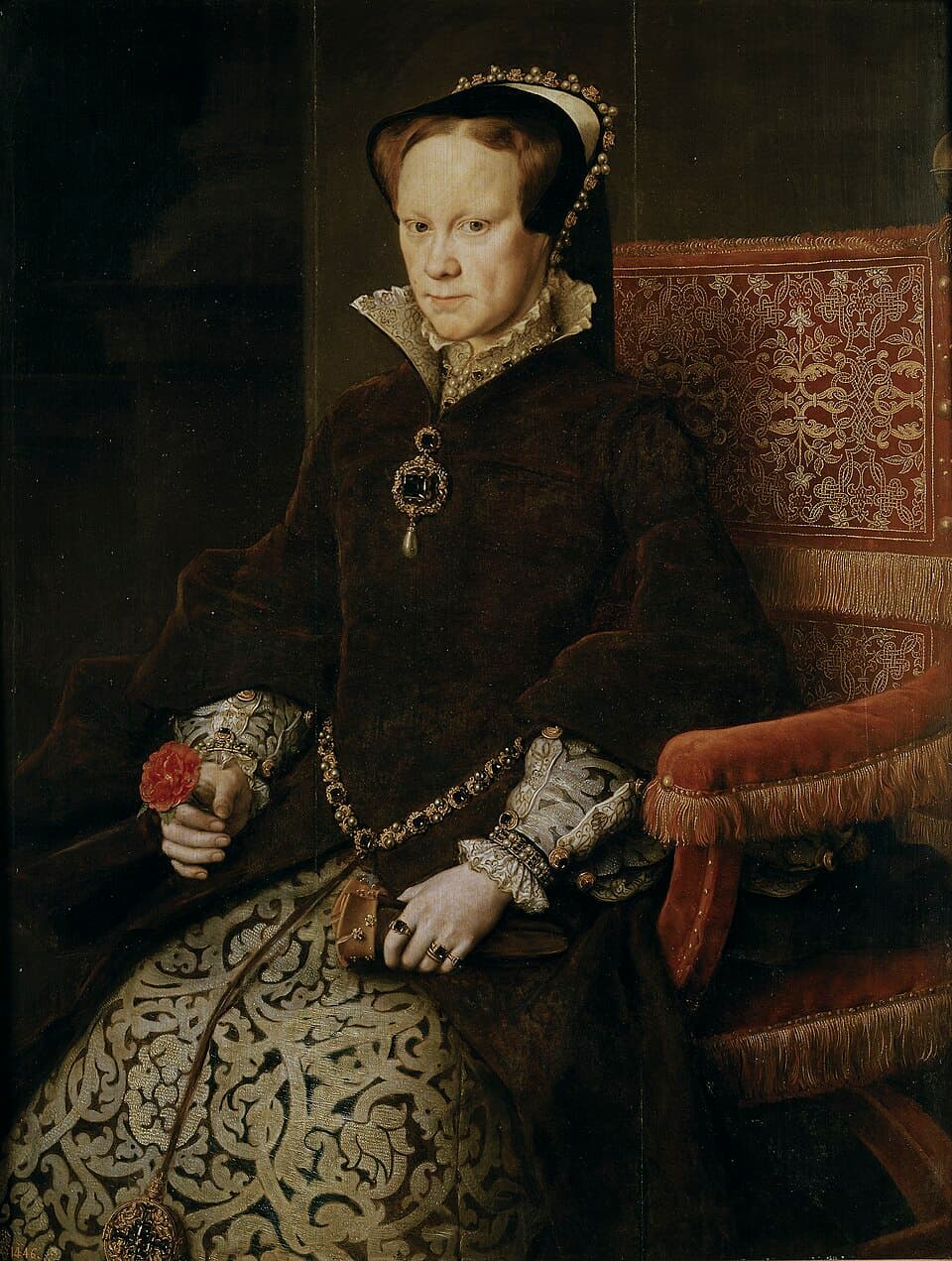
English · Politics
Queen Mary I of England
February 18, 1516 – November 17, 1558
Early Life and Background
Mary I of England (Mary Tudor) was born on 18 February 1516 at the Palace of Placentia in Greenwich, near London, the only surviving child of King Henry VIII and his first wife, Catherine of Aragon.[1][3][4][15] As a princess, Mary was cherished by her parents and widely recognized as heir presumptive for much of her childhood. She descended from both the English and Spanish royal houses, linking the Tudors to the powerful dynasties of Ferdinand of Aragon and Isabella I of Castile.[4][15]
Mary received an extensive humanist education, reflecting Renaissance ideals and the expectations for a royal heir. She was tutored in Latin, French, Spanish, music, and theology.[1][3] Contemporary observers praised her skill on the lute and virginals, as well as her fluency in multiple languages, which later aided her diplomatic interactions. Her mother’s strong Catholic piety deeply influenced Mary, instilling a devotion to the mass, the cult of the Virgin, and traditional forms of worship.[1][3]
For the first seventeen years of her life, Mary was effectively the sole heir to the Tudor dynasty.[4] Henry VIII arranged potential marriage alliances for her with continental princes, including the future Holy Roman Emperor Charles V, underscoring her importance in European politics.[1][3] However, her comfortable position was shattered when Henry’s determination to secure a male heir led him to seek annulment from Catherine and marriage to Anne Boleyn.
In the mid‑1520s, Mary was sent to Ludlow Castle in Wales, where she presided informally over the Council of the Marches and held a princely court, reflecting her status as Princess of Wales in practice if not in formal title.[9] This period gave her early exposure to governance and public ceremonial, experiences that later informed her conduct as queen.
Fall from Favor, Illegitimacy, and Formation of Convictions
Mary’s world changed dramatically in the 1530s. Henry’s break with Rome and marriage to Anne Boleyn led to parliamentary acts declaring his union with Catherine invalid. In 1533, following the birth of Anne’s daughter Elizabeth and the passage of the Act of Succession, Mary was formally declared illegitimate and excluded from the line of succession.[1][11][14][15] She was stripped of the title "Princess" and reduced to "the Lady Mary."
Forced to acknowledge her father’s supremacy over the Church and the invalidity of her parents’ marriage, Mary experienced intense psychological and spiritual conflict.[1][3] She resisted these changes for as long as possible, backed by her mother Catherine and Catholic supporters. Eventually, under pressure from Henry and his ministers, she submitted, a capitulation that left a lasting mark on her conscience and identity.
During these years, Mary lived in conditions akin to house arrest, under the authority of Anne Boleyn and later Jane Seymour’s households.[1][3] She endured separation from her mother, who remained steadfast in her refusal to renounce the marriage. Catherine’s death in 1536 further deepened Mary’s sense of grievance and shaped her belief that Henry’s religious innovations were unjust and impious.
Mary’s exclusion from the succession was partially reversed when her half‑brother Edward was born to Jane Seymour in 1537, and Henry sought a more stable settlement.[9][11] The Third Succession Act of 1544 restored both Mary and Elizabeth to the line of succession after Edward, though without removing the legal taint of illegitimacy.[1][11][14] This act would later provide the statutory foundation for Mary’s claim to the throne.
Position under Henry VIII and Edward VI
In the final years of Henry VIII’s reign, Mary gradually returned to favor at court, though her status remained ambiguous. She participated in family events and appeared in public with her father and siblings, but her religious conservatism contrasted with the increasingly reformist tendencies of some royal advisors.[1][3]
Upon Henry’s death in 1547, the nine‑year‑old Edward VI became king, with a regency led by Protestant nobles, notably the Duke of Somerset and later the Duke of Northumberland.[1][3][9] Mary, now in her early thirties, resided largely on her estates. She continued to practice Roman Catholicism, holding private masses in defiance of Edward’s religious legislation, which introduced the Book of Common Prayer and moved the Church of England toward more radical Protestant doctrine.[1][3]
Mary’s open refusal to conform made her a focal point for conservative and Catholic sympathizers. Imperial ambassadors from Charles V’s court corresponded with her, viewing her as a potential ally for restoring Catholicism.[3][10] Yet Mary remained cautious, aware that any overt rebellion against Edward’s government could provoke severe reprisals.
During Edward’s short reign, reformers dismantled many aspects of traditional worship, abolished chantries, and weakened the old ecclesiastical structures.[1][3] Mary’s experience of these changes, combined with memories of her mother’s treatment, hardened her conviction that Protestantism was both theologically erroneous and politically destructive.
Succession Crisis of 1553 and Mary’s Accession
Edward VI’s health began to fail in 1553. Influenced by his Protestant council, he drafted a "Devise for the Succession" that bypassed both Mary and Elizabeth on account of their Catholicism and alleged illegitimacy, naming their Protestant cousin Lady Jane Grey as heir.[1][3][9][12] Mary, aware of hostile maneuvering, withdrew from court.
Edward died on 6 July 1553, triggering a tense succession crisis.[1][9] On 10 July 1553, Lady Jane Grey was proclaimed queen in London, supported by Northumberland and key Protestant elites.[1][9] Mary, however, immediately asserted her claim under the Third Succession Act, issuing letters to nobles and towns proclaiming herself the rightful queen and rallying support, particularly from East Anglia.
Mary’s cause quickly gained momentum. A broad coalition of conservative gentry, Catholic sympathizers, and those loyal to Henry VIII’s statutory settlement backed her.[9][12] The Privy Council, sensing public opposition to Jane and the tenuous legality of Edward’s devise, abandoned Northumberland’s scheme. On 19 July 1553, Mary was proclaimed queen of England in London.[1][9]
On 3 August 1553, she entered London in a triumphant state procession, accompanied by her half‑sister Elizabeth.[1][9] Crowds greeted her enthusiastically, and civic pageantry underscored the legitimacy of her rule. Shortly afterward, John Dudley, Duke of Northumberland, was arrested, tried, and executed for treason on 22 August 1553, demonstrating Mary’s resolve to punish the architects of the attempted usurpation.[1][9]
Mary’s accession marked a watershed moment: she became the first woman to successfully claim and exercise the English crown in her own right, establishing a precedent for female sovereignty.[2][4][12]
Coronation and the Establishment of Queenly Authority
On 1 October 1553, Mary was crowned and anointed at Westminster Abbey, becoming the first uncontested queen regnant of England to be crowned in her own right.[1][2][4] The ceremony adapted traditional coronation rites for a female sovereign, confirming her status as God’s anointed ruler and solidifying public recognition of her authority.
Mary’s coronation was followed by the opening of her first Parliament on 5 October 1553, where she addressed members and began the legislative work of reversing Edwardian religious reforms.[1] This Parliament soon passed the First Act of Repeal on 21 October 1553, abolishing key religious statutes enacted under Edward VI and restoring the doctrinal position of 1547.[1][3]
Mary’s early policy combined clemency with firmness. She released some former opponents but insisted on the legitimacy of her succession and her Catholic convictions. Although her gender raised questions among some contemporaries about the capacity of a woman to rule, Mary quickly demonstrated that she would deploy the full range of royal prerogatives—legislation, patronage, and judicial authority—to shape her realm.[2][12]
Religious Policy and the Restoration of Catholicism
Mary’s central objective as queen was the restoration of Roman Catholicism as the established religion of England.[1][3][15] She regarded her father’s break with Rome and her brother’s Protestant reforms as grave spiritual disasters. In her first year, she revoked anti‑Catholic legislation and in 1553 repealed the 1533 Act of Sodomy, a notable legal change that historians note as an exceptional departure from later criminalization of male same‑sex activity.[14]
Her broader religious program sought to revive traditional worship, reinstate the mass, and restore the spiritual authority of the papacy. In 1554, she invited her cousin Cardinal Reginald Pole, long an exile and critic of Henry VIII, to return as papal legate. Pole arrived on 24 November 1554, was received by Mary, and soon addressed Parliament on 28 November 1554, promoting formal reconciliation with Rome.[1][3]
On 30 November 1554, Parliament passed measures to restore papal supremacy and revoke the royal supremacy established under Henry VIII.[1][2] These acts re‑aligned England with the Roman Church, though compromises were made to protect lay owners of former monastic lands. Subsequently, a Second Act of Repeal in 1554 removed remaining Henrician religious legislation and completed the legal return to papal authority.[1][4]
Mary’s regime also revived medieval heresy laws in 1554, leading to a campaign of persecution. From 1555 to 1558, approximately 280 Protestants were executed for heresy, mostly by burning, in what became known as the Marian persecutions.[1][6][9][11][15] The first victim was John Rogers, burned at Smithfield on 4 February 1555.[1][7] The most famous was former Archbishop of Canterbury Thomas Cranmer, executed in Oxford on 21 March 1556, after dramatically renouncing his recantations at the stake.[1][3]
Mary believed these measures were necessary to save souls and restore true religion. However, Protestant martyrologies, especially John Foxe’s later Book of Martyrs, portrayed the victims as heroic confessors and branded Mary as "Bloody Mary", a label that deeply influenced her posthumous reputation.[3][11][13]
Marriage to Philip of Spain and International Politics
Mary’s marital policy had far‑reaching consequences. Seeking a Catholic husband who could support her religious aims and provide an heir, she agreed to wed Philip of Spain, son of Charles V, despite widespread domestic opposition. The match sparked Wyatt’s Rebellion in 1554, a rising led by Sir Thomas Wyatt and others who feared foreign domination and the extension of Habsburg power into England.[1][9]
The rebellion was suppressed, and its aftermath led to the execution of several leaders, including Wyatt, and ultimately of Lady Jane Grey on 12 February 1554, as she remained a potential focal point for Protestant resistance.[1][9] On 25 July 1554, Mary and Philip were married at Winchester Cathedral, making Mary Queen consort of Spain.[1][3][9]
The marriage treaty attempted to safeguard English interests: Philip was styled king of England during Mary’s lifetime but received limited powers and was barred from automatically claiming the crown if Mary died without heirs.[3][11] Nevertheless, public unease persisted. Philip’s absences from England and cultural differences strained the relationship, and Mary’s false pregnancies—interpreted at the time as signs of hoped‑for heirs—ended without a child.[3][15]
In 1556, Philip succeeded Charles V, becoming Philip II of Spain on 16 January 1556, thereby expanding his responsibilities across a vast empire.[1][3] Mary’s position as his consort strengthened the symbolic ties between England and Spain but also risked entangling her kingdom in Habsburg wars.
War with France and the Loss of Calais
Mary’s alliance with Philip drew England into continental conflict. On 7 June 1557, England entered war against France in support of Spain, joining the ongoing Italian War.[1][3][11] The decision was controversial, given the financial strain and limited enthusiasm among the English political nation for foreign adventures.
The most enduring consequence of this war was the loss of Calais, England’s last major foothold on the European mainland. On 7 January 1558, French forces captured the port, ending nearly two centuries of English rule there.[1][11] The loss was a profound blow to national pride and strategic position. Later anecdotal accounts, though unverified, claim that Mary declared Calais would be found engraved on her heart when she died, expressing the depth of her sorrow.[3]
The loss of Calais contributed significantly to negative evaluations of Mary’s reign, both among contemporaries and later historians. It symbolized the collapse of medieval ambitions in France and shifted English focus toward maritime and colonial expansion, developments that would accelerate under Elizabeth I.[11]
Despite these setbacks, Mary’s government supported naval and commercial reforms in the 1550s, including exploration and trading ventures that helped lay foundations for later Elizabethan successes.[7][10][11][14] Nonetheless, the war’s outcome overshadowed these contributions in public memory.
Personal Life and Character
Mary’s personal life was marked by emotional hardship. Her relationship with Philip II was politically important but personally fraught: he spent significant time abroad, and their marriage produced no children.[3][15] Mary experienced at least one apparent pregnancy that ended without birth, likely a false pregnancy or misdiagnosed illness, causing public disappointment and deep personal distress.
Contemporaries described Mary as deeply pious, serious, and at times melancholic, shaped by childhood traumas, her mother’s humiliation, and her own experience of illegitimacy.[3][15] She valued confession, the mass, and the intercession of saints, and saw her queenship as a divine mandate to restore the true faith.
Despite the severity of her religious policies, Mary could show clemency in political matters, especially early in her reign, and maintained affectionate relationships with some courtiers and household servants.[3] Her bond with her half‑sister Elizabeth was complex—alternating between cooperation and suspicion, particularly when Elizabeth was implicated in Wyatt’s Rebellion—but Mary ultimately allowed Elizabeth to remain heir, as set by statute.[1][3][15]
Awards, Honors, and Formal Recognition
As a Tudor monarch, Mary did not receive modern "awards" in the contemporary sense, but she was the subject of numerous formal recognitions. Her coronation in 1553 was itself a central honor, conferring sacral and legal legitimacy.[1][2][4] She was addressed with full royal styles and maintained the royal household, patronage networks, and ceremonial roles associated with the English crown.
Internationally, Mary’s marriage to Philip II and her status as Queen consort of Spain signified high dynastic rank within European monarchical hierarchies.[1][3][11] Portraits produced during her reign, now held by institutions such as the National Portrait Gallery, depict her with insignia of sovereignty, including the crown, orb, and scepter.[12]
Later Life, Illness, and Death
By the late 1550s, Mary’s health deteriorated. She suffered from recurrent ailments, possibly including gynecological disease or cancer, and endured psychological strain from unfulfilled hopes for an heir, Philip’s absences, and political setbacks such as the loss of Calais.[4][16]
Mary died in London on 17 November 1558, widely reported as at St James’s Palace, aged 42.[1][3][4][15] Contemporary sources describe her final days as marked by religious devotion and acceptance of divine judgment. On the same day, Cardinal Pole also died, symbolically ending the principal leadership of England’s brief Catholic restoration.[1][3]
Succession passed smoothly to Elizabeth I, who had long been recognized as heir in law.[1][3][11] Elizabeth quickly moved to re‑establish Protestantism, culminating in the Elizabethan Religious Settlement of 1559, which re‑asserted royal supremacy and created a moderate Protestant national church. Mary’s policies were swiftly undone, though some institutional and administrative reforms persisted.
Mary was buried in Westminster Abbey on 10 December 1558James I, her remains were later placed in a shared tomb with Elizabeth I, topped by a monument that emphasizes Elizabeth, reflecting later historiographical preference for the younger sister. Mary’s Latin epitaph acknowledges her sovereign status but is overshadowed by Elizabeth’s celebrated memory.
Legacy and Historical Impact
Mary I’s legacy is complex and contested. She is widely recognized as the first uncontested queen regnant of England, setting a crucial precedent for female sovereignty.[2][4][12][15] Her successful accession and coronation demonstrated that a woman could rule in her own right, engage with Parliament, direct foreign policy, and shape religious life, challenging long‑standing assumptions about gender and kingship.
At the same time, her reign has often been overshadowed by the negative image of "Bloody Mary" created by Protestant writers and reinforced in later popular culture.[3][11][13] The Marian persecutions, with around 280 Protestant executions between 1555 and 1558, became central to this reputation.[1][6][9][15] In Elizabethan England, Foxe’s Book of Martyrs and other polemical works portrayed Mary as a cruel tyrant, ensuring that her Catholic restoration would be remembered primarily through its violence.
Modern historians have re‑examined Mary’s policies, noting that religious persecution was not unique to her reign but part of a broader early modern pattern, and that her efforts to restore Catholicism were coherent within the theological and political context of the mid‑16th century.[3][10][13][14] They emphasize her administrative competence, her reliance on statute to enact change, and her role in continuing certain naval and economic reforms that benefited later rulers.[7][10][14]
Mary’s gender has also been reassessed. Earlier narratives often contrasted her unfavorably with Elizabeth I, depicting Mary as weak, bigoted, or overly emotional in contrast to Elizabeth’s pragmatism. More recent scholarship situates both queens within the constraints of their time and acknowledges Mary’s achievements in navigating male‑dominated institutions and hostile political circumstances.[12][13][15]
In the history of women’s political power, Mary’s reign remains a turning point. She was the first woman to be crowned and recognized as sovereign of England and Ireland, paving the way for Elizabeth I and later queens. Her experience highlights the challenges facing queens regnant—especially the tensions between marriage, sovereignty, religion, and national interest—but also demonstrates their capacity to exert decisive influence over law, faith, and foreign affairs.
Mary I’s life thus stands at the intersection of dynastic politics, religious conflict, and the evolution of female monarchy. Though her policies were largely reversed after her death, her pioneering role as England’s first queen regnant and her determined attempt to restore Catholicism ensured that her reign would remain central to debates about gender, power, and belief in Tudor England.[1][2][3][4][11][12][15]
Dated achievements
21 indexed.
- Feb181516Politics
Birth of Mary Tudor
Mary was born at the Palace of Placentia in Greenwich, the eldest surviving child of King Henry VIII and Catherine of Aragon.
View details Wikipedia: Mary I of England - Aug031553Politics
State entry into London as ruling queen
Mary made a state entry into London, marking her assumption of power as queen, alongside Princess Elizabeth.