← All women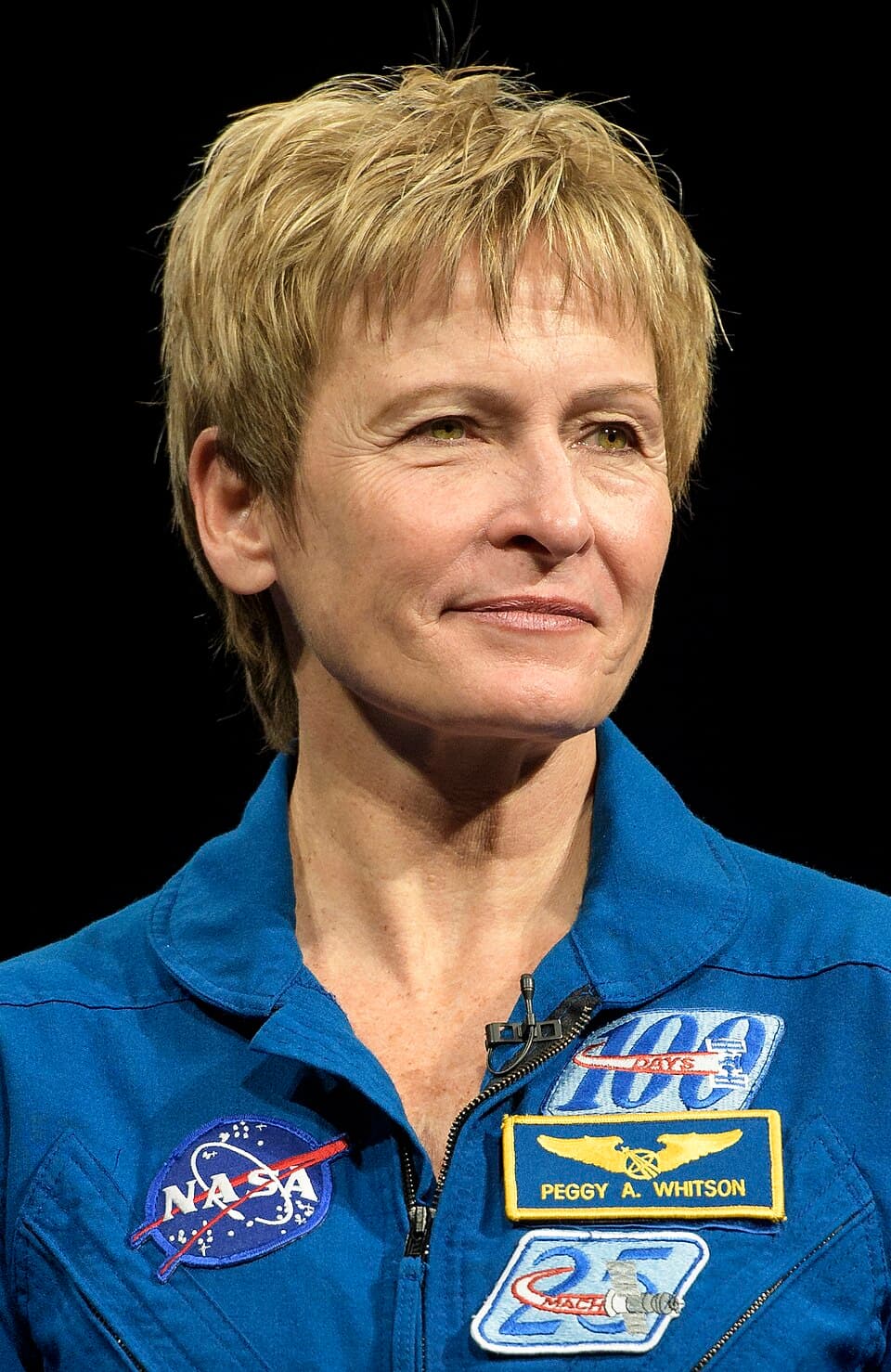
American · Science · Aviation
Peggy Whitson
February 9, 1960 – present
Early Life and Background
Peggy Annette Whitson was born on February 9, 1960, in Mount Ayr, Iowa, United States, and grew up on a farm near the small community of Beaconsfield in the same state.[1][2][3] Her rural upbringing, with its demands for hard work and self-reliance, is often cited as a formative influence on her later career in science and spaceflight.[1][9] As a child, she followed NASA’s Apollo missions and became fascinated by human space exploration, an interest that would guide her educational and professional choices.[2][9]
Whitson attended local schools in Iowa and excelled in science, particularly chemistry and biology.[12] She graduated from high school in 1978, during a period when women were only beginning to enter the astronaut corps in significant numbers, and when the broader scientific community was slowly expanding opportunities for women in research and engineering.[2][12] The combination of rural life, early exposure to spaceflight, and her strong academic performance set the stage for her pursuit of advanced scientific training.
Education and Scientific Training
Whitson enrolled at Iowa Wesleyan College, where she studied biology and chemistry.[12] She received her bachelor’s degree in 1981, developing a solid foundation in the life sciences that would later support her work in biochemistry and human physiology.[12] She then pursued graduate studies at Rice University in Houston, Texas, earning a Ph.D. in biochemistry in 1985.[12][1] Her doctoral research focused on molecular and cellular biology, and she gained experience in laboratory techniques that would later be applied to microgravity experiments.
Following her doctorate, Whitson remained in the Houston area and began collaborating with NASA researchers, reflecting a growing trend of academic scientists engaging directly with human spaceflight programs.[1][10] Her scientific credentials positioned her at the intersection of advanced research and the applied challenges of sustaining human life in space.
Career Beginnings at NASA
Whitson’s formal association with NASA began in 1986, when she joined the Johnson Space Center as a research associate and biochemist.[1][10] In these early roles she worked on projects related to cell biology and human physiology in microgravity, contributing to experiments that probed how living systems respond to the space environment.[1][3] Her work coincided with the expanding ambitions of NASA’s Life Sciences program, which sought to understand the effects of spaceflight on the human body and other biological systems.
Throughout the late 1980s and early 1990s, Whitson held a succession of research and project management positions at Johnson Space Center, including roles in the Biochemistry and Biophysics Section and participation in Shuttle–Mir and early ISS planning.[1][10] She served as project scientist for shuttle missions and played a significant part in designing experiments that would later be conducted on long-duration missions. This period showcased her ability to bridge rigorous laboratory science with the operational realities of human spaceflight.
Selection as an Astronaut
In 1996, Whitson was selected as a NASA astronaut candidate, entering a rigorous training program that included flight operations, systems engineering, survival training, and Russian language instruction.[2][6][10] Her selection reflected NASA’s increasing emphasis on recruiting scientists and engineers with deep research backgrounds, particularly in anticipation of the International Space Station program.[1][2]
After completing astronaut training, Whitson served in various support roles, including positions in the Astronaut Office, technical assignments related to the ISS, and as a liaison with international partners.[1][10] She helped develop operational procedures for the station’s laboratory modules and contributed to early decisions about experiment deployment, all while preparing for her first flight.
First Spaceflight: Expedition 5 and Science Officer Role
Whitson’s first spaceflight began on June 5, 2002, when she launched aboard the Space Shuttle Endeavour on mission STS-111 to the International Space Station.[1][2] She served as a flight engineer on Expedition 5, participating in a long-duration mission during which she lived and worked on the ISS for approximately six months.[1][2]
During Expedition 5, Whitson was designated NASA’s first International Space Station Science Officer, a newly created role that emphasized the coordination and execution of scientific research aboard the station.[1][8] As Science Officer, she supervised and conducted experiments in areas such as cell biology, protein crystal growth, human physiology, and materials science, collaborating with research teams on the ground to ensure that data collection met scientific standards.[1][2]
Her work on this mission demonstrated the viability of the ISS as a continuous research platform and helped establish procedures for future science operations. Whitson’s dual identity as both astronaut and scientist exemplified NASA’s evolving vision of the astronaut corps as a community of operational researchers, capable of conducting sophisticated experiments in orbit.[1][3][9]
Second Spaceflight and First Female ISS Commander
Whitson returned to space in 2007, launching on Soyuz TMA-11 to join Expedition 16 aboard the ISS.[2][3][11] During this mission she became the first woman to command the International Space Station, leading the crew and managing station operations and safety.[3][8]
As commander, Whitson oversaw a range of activities, including hardware installations, maintenance, and experiments, as well as operations involving visiting spacecraft. Her leadership required coordination among multiple space agencies—NASA, Roscosmos, and other international partners—and careful management of resources and schedules.[1][3]
Expedition 16 further solidified Whitson’s reputation as a highly capable mission leader and operational expert. The mission highlighted the increasing integration of women into top command positions in human spaceflight, illustrating a shift from early decades when leadership roles were almost exclusively held by men.[3][8]
Chief of the Astronaut Office
In 2009, Whitson was appointed Chief of NASA’s Astronaut Office, making her the first woman and the first non-military astronaut to hold the position.[2][8][14] As Chief Astronaut, she became responsible for the coordination of astronaut activities, including selection, training, and flight assignments, and served as a key advisor to NASA on human spaceflight matters.
Her tenure in this role reflected the growing prominence of civilian scientists within NASA’s leadership structure and further broke traditional patterns that had favored military test pilots. Whitson’s experience on long-duration missions and her scientific background contributed to shaping astronaut training programs around the complex demands of ISS operations and future exploration initiatives.[1][8]
Third Long-Duration Mission: Expedition 50/51
Whitson’s third long-duration mission to the ISS took place in 2016–2017, when she joined Expedition 50 and later commanded Expedition 51.[1][2] The mission involved extensive scientific research, maintenance tasks, and public outreach activities aimed at sharing the experience of living in space with audiences on Earth.
During this mission, Whitson conducted multiple spacewalks, contributing to station maintenance and upgrades, including work on external hardware and systems.[1][9] On March 30, 2017, she completed her eighth spacewalk, bringing her total extravehicular time to 53 hours and 22 minutes and setting a record for the most spacewalk time by any female astronaut at that point.[1][10]
She also achieved multiple endurance records. On April 24, 2017, while still aboard the station, Whitson surpassed the previous NASA record for cumulative time in space, reaching 534 days and ultimately accumulating 665 days by the end of the mission, the most for any American and any woman at that time.[1][2][15] On April 9, 2017, she became the oldest woman to fly in space, at age 57, and during Expedition 51 she became the first woman to command the ISS twice, reflecting her leadership on both Expeditions 16 and 51.[2][8][11]
Whitson returned to Earth on September 3, 2017, concluding Expedition 51. Her three NASA missions gave her a cumulative 665 days in orbit, at that time the record for an American astronaut and for any woman.[1][2][9]
Records and Milestones
Across her NASA career, Whitson accumulated a remarkable set of records:
- Most cumulative time in space by an American astronaut and by any woman, reaching 665 days by 2017.[1][2][3]
- First female commander of the International Space Station, leading Expedition 16.[3][8]
- First woman to command the ISS twice, commanding Expeditions 16 and 51.[8][10]
- First woman and first non-military Chief of NASA’s Astronaut Office, beginning in 2009.[2][8][14]
- Record holder for most spacewalks by a female astronaut, with a total of 10 spacewalks and 60 hours 21 minutes of EVA time.[1][4][10]
These achievements placed Whitson at the forefront of human spaceflight history and marked her as one of the most experienced astronauts in the world.
Awards, Honors, and Recognition
Whitson’s pioneering career has been recognized with numerous awards and honors from NASA and external organizations. She has received multiple NASA Space Flight Medals, the NASA Distinguished Service Medal, and the NASA Outstanding Leadership Medal, among other distinctions, reflecting both her operational achievements and leadership contributions.[1][10]
Beyond NASA, she has been honored by scientific, educational, and civic institutions. Biographical summaries note that she has been invited to speak at universities, conferences, and public events, where she often addresses topics such as perseverance, scientific curiosity, and the importance of role models for young people interested in STEM fields.[10][13][14]
Her records for time in space and spacewalks have been widely covered in media outlets and educational publications, including encyclopedias and science-focused news organizations, cementing her reputation as a central figure in contemporary space history.[3][9][15]
Retirement from NASA and Transition to Axiom Space
Whitson retired from NASA in June 2018, after more than three decades of service and three long-duration missions to the ISS.[1][9][11] Her retirement marked the end of her government service but not the end of her spaceflight career.
She later joined Axiom Space, a commercial spaceflight company focused on organizing private missions to the ISS and developing future commercial space stations.[8] At Axiom, Whitson serves as director of human spaceflight and as an Axiom astronaut, bringing her extensive operational and scientific experience to the design and execution of commercial missions.[8]
Commercial Spaceflight Leadership: Axiom Missions
In 2023, Whitson commanded Axiom Mission 2 (Ax-2), a privately organized mission that transported a crew of private and sponsored astronauts to the ISS aboard a SpaceX Crew Dragon spacecraft.[8][9] She launched on May 21, 2023, becoming the first woman to command a private astronaut mission.[8]
Ax-2 demonstrated the growing role of commercial entities in human spaceflight and showed how experienced astronauts can apply their skills in new institutional contexts. Whitson’s leadership helped validate private missions as serious contributors to research, technology demonstration, and international cooperation, rather than purely tourism-focused ventures.[8][9]
In 2024, she further extended her experience by commanding Axiom Mission 4 (Ax-4), adding to her cumulative time in space and reinforcing her status as America’s most experienced astronaut by total days in orbit, now cited as 695 days.[2][8]
Personal Life
Whitson is married to Clarence F. "Cliff" Whitson, a fellow scientist.[2] Biographical sources note that her spouse has supported her demanding career in research and spaceflight, although their personal life remains relatively private. They have often chosen to keep detailed family information out of public view, a common practice among astronauts who experience intense media attention.[2][10]
Whitson’s personal interests include promoting science education and mentoring young people, especially girls, in STEM fields. She has participated in outreach activities through organizations such as 4‑H, where she discusses her journey to becoming an astronaut and emphasizes persistence and curiosity.[14] Her appearances at schools and events underscore her commitment to helping the next generation envision themselves in scientific and technical careers.
Legacy and Historical Impact
Peggy Whitson’s legacy is defined by her combination of scientific expertise, operational excellence, and barrier-breaking leadership. With 695 cumulative days in space, she holds the record among American astronauts and among women for total time spent in orbit.[2][4][8] Her 10 spacewalks and 60 hours 21 minutes of extravehicular activity make her the woman with the most spacewalks and the greatest EVA time.[1][4][10]
As the first female commander of the ISS, the first woman to command it twice, and the first woman and first non-military Chief of NASA’s Astronaut Office, Whitson redefined who could lead in human spaceflight.[3][8][14] Her achievements challenged long-standing gender norms and expanded the perceived possibilities for women in high-risk, high-technology fields.
From the perspective of women’s history, Whitson stands alongside other pioneering astronauts as a model of sustained excellence, demonstrating that women can not only enter male-dominated professions but reshape them. Her career illustrates how scientific training can translate into operational leadership and how institutional barriers can be overcome through expertise and persistence.
Whitson’s transition from NASA to Axiom Space also highlights the evolving relationship between government and commercial entities in space exploration. As a leading figure in both contexts, she embodies the continuity between traditional public-sector programs and the emerging commercial space economy, showing that women will play central roles in the future of human spaceflight.
Later Life and Ongoing Contributions
As of the mid‑2020s, Whitson remains active in human spaceflight through her work with Axiom Space and continued public engagement.[2][8][9] Her cumulative space time has been updated to 695 days, incorporating her commercial missions, and she is widely described as America’s most experienced astronaut by days spent in orbit.[2][8]
Whitson continues to influence space policy, training, and public understanding of human spaceflight. Her career offers a template for how scientists can become astronauts, how women can lead complex missions, and how experience gained in government service can inform the development of commercial space ventures. Her story remains a touchstone in discussions of gender, science, and exploration, ensuring her place in any comprehensive editorial almanac of women’s history.
Dated achievements
10 indexed.
- Feb091960Aviation
Birth of Peggy Whitson
Birth of Peggy Whitson in Mount Ayr, Iowa.
View details Peggy Whitson - Wikipedia - Jun052002Aviation
First spaceflight: Launch of STS-111 / Expedition 5
Whitson's first spaceflight started with the launch of STS-111 to ISS as a flight engineer on June 5, 2002.
View details