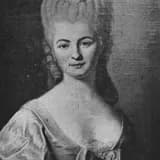
In 1759, Lepaute helped predict the return of Halley’s Comet, a celebrated triumph of Newtonian astronomy.
By 1759, Nicole-Reine Lepaute and her collaborators had predicted the return of Halley’s Comet, a landmark achievement in celestial mechanics and one of the most famous successes of predictive astronomy in the eighteenth century. The calculation was part of the effort that showed Newtonian gravitation could be used not only to explain the heavens but to forecast future events with remarkable accuracy.
This achievement was historically important because it transformed a famous comet from an object of omen and speculation into a test case for mathematical astronomy. Lepaute worked in an era when women were usually excluded from academies and scientific offices, yet her calculation contributed to a result that was recognized across Europe. The work involved long, exacting numerical labor and a deep understanding of how planetary gravitation would alter the comet’s orbit.
Although the prediction is often associated primarily with Clairaut and Lalande, the available sources confirm Lepaute’s participation and treat her as a major contributor. Her role is especially significant in the history of women in science because it demonstrates the hidden labor behind landmark discoveries. The success of the prediction strengthened her reputation and helped establish her as one of the most capable astronomical calculators of her century.