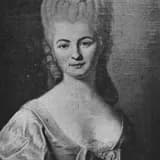
Born on 5 January 1723 in the Palais du Luxembourg in Paris, Nicole-Reine Étable de la Brière would become a pioneering French astronomical calculator.
On 5 January 1723, Nicole-Reine Étable de la Brière was born in the Palais du Luxembourg in Paris, where her father served in the household of Elisabeth d’Orléans, former Queen of Spain. This aristocratic but domestic court setting shaped both the constraints and possibilities of her life.
Growing up inside a royal palace, she was surrounded by symbols of power and by the rhythms of court life, yet, as the daughter of a servant, she had no formal claim to privilege or advanced schooling. Her later mathematical achievements therefore emerged not from institutional education but from self-directed study and informal mentorships.
Her birth in 1723 placed her at the heart of the Enlightenment, just as Newtonian physics and observational astronomy were transforming European science. In this context, a girl with a strong aptitude for numbers and geometry would typically have been confined to private curiosity. That Nicole-Reine would go on to compute cometary orbits, eclipse paths, and planetary ephemerides shows how exceptional this beginning was.
The precise documentation of her birth at the Palais du Luxembourg matters historically because it anchors the story of a woman who crossed boundaries of class and gender. From these early circumstances, she would become one of the key female scientific figures of eighteenth‑century France, later collaborating with leading astronomers such as Alexis Clairaut and Jérôme Lalande.