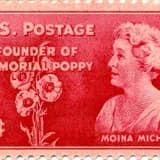
In 1921, the American Legion Auxiliary adopted the red poppy as its memorial flower, extending Moina Michael’s poppy campaign into a nationwide women-led effort.
In 1921 (represented by January 1 because the precise day is not specified in available sources), the American Legion Auxiliary officially adopted the poppy as its memorial flower, building directly on the advocacy of Moina Belle Michael. Auxiliary histories and postal-museum accounts credit her with inspiring the adoption and shaping the Auxiliary’s early poppy programs.
This organizational decision was crucial to the development of large-scale poppy fundraising. The Auxiliary, a women-led body aligned with the American Legion, mobilized volunteers across the United States to make and distribute silk poppies. Disabled veterans were often employed in their production, creating both symbolic recognition and economic support.
Although not a "first" in the conceptual sense, the 1921 adoption translated Michael’s idea into a durable institutional practice. It showed women’s organizations assuming leadership in national remembrance culture and in structured charitable work for veterans at a time when women’s public roles were rapidly expanding in the wake of suffrage.
This milestone also facilitated the international spread of the poppy tradition, as contemporary efforts by figures like Anna Guérin and organizations such as Earl Haig’s British Legion Appeal Fund took up similar models of poppy sales. Through the Auxiliary’s action, Michael’s emblem became embedded in annual observances and fundraising cycles, turning a symbol born of poetry into a practical instrument of relief.