← All women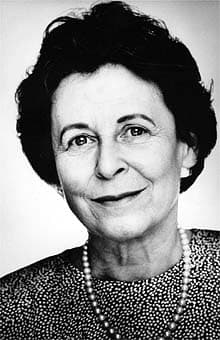
American · Arts · Literature · Politics
Meg Greenfield
December 27, 1930 – May 13, 1999
Early life and education
Mary Ellen “Meg” Greenfield was born on December 27, 1930, in Seattle, Washington, the daughter of Lewis James and Lorraine Nathan Greenfield. She grew up in a Jewish family and was the younger of two children; her brother, James Greenfield, later became known as Jim. Biographical sources identify Seattle as the city that shaped her early life and note that she attended the Bush School before leaving the Pacific Northwest for college. Her birth and upbringing in Seattle remained part of her identity even after she became one of the most visible writers in Washington, D.C.[1][2][3]
Greenfield enrolled at Smith College, where she graduated summa cum laude in 1952. She then studied at Newnham College, Cambridge University, as a Fulbright Scholar in 1952–53. These years established the intellectual habits that would later define her journalism: close reading, sharp analysis, and a preference for carefully reasoned argument over rhetorical flourish. Sources describing her education emphasize both her academic distinction and the breadth of her training before she entered professional journalism.[1][2][3][6]
Early career
Greenfield began her journalism career at The Reporter, a political magazine where she worked for more than a decade. Sources differ slightly on the start of that relationship, but they consistently place her at the magazine by the early 1960s and note that she became its Washington editor in 1965. During those years, she learned the craft of editorial reporting and developed expertise in civil rights, federal defense issues, and national politics. This period was formative: it gave her the subject-matter knowledge and Washington contacts that would later make her such a force in editorial writing.[1][6][13]
Her work at The Reporter brought her into the orbit of the national political press at a moment when journalism was changing rapidly. Women were still scarce in senior editorial positions, and Washington commentary was dominated by men. Greenfield’s advancement in this environment made her an important figure in the slow widening of professional opportunity for women in political journalism. She was building a reputation not merely as a capable writer, but as someone able to interpret policy with unusual precision and independence.[4][5][6]
The Washington Post and Newsweek
In 1968, Greenfield joined The Washington Post as an editorial writer. The timing was consequential. The late 1960s were among the most turbulent years in modern American politics, with civil rights struggles, the Vietnam War, and intense debate over the role of government in public life. Greenfield’s arrival on the Post editorial page placed her in the middle of those national arguments. Her influence grew quickly; by 1970 she had become deputy editor of the editorial page, and by 1979 she had become editor of the page itself, a position she held until her death.[1][5][6][13]
Her Post career ran in parallel with a long relationship to Newsweek, where she wrote a biweekly column from 1974 to 1999. That dual role made her one of the most recognizable editorial voices in the country. Readers encountered her both in the daily newspaper and in a major national magazine, extending her reach across the political and journalistic mainstream. Her commentary was known for clarity, wit, and a disciplined moral seriousness that could cut through ideological noise without descending into cant.[1][2][3][8][12]
Greenfield’s status in Washington was not limited to formal titles. She became a close confidante of publisher Katharine Graham and a central figure in the city’s political and social life. Later archival and interpretive accounts portray her as an insider who understood both the mechanics of power and the social world in which it was exercised. That combination helped make her editorial judgments especially influential: she was not merely commenting on Washington from the outside, but helping define how its institutions were discussed by the broader public.[2][4][15]
Editorial style and influence
Greenfield’s work stood out for its refusal to reduce politics to slogans. Contemporary and retrospective accounts describe her as witty, exacting, and deeply serious about policy details. She wrote on affirmative action, abortion rights, defense policy, the Panama Canal treaties, and other major issues of the era, bringing a lawyerly and analyst’s discipline to subjects that often generated more heat than light. The New York Times described her as someone who examined policy with the zeal of a political scientist and a deep respect for democratic process.[12]
Her influence was also stylistic. In a period when editorial pages often favored grandstanding, Greenfield favored precision and argument. That approach helped establish the Washington Post editorial page as a place where national policy could be discussed with intellectual seriousness. She became one of the best-known women in opinion journalism, and her success helped raise the standard for later generations of editorial writers.[2][3][9][15]
Greenfield’s place in journalism history is especially notable because she succeeded in a field where women were often confined to marginal beats or supportive roles. She rose to direct one of the country’s most prestigious editorial pages and held that power for two decades. That achievement mattered not because she presented herself as a conventional feminist icon—indeed, one obituary noted her ambivalence toward the feminist movement—but because her career itself demonstrated how authority could be exercised by a woman in a domain that had long resisted it.[4][15]
Awards and recognition
The most prominent formal recognition of Greenfield’s career was the 1978 Pulitzer Prize for Editorial Writing. The Pulitzer citation recognized the strength of her editorial work, and the award confirmed her place among the most influential public commentators of her generation. The prize was an important professional milestone both for Greenfield and for the broader history of women in editorial journalism, since it publicly honored a woman whose voice shaped major national debates from within a leading newspaper institution.[1][2][3][9][12]
Beyond the Pulitzer, Greenfield accumulated a reputation that was itself a form of recognition. She was trusted by editors, cited by readers, and remembered in obituaries and retrospective articles as an “editor extraordinaire” and a major force on the Post opinion pages. The preservation of her papers at the Library of Congress further underscores her historical importance. Those archives document the breadth of her career and the range of her influence across journalism, politics, and public life.[13][15]
Personal life
Greenfield never married and had no children, according to biographical sources. That fact is often noted because it distinguishes her from many public figures whose family life is foregrounded in biography. In Greenfield’s case, her work and her intellectual life were the principal public dimensions of her identity. She remained private about much of her personal life, yet not isolated from Washington society. Later accounts emphasize her role in the city’s social world, where her dinners and conversations were part of a broader culture of policy and journalism.[3][4][14]
She lived much of her later life in Washington and, when she was diagnosed with cancer, partly retired to Bainbridge Island in Washington state. Even then, she continued working on a posthumously published memoir titled Washington, which offered a window into the city and the circles she had long observed from the editorial page. Her personal life therefore cannot be separated from her professional one: both were anchored in the intellectual and social world of American politics.[2][14]
Later life, death, and legacy
Greenfield died on May 13, 1999, in Washington, D.C., at age 68, of lung cancer. Her death prompted extensive obituaries in major newspapers, which described her as a shaper of The Washington Post editorial page and a subtle but powerful presence in policy debate across several presidential administrations. Those notices also emphasized the longevity of her influence, which extended well beyond the newspaper’s immediate readership.[2][11][12][15]
Her legacy rests on several linked achievements. She helped professionalize and elevate editorial writing as a form of public reasoning. She proved that a woman could occupy and sustain one of the most influential positions in American newspaper opinion. And she contributed to the political culture of Washington during a period when the press played a central role in translating policy disputes for the public. The Library of Congress papers, the enduring citations to her work, and continued historical interest in her career all reflect a legacy that is both journalistic and institutional.[13][14]
Greenfield’s career is now remembered as part of the broader transformation of American media in the second half of the twentieth century. Her work at The Washington Post and Newsweek showed how rigorous editorial voice could influence public understanding without sacrificing subtlety or intelligence. For women in journalism, her example remains especially important: she did not simply enter a male-dominated profession; she helped redefine its standards from within.
Dated achievements
4 indexed.
- Dec271930Literature
Birth of Meg Greenfield
Birth of Mary Ellen “Meg” Greenfield in Seattle, Washington, the future Washington Post editorial leader and Pulitzer Prize-winning journalist.
View details Meg Greenfield Biography - Department of Classics - Jan011968Arts
Joined The Washington Post
Joined The Washington Post in 1968, beginning the career phase that made her a central editorial voice in American journalism.