← All women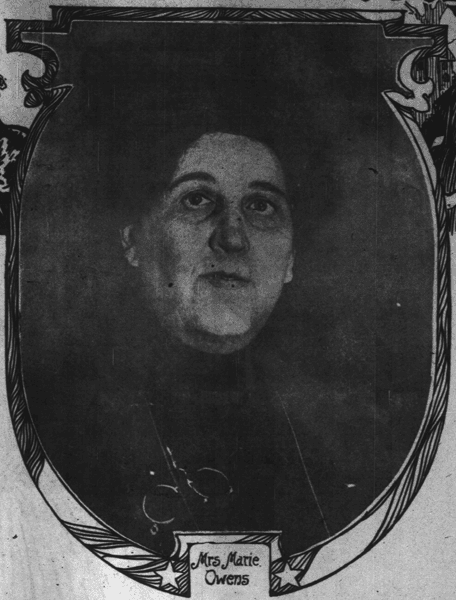
Canadian, American · Politics · Activism · Law
Marie Owens
December 21, 1853 – June 10, 1927
Early life and background
Marie Connolly Owens was born on December 21, 1853, in Ottawa, Ontario, then part of British North America. She was the daughter of Irish immigrants, a background that placed her within the larger history of famine-era migration and the working-class struggles faced by many Irish families in North America. The available sources identify her birth name as Marie Connolly; after marriage she became known as Marie Owens. Details about her formal education are limited in the accessible record, but the course of her life suggests a woman who developed practical skills, persistence, and a strong sense of public duty in an era when women were generally expected to confine themselves to domestic roles.
Owens later moved to Chicago, where she built a family life and entered public service. Her early adult years were shaped by marriage, motherhood, and widowhood. Sources commonly state that she married Thomas Owens and that they had five children. Thomas died in February 1888, leaving her responsible for supporting the family. That loss became a turning point in her life, forcing her into wage labor and public service at a time when widowed women with children faced severe economic and social pressure.
Career beginnings
Before joining the police department, Owens worked for the Chicago city health system. By 1889 she was employed as a factory inspector, a post that connected her directly to the problem of child labor in Chicago’s industrial economy. Reformers of the period were increasingly alarmed by sweatshop conditions, long hours, and the exploitation of children in factories and workshops. Owens’s work brought her into contact with these realities, and it also revealed the limitations of her authority. As a health inspector, she could investigate conditions, but she lacked the legal power to search private property or make arrests.
Those limitations made her a candidate for a new and unusual role. In 1891, Owens was transferred to the Chicago Police Department and appointed a Detective Sergeant with full powers of arrest and a police star. Institutional and journalistic accounts widely describe her as the first female police officer in Chicago and, according to later historical research, the first known female police officer in the United States. The appointment was not merely symbolic. It reflected public concern over child labor and factory abuse, and it gave Owens the authority to enforce laws that had previously been difficult to apply effectively.
Major accomplishments
Owens’s most important historical achievement was not simply that she entered police service, but that she did so in a position with genuine authority. Unlike later women who were sometimes limited to clerical or specialty roles, she held the title of detective sergeant and the legal power to act as a sworn officer. That was exceptionally rare in the early 1890s, when women were commonly excluded from policing, law, and other coercive public institutions. Her appointment helped establish the principle that women could exercise police authority in the public interest.
Her work focused on the enforcement of child labor and compulsory education laws. Historical accounts describe her visiting courts, assisting detective officers in cases involving women and children, and intervening on behalf of young workers. Some sources note that she encountered children as young as seven working in factories. Others say she helped establish schools inside department stores and persuaded employers to reduce the length of the workday for young employees. These accounts place her in the center of Progressive Era reform, when urban investigators were trying to combat exploitation through a combination of law enforcement, social welfare, and public advocacy.
Owens also became a model of how police authority could be used to address family distress. Several later accounts describe her helping abandoned mothers locate absent fathers and using her own resources to support vulnerable women and children. While the details of every episode are not equally documented, the consistent theme across the sources is clear: she used her office to bridge the gap between law and social aid. That approach gave her work a wider moral and civic significance than ordinary policing.
Recognition and public memory
Owens did not receive the kind of public honors that later generations of trailblazing women officers might expect, and much of her recognition came retrospectively. Modern institutional materials from Chicago police and university sources have highlighted her as a departmental pioneer and as a figure of national significance in women’s history. These commemorations have been important in restoring her place in the historical record and in correcting the tendency of early women police officers to disappear from mainstream narratives.
Her name has also been used in educational, museum, and digital-history projects that present her as a foundational figure in women’s policing. That recovery matters because Owens worked at a time when women’s public authority was frequently viewed as exceptional or even improper. The fact that she endured in the role for decades makes her one of the most important early examples of a woman successfully occupying a sworn law-enforcement position in the United States.
Personal life
Sources identify Owens as the wife of Thomas Owens and the mother of five children. After Thomas’s death in 1888, she appears to have become the primary provider for the family. Later accounts indicate that she retired to a life supported by a police pension and, after leaving Chicago, moved to New York to live with one of her daughters. These biographical details underscore the extent to which her career was shaped by family responsibility as well as by public service.
Her life illustrates the overlapping burdens many widowed women carried in the late 19th century. She had to provide for children while navigating a labor market that offered few opportunities to women with dependents. Her rise into police work was therefore not only a personal achievement but also a response to the economic and gender constraints of her time. That context helps explain why her career remains historically resonant: it demonstrates how necessity, reform, and institutional openings could combine to produce a barrier-breaking public role.
Later life and death
Owens retired from the Chicago Police Department in 1923 after approximately 32 years of service. She retired with a police pension, a recognition that reflected the length and significance of her contribution. By then, women’s participation in policing was still limited, but Owens had already established a precedent that others could follow. She had proven that women could perform sworn law-enforcement duties, investigate social abuses, and command legal authority in a male-dominated institution.
She died in New York City on June 10, 1927. Sources indicate that she was buried in Calvary Cemetery in Evanston, Illinois. Her death marked the end of a life that had begun in immigrant Ottawa and ended in the historical memory of Chicago policing. Though she was not always celebrated in her own lifetime, later historians and police institutions have increasingly recognized her as a pioneer.
Legacy
Marie Owens occupies a crucial place in the history of women in law enforcement. She is remembered as the first female police officer in Chicago and, in later scholarship and institutional commemorations, as the first known female police officer in the United States. Her career shows that women’s entry into policing was tied not only to gender equality but also to social reform, especially the fight against child labor and the protection of families.
Her legacy lies in both symbolism and substance. Symbolically, she shattered the assumption that police authority belonged exclusively to men. Substantively, she demonstrated that women officers could address problems that were often invisible to male-dominated institutions, including the exploitation of children and the vulnerabilities of women in industrial cities. For historians of women’s history, labor reform, and urban policing, Owens stands as an early and enduring example of how one woman’s public service could alter the possibilities for many who followed.
Dated achievements
4 indexed.
- Dec211853Activism
Birth of Marie Connolly Owens
Birth of Marie Connolly Owens in Ottawa, Ontario, to Irish immigrant parents.
View details Marie Owens - Wikipedia - Jan011891Politics
Becomes first female police officer in Chicago and the United States
In 1891, Owens became Chicago’s first female police officer and is widely regarded as the first in the U.S.