← All women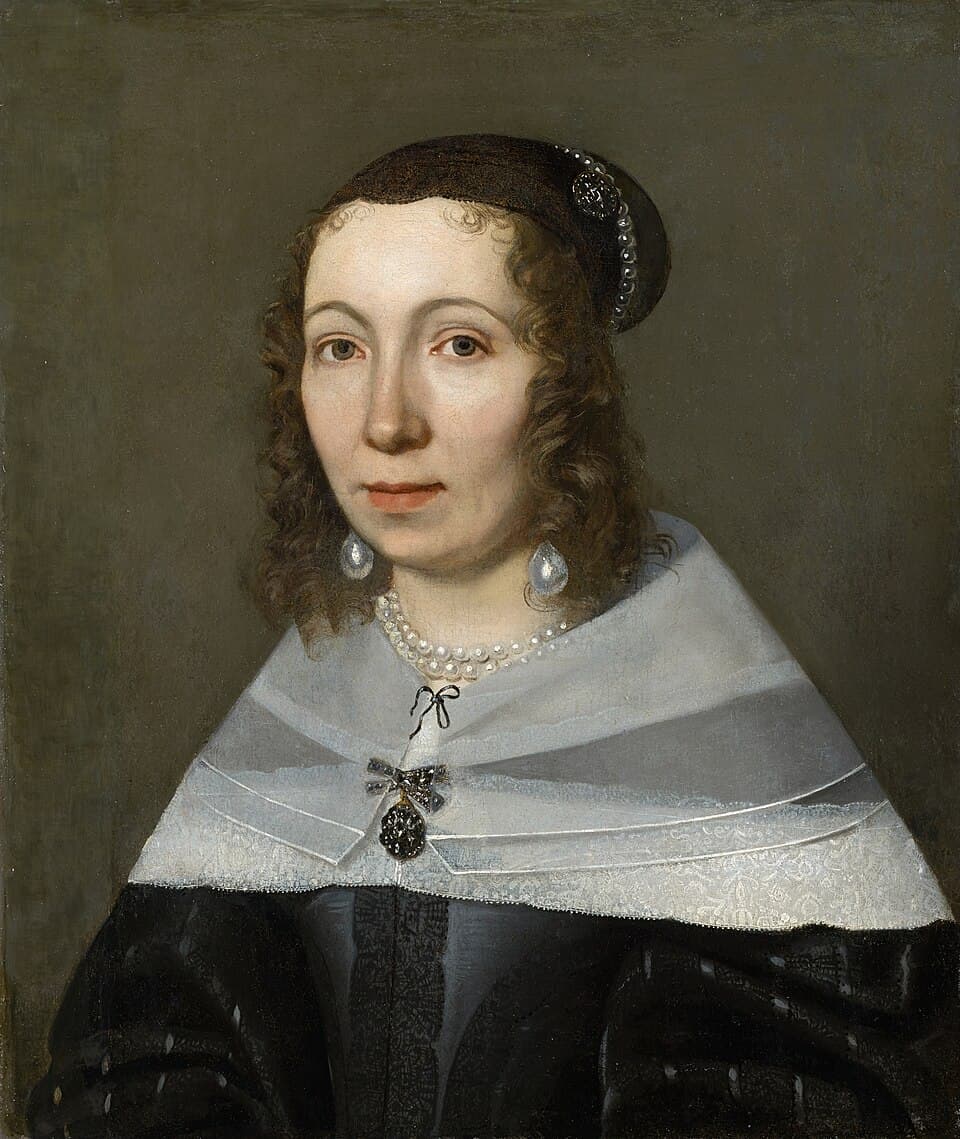
German, Dutch · Science · Arts · Exploration
Maria Merian
April 2, 1647 – January 13, 1717
Early life and family background
Maria Sibylla Merian was born on 2 April 1647 in Frankfurt am Main, in the Holy Roman Empire, into a family whose professional world was centered on printmaking, engraving, and publishing. Her father, Matthäus Merian the Elder, was a prominent engraver and publisher, and her mother, Johanna Sibylla Heyne, later remarried the still-life painter Jacob Marrel after Matthäus Merian’s death. This environment gave Merian unusually early access to images, paper, pigments, and the techniques of reproduction that would later support her own career as an illustrator and author.
Growing up in a household connected to art and printing also meant that Merian was exposed to the material culture of knowledge. She learned to see images not only as decoration but as tools for communication, observation, and preservation. In a period when formal scientific education was largely unavailable to women, this artistic training became a crucial doorway into natural history. From an early age she showed an interest in insects, caterpillars, and the plants they fed on, subjects that many contemporaries considered trivial or merely ornamental.
Frankfurt in the mid-seventeenth century was a commercial and intellectual crossroads, and Merian’s upbringing in that city helped position her at the intersection of art and learning. Her later work would draw on this early synthesis. She was not trained in a university setting, but she developed the skills of observation, drawing, and coloring that allowed her to make authoritative records of living creatures. In that sense, her family background shaped not only her career path but also her method: close looking, careful depiction, and an insistence that nature should be studied directly.
Early training and first artistic work
Merian’s artistic training began within the household and studio environment of her family. She learned drawing and watercolor techniques in a milieu that valued precision and commercial quality. As a young woman, she also encountered the work of her stepfather Jacob Marrel, a painter of flowers and still lifes, whose influence likely helped shape her interest in botanical subjects. The combination of engraver’s discipline and painterly color would later become one of the hallmarks of her natural-historical illustrations.
Her earliest independent work appears to have focused on flowers and insects, often combined in compositions that reflected both artistic taste and observational curiosity. By the 1670s she was already building a reputation for images of flowers, and in 1675 she published her first book of flowers. That publication established her as more than a talented amateur. It showed that she could produce work for circulation, participate in the book market, and appeal to audiences interested in decorative and botanical subjects.
In 1679, Merian published her first caterpillar book, a work that would prove decisive for her scientific reputation. Instead of treating insects as isolated curiosities, she linked caterpillars with the host plants on which they fed and with the adult forms into which they transformed. This was a major conceptual advance. Many people still accepted inherited assumptions about spontaneous generation or did not understand the full insect life cycle, but Merian’s careful sequencing of egg, larva, pupa, and adult offered a visually persuasive alternative based on observation.
Marriage, household life, and artistic independence
Merian married Johann Andreas Graff, a painter and merchant, and the marriage produced two daughters, Johanna Helena and Dorothea Maria. The relationship eventually broke down, and Merian later separated from her husband. Her domestic life was therefore marked by both family responsibility and personal independence. She lived and worked in settings that required her to sustain herself and her daughters while also pursuing increasingly ambitious artistic and natural-historical projects.
The fact that she maintained productive work despite the constraints placed on women in her era is central to her historical importance. Seventeenth-century women, especially married women, were often expected to subordinate their ambitions to family and household obligations. Merian did not completely escape those pressures, but she managed to develop a career that combined teaching, production, and publication. Her daughters also became important collaborators, demonstrating that her work was supported by a family network rather than by formal institutional sponsorship.
By the later part of the seventeenth century, Merian had moved to Amsterdam, where she found access to collectors, merchants, and natural historians interested in the wider world. Amsterdam was a hub of global trade and natural-history exchange, and it provided her with specimens, images, and contacts that expanded her work. There she refined both the scientific content and the artistic presentation of her publications, bringing together empirical detail and elegant design in a way that made her books desirable to both scholars and collectors.
Scientific contributions and the caterpillar books
Merian’s major scientific contribution was her insistence that insects should be studied through their life cycles and in relation to the plants and environments that sustained them. Her caterpillar books documented metamorphosis in a way that was both carefully observed and visually clear. She did not simply catalog species; she showed change over time, making development itself a central scientific subject. This was a significant departure from many earlier natural history works that emphasized classification over process.
Her illustrations brought together caterpillars, chrysalises, butterflies, moths, flowers, leaves, and other environmental details in single compositions. This method conveyed ecological relationship as well as anatomical form. It also helped readers understand that insects were not spontaneously generated but developed from eggs and passed through recognizable stages. Such conclusions contributed to the advance of entomology in the late seventeenth and early eighteenth centuries.
The originality of Merian’s method lay in her combination of firsthand observation, artistic design, and explanatory sequence. Her images were not mere embellishments to text; they were a central means of argument. Because women were rarely welcomed into scholarly institutions, Merian built authority through publication and visual proof. Her books entered networks of collectors, physicians, artists, and naturalists, allowing her observations to circulate widely even in the absence of institutional office. In this way, her work helped redefine what counted as scientific evidence.
The Suriname expedition
In 1699, Merian undertook her celebrated self-funded expedition to Suriname with her younger daughter, Dorothea Maria. This journey was one of the boldest acts of scientific independence in early modern Europe. Rather than traveling as part of a husband’s household or under the protection of a patron, she organized the expedition on her own initiative to observe tropical insects and plants in their native setting.
The trip is historically important not only because of the scientific results it produced, but because of what it represented. Women in Merian’s era were generally denied access to independent scholarly travel, and overseas field research was even more strongly associated with male explorers, missionaries, and colonial administrators. Merian overcame those barriers by financing the journey herself and by insisting on her right to study the natural world directly. Her work in Suriname therefore stands as a rare example of a woman exercising scientific agency across geographic and imperial boundaries.
During the expedition she recorded insects at different stages of development and carefully observed their relationships to host plants and habitats. She later returned to Amsterdam and transformed these notes and drawings into one of her most famous books. The Suriname journey strengthened her reputation as an observer of living nature and gave her work a global dimension. It also linked European natural history to the colonial world, even as her own approach remained distinctively empirical and visual.
Metamorphosis Insectorum Surinamensium
In 1705, Merian published Metamorphosis Insectorum Surinamensium, her most famous work. The book, issued in Dutch and Latin, presented illustrations and descriptions of tropical insects, plants, and their developmental stages. It was the culmination of years of field observation, drawing, and editorial work. The volume’s combination of scientific content and artistic excellence made it one of the most admired natural-history books of the early modern era.
The significance of Metamorphosis lies in its method as much as in its subject. Merian showed insects in relation to their food plants, demonstrated metamorphosis through sequential images, and presented the Surinamese environment as an interconnected system. This made the book valuable to naturalists, physicians, collectors, and artists alike. It also helped bring the study of insect life into a more precise and observational framework. Her approach anticipated later ecological thinking by emphasizing relationships among organisms rather than isolated specimens.
The publication also represented a major achievement for a woman author in a male-dominated intellectual culture. Books of natural history were expensive to produce and often depended on elite support. Merian’s ability to bring the project to completion testified to her technical skill, entrepreneurial determination, and scientific credibility. The work circulated internationally and helped secure her posthumous reputation as one of the most important illustrators and observers of her age.
Recognition, later reputation, and influence
Merian did not receive the kinds of formal academic honors that later scientists might receive, in part because such structures were rarely open to women in her lifetime. Yet she earned recognition through the circulation of her books and through the admiration of later naturalists, historians, and artists. Her work was valued for its clarity, beauty, and empirical reliability. She became known as a figure who united science and art rather than separating them.
In modern historical writing, Merian is often described as an early entomologist, an important naturalist, and an innovator in scientific illustration. Some historians also place her in the history of ecology because she consistently linked insects to host plants and habitats. While such labels are partly retrospective, they reflect the genuine novelty of her approach. She examined organisms in context, observed development over time, and used images as evidence. Those methods made her work durable and influential.
Institutions such as major museums, gardens, and scientific history organizations now honor her as a pioneering woman of science and art. Her work is studied both for its scientific content and for its contribution to the history of visual culture. In particular, she stands as an important example of how a woman could create authority outside formal institutions by combining skill, curiosity, and perseverance.
Personal life and family relationships
Merian’s personal life was shaped by marriage, separation, motherhood, and collaboration. Her daughters, especially Dorothea Maria, played meaningful roles in her later life and work. Their companionship on the Suriname voyage illustrates how family relationships could support women’s intellectual pursuits even when public institutions did not. Merian’s domestic and professional worlds were intertwined, and her career cannot be separated from the labor and assistance that made it possible.
Her separation from her husband is also important historically because it allowed her greater autonomy. Although women’s legal and economic options were limited, Merian managed to build a life in which she could pursue research, publish books, and move across cities and countries. The tension between family obligation and artistic freedom is part of what makes her career so compelling: she did not live outside the constraints of her era, but she worked persistently within and against them.
Death and legacy
Maria Sibylla Merian died in Amsterdam on 13 January 1717. Her death ended a career that had already produced a remarkable body of work, but her influence continued to grow after her lifetime. Her books remained admired for their beauty and precision, and her combination of art and observation later made her a model for historians of science, illustrators, and naturalists.
Merian’s legacy is especially significant for women’s history. She demonstrated that a woman could produce authoritative knowledge, support herself through artistic labor, travel for research, and publish on a large scale in a world that routinely excluded women from scholarly institutions. She also showed that scientific understanding could be advanced through close observation of ordinary life forms such as caterpillars, butterflies, and host plants. Her work helped shift natural history toward a more process-based and environment-based view of living things.
Today she is remembered not only as a botanical artist but also as a founder figure in entomology and a key precursor to ecological thinking. Her reputation rests on a rare combination of intellectual independence, technical skill, and visual power. In the history of science and art, Maria Sibylla Merian stands as one of the most remarkable women of the early modern world.
Dated achievements
3 indexed.
- Apr021647Science
Birth of Maria Sibylla Merian in Frankfurt am Main
Maria Sibylla Merian was born in Frankfurt am Main into a family of publishers and engravers, setting the stage for her future as a naturalist-artist.
View details Maria Sibylla Merian - Wikipedia - Jan011699Exploration
Self-funded scientific expedition to Suriname
Merian funded and organized her own expedition to Dutch Suriname with her daughter Dorothea, a rare independent scientific journey for a European woman.