← All women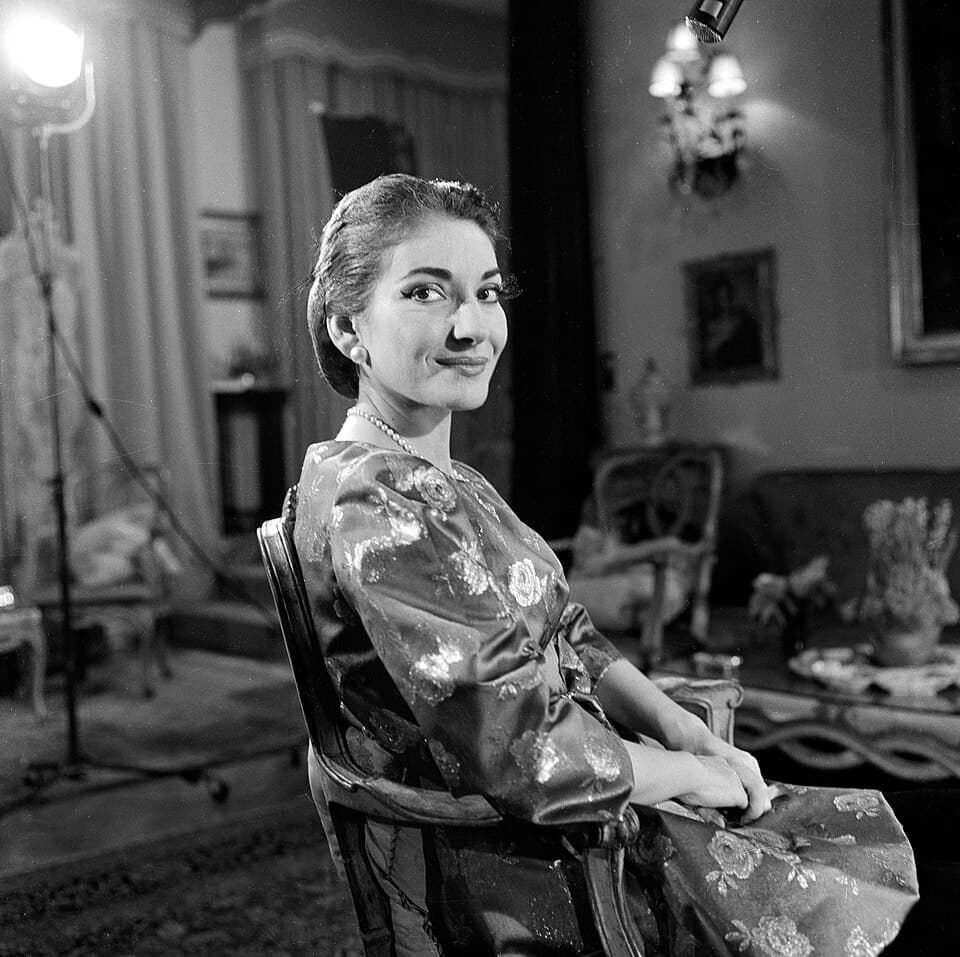
Greek, American · Arts
Maria Callas
December 2, 1923 – September 16, 1977
Early life and background
Maria Callas was born Maria Anna Cecilia Sophia Kalogeropoulou on 2 December 1923 in New York City, to Greek immigrant parents George Kalogeropoulos and Evangelia ("Litsa") Dimitriadou.[1][2][5] Her father, a pharmacist, later shortened the family name to Callas (or Kalos) to sound more American.[1][9][16] She grew up in a tense household marked by frequent parental quarrels and financial instability, conditions that would shape her drive, insecurity and fierce work ethic.[4][13]
The Callas family lived in various neighborhoods of Manhattan during Maria’s childhood. Her mother, disappointed not to have borne a son, initially showed little affection for her, but soon realized that Maria’s musical aptitude could be exploited and began to push her toward performance.[1][4] Callas later recalled a lonely childhood in which she felt undervalued except when singing, a dynamic that helped forge her intense identification with operatic heroines who suffer and sacrifice.
In 1937, amid the Great Depression and the breakdown of her parents’ marriage, Maria’s mother took Maria and her older sister Jackie back to Greece, leaving George in New York.[1][4][5] The move, made when Maria was in her early teens, transformed her environment. In Athens, she was surrounded by the Greek language, culture and the turbulent politics of a country soon to be drawn into war. It was there that her formal musical education began in earnest.
Callas enrolled at the National Conservatoire and later at the Athens Conservatoire, studying with the esteemed Spanish coloratura soprano Elvira de HidalgoCavalleria rusticana in 1939, which reportedly won her a first prize in opera.[4] These formative years in Athens, during which she often walked long distances to save money for music scores and lessons, forged the technical and psychological foundation of her later career.
Career beginnings and wartime Athens
Callas’s professional life began against the backdrop of World War II and the Axis occupation of Greece. In early 1941 she made her professional debut at the Royal (later Greek National) Opera in Athens in a modest role in Franz von Suppé’s operetta Boccaccio, marking her transition from student to professional singer.[5] Despite difficult wartime conditions, including shortages and censorship, she continued to appear in Athens productions, quickly graduating to more substantial parts.
A decisive breakthrough came on 27 August 1942, when she sang her first leading role as the title heroine in Puccini’s Tosca at the Olympia Theatre in Athens.[5] Still in her teens, she took on the taxing role of Floria Tosca, showcasing both her powerful dramatic soprano and her instinctive acting ability. This performance established her as a leading soprano in Greece and foreshadowed her later identification with the role on international stages.
After the liberation of Greece, Callas faced a difficult professional environment marked by political polarization, limited resources and internal intrigues within the opera company.[1][5] She also confronted personal tensions with her mother, who managed aspects of her career while exploiting her financially and emotionally, according to later biographical accounts.[13] By 1945 she resolved to seek opportunities abroad, encouraged by visiting conductors who recognized that her talents demanded a wider arena.
Move to Italy and international breakthrough
In 1947 Callas returned briefly to the United States, auditioning unsuccessfully at the Metropolitan Opera before receiving an offer from Italy.[1][2] That same year she traveled to Verona, where she met industrialist Giovanni Battista Meneghini, who would become her patron, manager, and later her husband.[9] Italy, with its dense network of opera houses and postwar cultural revival, offered fertile ground for her ambitions.
Her Italian breakthrough occurred on 2 August 1947, when she made her Italian debut at the Arena di Verona as the title character in Ponchielli’s La Gioconda, conducted by Tullio Serafin.[5] The performance, in one of Europe’s most prestigious open‑air venues, drew an ecstatic audience response and brought her to the attention of the Italian music world. Serafin quickly became a key mentor, guiding her repertory choices and encouraging her to explore bel canto roles alongside heavier dramatic parts.
Over the next few years, Callas sang demanding roles across the Italian peninsula, including Turandot at Rome’s Terme di Caracalla in 1948, confirming her capacity for both volume and stamina.[5] A famous episode from this period saw her switching within days from Brünnhilde in Wagner’s Die Walküre to Bellini’s Norma, demonstrating an extraordinary stylistic range that astonished contemporaries and later raised questions about the long‑term impact on her voice.[1][2]
From 8 to 10 September 1949, she recorded her first commercial discs at the RAI Auditorium in Turin, inaugurating a recording career that would make her interpretations available to a global audience.[5] These early sessions, dominated by Italian arias, already revealed the distinctive profile that would polarize critics: an idiosyncratic timbre, incisive diction, daring rubato and a strong emphasis on textual expression.
La Scala and the golden decade
The 1950s are generally regarded as Callas’s "golden decade". Central to this period was her relationship with La Scala in Milan, Italy’s most prestigious opera house. On 12 April 1950 she appeared there for the first time, singing the title role in Verdi’s Aida as a stand‑in for Renata Tebaldi.[5] Though this was not a contracted debut, it exposed her to La Scala’s exacting audience and critics, revealing both her formidable dramatic resources and the individuality of her voice.
Her official, contracted La Scala debut came on 7 December 1951, when she sang Princess Elena in Verdi’s I Vespri Siciliani for the opening of the theater’s season.[5] This engagement marked the beginning of an intense artistic collaboration with La Scala that would define her career and significantly influence postwar opera. Over the next decade, she appeared there in a series of landmark productions, often under the musical direction of Serafin and the stage direction of Luchino Visconti and others, including:
- Bellini’s Norma, which became one of her signature roles
- Donizetti’s Lucia di Lammermoor, notable for its psychologically probing mad scene
- Verdi’s La traviata, in a Visconti production often cited as a turning point in operatic stage realism
- Cherubini’s Medea, in which she reimagined a relatively neglected work as a modern psychological tragedy
In parallel, Callas underwent a dramatic physical transformation. Around 1951 she began a strict regimen that led to the loss of a substantial amount of weight over a relatively short period.[1][5] This change intensified her stage presence and expanded her possibilities as a singing actress, but some observers have argued that it may also have affected her vocal stability and endurance.
The early 1950s also saw the consolidation of her discographic legacy. In 1953 she made major studio recordings of Mascagni’s Cavalleria rusticana and Donizetti’s Lucia di Lammermoor, among others, for EMI.[4] These recordings, supervised by producers such as Walter Legge, captured her at or near her vocal peak and would later be regarded as reference interpretations, especially for the bel canto repertory.
Bel canto revival and artistic significance
Callas is widely credited by critics and musicologists with playing a central role in the mid‑20th‑century revival of bel canto opera.[2][5] At a time when many 19th‑century Italian works by Bellini, Donizetti and early Verdi were neglected or performed in heavily cut and simplified versions, she insisted on restoring original scores, ornamentations and dramatic coherence. Her combination of dramatic soprano weight with coloratura agility allowed her to sing roles like Norma, Lucia, Elvira (I puritani) and Anna Bolena with an expressive intensity not heard for generations.
Collaborating closely with Serafin and stage directors such as Visconti and Franco Zeffirelli, she treated operatic characters as psychologically complex beings rather than as mere vehicles for vocal display. Her performances emphasized textual meaning, subtle dynamic shading and theatrical verisimilitude. This approach influenced a generation of singers and directors, contributing to a broader shift toward regie‑theater and dramatic realism in opera.[1][2]
Callas’s recordings of bel canto works in the 1950s—such as her 1955 studio Norma and 1957 recordings of Cherubini’s Medea and Bellini’s La sonnambula—have remained central to the discography.[4] They helped redefine expectations for these roles, with later interpreters often measured against her example. While some contemporaries criticized technical imperfections, the emotional immediacy and structural insight of her performances made a lasting impact on how these operas are understood.
American debuts and global celebrity
Although American‑born, Callas did not achieve major success in the United States until the mid‑1950s. In 1954 she made her American operatic debut with the Lyric Opera of Chicago, singing Bellini’s Norma and other roles to considerable acclaim.[4] These appearances introduced her to U.S. audiences as an already controversial European star whose artistry and temperament defied conventional expectations.
Her most symbolically charged American engagement came on 29 October 1956, when she debuted at the Metropolitan Opera in New York, again in the title role of Norma.[1][9] The performance, in the city of her birth, was both an artistic and public event, covered widely in the press. Audience reaction was fervent, and critical opinion divided; some hailed a new standard of dramatic truth, while others expressed reservations about her vocal timbre and certain technical aspects. Nonetheless, the debut firmly established her as a major figure in American operatic life.
In the United States and internationally, Callas became a media phenomenon. Photographs in fashion magazines, coverage of her glamorous lifestyle and reports of backstage disputes contributed to an image of the "diva" as charismatic and unpredictable. She appeared on television and made numerous recordings, further extending her fame beyond traditional opera circles.[1][2] Her ability to command attention in both artistic and popular media domains marked a new phase in the relationship between high culture and celebrity.
Awards, honors and recognition
Over the course of her career, Callas received numerous honors, reflecting both her artistic stature and her symbolic importance. She was appointed a Commendatore of the Order of Merit of the Italian Republic (OMRI), one of Italy’s significant civilian honors, recognizing her contributions to the country’s cultural life.[7][11] She also received decorations from the Greek state and various cultural institutions, and was celebrated by critics and colleagues as a transformative figure in opera.
While detailed dates for many awards are not consistently documented, contemporary reviews, festival programs and institutional archives demonstrate the breadth of her recognition. She was repeatedly invited to open seasons at major houses, a sign of prestige, and featured as a star artist at festivals such as those in Verona and Edinburgh. In the decades following her death, retrospectives, museum exhibitions and centenary celebrations—such as the opening of the Maria Callas Museum in Athens—have continued to affirm her status as an icon of 20th‑century music.[5]
Personal life: marriage and relationships
Callas’s personal life attracted as much attention as her artistry, often framed in the press as a modern operatic drama. In Italy she developed a close relationship with Giovanni Battista Meneghini, a wealthy industrialist significantly older than she. They married in 1949, and he took on the role of her manager, controlling many aspects of her career and finances.[1][9] During the height of her success in the 1950s, she was often known as Maria Meneghini Callas.
By the late 1950s, tensions in the marriage were exacerbated by her growing independence, artistic pressures and the increasing presence of journalists in her private life. In 1959 she began a much‑publicized relationship with Greek shipping magnate Aristotle Onassis, whom she had met in the mid‑1950s. The relationship, intense and tumultuous, led to her separation from Meneghini and became a staple of international gossip coverage.[1][13]
Biographers and investigative journalists have later alleged that both Meneghini and Onassis exploited Callas financially and emotionally, with reports of infidelity, controlling behavior and emotional abuse.[13] Onassis ultimately married Jacqueline Kennedy in 1968, an event that deeply wounded Callas, who had long hoped for a more stable partnership. She had no children, and in later interviews and accounts, friends suggested that the absence of a family life contributed to her feelings of isolation.
Later career, teaching and film
By the early 1960s, signs of vocal wear became increasingly evident. Critics noted more frequent cancellations, unevenness in live performances and a narrowing of her repertory.[1][2] The reasons remain debated, with proposed factors including exceptionally strenuous roles, rapid weight loss, health issues and psychological stress. Nevertheless, she continued to deliver powerful interpretations in select performances.
In 1965 she made what would be her final appearances in staged opera, including a famous run of Tosca in London, after which she effectively retired from the operatic stage.[4][5] She subsequently explored new artistic avenues. Notably, she collaborated with Italian director Pier Paolo Pasolini on the 1969 film Medea, in which she portrayed Euripides’ tragic heroine without singing, relying solely on her acting skills.[4] The film, now a cult work, revealed her capacity for purely dramatic performance and extended her influence into art cinema.
Between 1971 and 1972 Callas taught master classes at the Juilliard School in New York.[4][16] These classes, attended by young singers from around the world, offered insights into her approach to interpretation, phrasing and character. Transcripts and recordings of the sessions, later published and broadcast, show her demanding, sometimes severe, but profoundly committed attitude to musical and textual fidelity. Through this pedagogical work, she influenced a new generation beyond those who had seen her perform live.
In 1973–74, she returned to the stage in a different format, undertaking a concert tour with tenor Giuseppe Di Stefano. The tour, covering Europe, North America and Asia, allowed audiences to hear her again in arias and duets, though her voice by then showed clear signs of decline. The final concert of this series, in Sapporo, Japan, on 11 December 1974, is generally regarded as her last public performance.[4]
Later life and death
After the Sapporo concert, Callas withdrew largely from public life, living in relative seclusion in her Paris apartment. Friends and biographers describe this period as one of melancholy and introspection, punctuated by occasional teaching and private musical work but devoid of major new public projects.[1][13] The death of Aristotle Onassis in 1975 and the fading of her own vocal abilities contributed to a sense of loss and disorientation.
On 16 September 1977, Maria Callas died in Paris at the age of 53, widely reported as due to a heart attack (acute myocardial infarction).[1][2][9][11][15] She was cremated, and her ashes were eventually scattered in the Aegean Sea, symbolically returning her to her Greek heritage.[1] News of her death prompted widespread tributes in the international press, with many writers emphasizing the intensity of her artistry and the tragic undertones of her life story.
Legacy and historical impact
In the decades since her death, Maria Callas has come to be regarded as one of the most influential opera singers of the 20th century.[1][2] Her recordings remain bestsellers, and new remasterings continue to attract listeners. Critics often describe a "before and after Callas" divide in the history of operatic performance, particularly in the Italian repertory.[5]
Her legacy can be summarized in several key dimensions:
- Bel canto revival: By insisting on stylistic fidelity and dramatic truth in works by Bellini and Donizetti, she helped restore serious critical and popular attention to operas that had been dismissed as vehicles for vocal display.
- Integration of acting and singing: Callas treated opera as drama in music, setting a standard for physical and psychological involvement that influenced later stars from Renata Scotto and Shirley Verrett to modern interpreters.
- Recording and media presence: Her extensive discography, filmed performances and televised appearances made her a global icon and demonstrated the power of recording technology to shape reputations.
- Gender and celebrity: As a woman navigating male‑dominated institutions and a voracious press, she became a prototype of the modern female superstar, scrutinized for her appearance and private life as much as for her artistry. Her story has inspired countless books, films and stage works, including the documentary Maria by Callas, which re‑examines her life through her own words.
Institutions and initiatives continue to honor her memory. The Maria Callas Museum in Athens, opened in the 21st century, preserves costumes, scores, recordings and personal items, presenting her life and work to new generations.[5] Centennial celebrations in 2023 included exhibitions, new biographies and special performances around the world, underscoring her enduring resonance.
For musicologists and performers alike, Callas remains a subject of intense study and debate. Her technical choices, interpretive liberties, vocal decline and dramatic innovations continue to provoke discussion, making her not only a historical figure but an ongoing presence in the evolving practice of opera. Above all, her ability to convey vulnerability, rage, ecstasy and despair through voice and gesture secured her place as "La Divina"—a singer whose art, for many listeners, transcends time.
Dated achievements
9 indexed.
- Dec021923Arts
Birth of Maria Callas in New York City
Birth of Maria Callas (Maria Anna Cecilia Sophia Kalogeropoulou) in New York City to Greek immigrant parents.
View details Maria Callas – Biography - Aug271942Arts
First leading role as Tosca in Athens
First leading role: Callas debuts as Tosca at the Olympia Theatre in Athens, establishing herself as a leading soprano in Greece.