← All women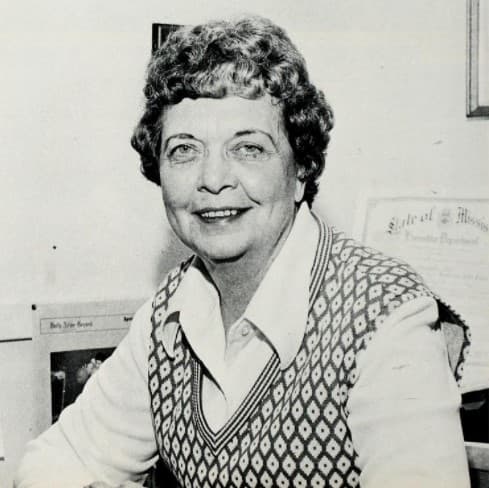
American · Sports
Margaret Wade
December 30, 1912 – February 16, 1995
Early Life and Background
Lily Margaret Wade was born on December 30, 1912, in McCool, Attala County, Mississippi.[1][12] She was the youngest of eight children of Robert and Bittie Wade, and spent her childhood in a rural environment that offered few formal opportunities for girls’ athletics.[4][6] The broader cultural climate of the early 20th-century South regarded strenuous sport as inappropriate for women, a view that would profoundly shape Wade’s later activism.
As a student, Wade moved to Cleveland, Mississippi, where she attended school and discovered basketball.[2][6] She played for the Lady Wildcat basketball team at Cleveland High School in the mid-1920s, quickly emerging as a standout forward.[2] Her success at the high school level demonstrated both her natural talent and her determination to excel despite societal limitations on women’s participation in sport.
Wade’s abilities earned her a place at Delta State Teachers College (now Delta State University). She enrolled in the late 1920s and joined the college’s women’s basketball team, becoming one of the program’s central figures.[1][4][6] Her early experiences at Delta State—first as a star player, then as a witness to the sport’s institutional suppression—would later inform her approach to coaching and her drive to secure lasting opportunities for women athletes.
College Career and the 1932 Program Discontinuation
At Delta State, Wade became a key member of the women’s basketball team beginning in 1929
In 1930, Wade’s team posted a 13–0 record, an undefeated season that demonstrated the skill and organization present in women’s basketball even at a time when the sport lacked broad institutional support.[6] Delta State’s women reached Mississippi Valley and Southern championships, and Wade herself earned recognition as "Best Female Athlete" in 1932.[10] She also excelled in other sports, winning Delta State tennis titles in 1932 and 1933.[10] This promising trajectory abruptly ended on March 10, 1932, when Delta State’s administration decided to eliminate the women’s basketball program, declaring the sport "too strenuous" for women.[1][6][12] The action reflected widespread contemporary beliefs about women’s physical fragility and propriety. Wade and her teammates staged a dramatic protest, burning their uniforms to express outrage at the decision and their exclusion from competitive sport.[1][6] The termination of the program ended Wade’s college playing career but did not extinguish her passion for the game. She completed her studies, graduating from Delta State around 1933, and soon turned toward coaching and semi-professional play.[6][12] The 1932 episode became a formative experience: it illustrated the vulnerability of women’s athletics to administrative decisions and inspired Wade’s later efforts to build durable structures for women’s basketball. After the cancellation of Delta State’s program, Wade continued to play basketball with the Tupelo Red Wings, a semi-professional women’s team, for approximately two seasons in the mid-1930s.[6][12] She served as team captain and helped lead the Red Wings to a Southern Championship, demonstrating that high-level women’s basketball could flourish outside traditional collegiate structures when given opportunity.[6] Her playing career ended prematurely when a knee injury forced her retirement from competitive play.[6][12] Rather than leaving the sport, Wade resolved that she "would never be separated from the game" but would instead engage in another capacity—as a coach.[6] This transition marked the beginning of a long and influential coaching career across Mississippi’s high school system. In 1933, shortly after graduating from Delta State, Wade began coaching and teaching at the high school level.[6][12] She held positions at Marietta High School in 1933–34 and Belden High School in 1934–35.[10] She then embarked on a storied tenure at Cleveland High School starting around 1940, where she coached girls’ basketball for nearly two decades.[6][10] At Cleveland High School, Wade compiled a remarkable record. Between the mid-1940s and late 1950s, her teams won Bolivar County basketball championships in 14 out of 15 years (1944–59) and captured multiple Delta Valley Conference championships (1952, 1953, 1956).[10] Overall, she amassed a high school coaching record of 453–89, making her one of the most successful high school basketball coaches in Mississippi history, male or female.[5][10] After concluding her high school coaching career in 1954, Wade entered a brief retirement from coaching, but she remained committed to physical education.[6] In 1959Director of Women’s Physical Education, a role she would hold for many years.[5][6] In this position, Wade oversaw intramural sports, physical education curricula, and recreational activities for women students. These responsibilities were crucial during the years before widespread intercollegiate competition. Wade’s work helped sustain an athletic culture for women and ensured that physical activity remained part of their education, even in the absence of varsity teams.[6][12] Her presence at Delta State during the 1960s and early 1970s meant that she was well positioned to influence decisions as the national landscape changed. In 1972, the passage of Title IX of the Education Amendments mandated equal opportunities for women in federally funded educational institutions, including athletics. Although Delta State was a small regional university, the growing national emphasis on women’s sports created new possibilities—possibilities Wade was uniquely prepared to help realize. In the early 1970s, Delta State administrators decided to resurrect the women’s basketball program that had been dormant since 1932. In 1973, they turned to Wade, then about 60 years old and widely respected for her high school coaching achievements and her leadership in physical education, to lead this revival.[1][5][6][12] Wade began her official tenure as head coach for the 1973–74 season, effectively starting on November 1, 1973, with preseason preparations.[1][6] Her first Lady Statesmen team compiled a 16–2 record, an immediate sign that the revived program would be competitive at a high level.[1][5] Wade’s coaching style was characterized by disciplined fundamentals, strong defense, rigorous conditioning, and an atmosphere in which female athletes were both challenged and supported. From the outset, Wade cultivated a core group of players, including stars like Lucy Harris, who would become one of the most celebrated figures in women’s basketball. Under Wade’s guidance, Delta State began to compete in the Association for Intercollegiate Athletics for Women (AIAW), the primary governing body for women’s collegiate sports before the NCAA’s full involvement.[1][5] Wade’s leadership produced one of the most dominant eras in early women’s collegiate basketball. Over three seasons—1974–75, 1975–76, and 1976–77—Delta State’s Lady Statesmen amassed a combined record of 93–4 and a 51-game winning streak.[1][5] During this period, they won three consecutive AIAW Division I national championships, a feat that remains a benchmark in the sport’s history. On March 23, 1975, Delta State secured its first AIAW national title for the 1974–75 season, completing an undefeated 28–0 campaign.[1][5][10][12] The team’s success, driven by Wade’s coaching and Harris’s scoring, demonstrated that a small Southern university could compete with and surpass larger, better-known institutions in women’s basketball. Wade’s program followed this triumph with a second national championship on March 21, 1976, winning the 1975–76 AIAW Division I tournament.[1][5][12] This repeat performance confirmed Delta State’s status as a powerhouse and reflected Wade’s ability to sustain excellence even as opponents adjusted to her team’s strengths. The pinnacle came on March 27, 1977, when Delta State captured its third consecutive AIAW national title for the 1976–77 season.[1][5][10][12] The three-peat was unprecedented in women’s collegiate basketball and drew national media attention. Many observers credited Wade’s disciplined system and her player development for this sustained dominance. Beyond the national titles, Delta State under Wade also won multiple Region 3 AIAW championships (1975–77) and Mississippi state AIAW championships (1974–77).[10] Her teams became the first Mississippi women’s basketball team to play in Madison Square Garden, further evidence of the program’s growing national profile.[10] Wade’s success attracted an array of honors. In 1974, following Delta State’s undefeated season and first national championship, she was named AIAW National Coach of the Year, recognizing her as the premier women’s collegiate coach in the country.[6] In subsequent years, she received additional regional and national coach-of-the-year citations in connection with the Lady Statesmen’s dominance.[6][10] Her contributions were also celebrated within Mississippi. In 1972, she entered the Delta State Sports Hall of Fame, confirming her status as one of the institution’s foremost athletic figures.[10] In 1975, around the time of the first AIAW championship, she was inducted into the Mississippi Sports Hall of Fame, a major statewide recognition of her impact as both player and coach.[6][10] Further honors followed: the Mississippi Coaches Hall of Fame inducted her in 1976, and she received the Governor’s Outstanding Mississippian Award in 1975.[10] In 1977, she was named Kellogg’s Coach of the Year in Mississippi, reflecting popular and commercial appreciation for her achievements.[10] On April 30, 1977, the Women’s Basketball Coaches Association established the Wade Trophy in her honor, to be awarded annually to the top NCAA Division I women’s basketball player.[1][5][10][12] The award quickly came to be known as the "Heisman Trophy of women’s sports," and its creation ensured that Wade’s name would remain prominent in women’s basketball.[10] In 1978, after she had retired from coaching but while her influence remained strong, Wade received the sport’s highest formal recognition. On October 13, 1978, she was inducted into the Naismith Memorial Basketball Hall of Fame, becoming the first woman ever enshrined in the Hall.[1][4][6][12] This milestone acknowledged her role in elevating women’s basketball to national prominence and signaled an institutional shift toward recognizing women’s contributions in the sport. Posthumously, Wade continued to receive honors. In 1999, she was inducted into the inaugural class of the Women’s Basketball Hall of Fame in Knoxville, Tennessee, further solidifying her legacy as one of the sport’s foundational figures.[4][5] Her career and influence are also documented in oral histories and archival collections at Delta State University.[6][11] Wade’s coaching philosophy combined strict discipline with genuine care for her players. She emphasized fundamentals—solid defense, efficient offense, and teamwork—while insisting on conditioning and mental toughness.[1][5][6] Her coaching style reflected her belief that women deserved the same rigorous preparation and competitive respect accorded to men’s teams. Players often described Wade as demanding but fair, someone who expected excellence and gave her athletes the tools to achieve it. She cultivated a family-like atmosphere, earning the affectionate nickname "Aunt Maggie", yet she did not hesitate to push players to their limits in practice and competition.[6] Her impact on the game extended beyond her own teams. The success of Delta State’s program, combined with the visibility of the Wade Trophy, helped normalize the idea of women’s basketball as a central component of collegiate athletics. Wade’s achievements encouraged other universities to invest seriously in women’s programs and influenced subsequent generations of coaches who looked to her as a model of program-building in the AIAW and early NCAA eras. Although most sources focus on Wade’s professional accomplishments, they also emphasize her deep personal commitment to her players and her community. She maintained close relationships with former athletes, many of whom continued to refer to her as "Coach Wade" or "Aunt Maggie" long after their playing days.[6][11] Public records and biographies primarily address her career and do not highlight marriage or children, suggesting that her primary life focus was education and coaching.[6][12] Her identity was closely tied to Delta State and to Mississippi basketball culture, and she was widely regarded as a mentor and role model for young women across the state. Wade retired from collegiate coaching after the 1977–78 season, formally stepping down around September 1, 1978 with a college record of 157–23.[1][5][12] Even in retirement, she remained a key figure at Delta State and in Mississippi sports, frequently honored at events and remembered in the stories of former players and colleagues. On February 16, 1995, Margaret L. Wade died in Cleveland, Mississippi, at age 82.[1][6][12] Obituaries and memorials described her as "the mother of modern women’s college basketball" and emphasized her role in advancing women’s opportunities in sport.[2][6] Her death prompted renewed interest in her papers and memorabilia, leading to the creation of the Margaret Wade Collection in the Delta State University Archives and to oral history projects documenting her life.[6][11] Margaret Wade’s legacy in women’s basketball is multifaceted. She is remembered first as the architect of the Delta State Lady Statesmen dynasty, a team that dominated AIAW competition in the mid-1970s with three consecutive national championships and a remarkable winning record.[1][5][10][12] That success alone places her among the greatest coaches in the history of the sport. Equally important is her role in the structural development of women’s athletics. Wade’s experiences—from having her college program canceled in 1932, to building high school powers, to returning as a college coach after Title IX—illustrate the dramatic expansion of women’s opportunities over the 20th century. Her work proved that when women were given serious coaching and institutional support, they could produce high-level, nationally competitive teams. Wade also left a lasting imprint through the Wade Trophy, which continues to be awarded annually to the nation’s top NCAA Division I women’s player. Each presentation of the award reiterates her name and legacy, keeping her contributions in public view for new generations of athletes and fans.[1][5][10] Her enshrinement as the first woman in the Naismith Memorial Basketball Hall of Fame marks a watershed in the recognition of women’s contributions to basketball.[1][4][6][12] It helped open the door for subsequent women inductees and pushed major sports institutions to confront the gender imbalances in their honors and histories. Within Mississippi, Wade is a central figure in sports culture. She is commemorated in the Mississippi Sports Hall of Fame, the Mississippi Coaches Hall of Fame, and the Delta State Sports Hall of Fame, and her story is woven into state narratives about athletic achievement.[6][10] Her influence is visible in the continued strength of women’s basketball in the region. On November 14, 2014, Delta State University dedicated a bronze statue of Wade outside Walter Sillers Coliseum, providing a permanent physical tribute to her legacy.[2][10] The statue ensures that students, faculty, and visitors are reminded daily of the woman who helped transform both the university and women’s collegiate basketball. In summary, Margaret Wade stands as a foundational figure in women’s sports history: a player whose career was cut short by institutional bias, a high school coach who built winning programs and nurtured generations of athletes, a college coach who created a national powerhouse, and a trailblazer whose recognitions—including the Wade Trophy and Hall of Fame inductions—have kept her name central to the narrative of women’s basketball.Semi-Professional Play and Early Coaching Career
Return to Delta State and Physical Education Leadership
Resurrection of Delta State Women’s Basketball
AIAW National Championships and the Delta State Dynasty
Awards, Honors, and Recognition
Coaching Philosophy and Impact on the Game
Personal Life
Later Life and Death
Legacy and Historical Significance
Dated achievements
12 indexed.
- Dec301912Sports
Birth of Lily Margaret Wade
Lily Margaret Wade was born in McCool, Attala County, Mississippi.
View details Mississippi Encyclopedia: Margaret L. Wade - Mar101932Sports
Delta State discontinues women's basketball program
Delta State Teachers College ended its women's basketball program, cutting short Wade's playing career; players burned their uniforms in protest.