← All women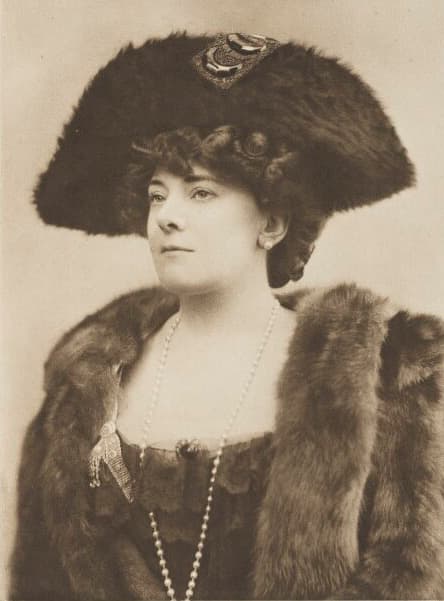
British · Aviation · Exploration · Politics · Activism
Lucy Lady Houston
April 8, 1857 – December 29, 1936
Early life and background
Fanny Lucy Radmall, later Lucy, Lady Houston, was born on 8 April 1857 in Lambeth, London. Some reference works give 1858, but several biographical sources converge on 1857, and the date of 8 April is consistently recorded. She came from a modest background by the standards of the circles she later entered: her father was a woollen warehouseman and draper, and she grew up in an urban London environment shaped by commerce, class mobility, and strong social boundaries.
Her early years are important because they help explain the force of her later self-invention. Lucy Houston did not begin life as a titled woman or a great heiress. She entered adulthood in a society that limited women’s legal, political, and financial independence, yet she built a public identity that combined beauty, style, theatricality, and strategic relationships. Later biographical accounts describe her as having worked as a performer in her youth, and this helped establish the social poise and confidence that would become central to her public life.
Her rise also reflected the possibilities and contradictions of Victorian and Edwardian society. Women of her generation faced narrow expectations, but metropolitan London offered routes into the worlds of the stage, marriage, patronage, and celebrity. Houston exploited those opportunities with unusual energy. Her life illustrates how a woman with determination could move across class barriers, though not without scandal and controversy.
Marriage, wealth, and social ascent
Houston’s fortunes changed through marriage. She married Theodore Brinckman in 1883, but the marriage ended in divorce in 1895. She later married George Gordon, 9th Lord Byron, in 1901; he died in 1917. In 1924 she married Sir Robert Paterson Houston, a wealthy shipowner and politician, and after his death in 1926 she inherited substantial wealth. The combination of inheritance and social status transformed her into one of the richest women in Britain.
Her marriages were central to her public trajectory, but they were also controversial. Houston became associated with wealth, luxury, and self-display, yet she used her position in ways that were not purely decorative. She developed a reputation as an extravagant hostess, a strong-minded political commentator, and a woman willing to use her fortune to shape public life. In a society that often expected women of means to remain socially unobtrusive, she made conspicuous intervention a principle of conduct.
By the 1920s she was widely recognized as a prominent and sometimes notorious public figure. She possessed the resources to influence politics, patronize causes, and invest in technological projects. That unusual combination of money, independence, and assertiveness made her both famous and controversial.
Philanthropy and the First World War
During the First World War, Houston developed a reputation for energetic patriotic philanthropy. She supported soldiers and war workers, and one account describes her sending practical items such as socks and matches to troops on the continent. Her war work was not simply charity in a conventional sense; it formed part of a larger self-presentation as a woman who actively supported the national war effort.
In 1917, she was appointed Dame Commander of the Order of the British Empire (DBE), reportedly in recognition of her work establishing Bluebird’s Nest, a rest home in Hampstead for nurses serving in the war. Although the exact investiture date is not readily documented in accessible sources, the honor itself indicates the extent to which her wartime philanthropy had become publicly visible. It also placed her among the early women to receive such recognition.
This phase of her life matters historically because it shows how women used philanthropy to enter public life before they enjoyed equal access to formal political power. Houston’s war work helped establish her as a national figure and provided a platform from which she later pursued more controversial ventures in politics and aviation.
Political activism and the press
Houston was also a political activist and suffragist. She was not a conventional party politician; rather, she operated through public campaigning, money, and media. Her nationalism became increasingly pronounced in the interwar period, and she used wealth and publicity to advance her views with unusual force. She took over and used the Saturday Review from 1933 as a platform to attack the National Governments of Ramsay MacDonald and Stanley Baldwin, frequently describing them as unpatriotic.
This use of the press is significant because it shows how Houston sought influence beyond philanthropy. She did not merely donate to causes; she wanted to shape national debate. Her newspapers and political interventions were part of a wider pattern of independent female agency that challenged expectations of female deference. Whether admired or condemned, she was impossible to ignore.
Her politics were often idiosyncratic and extreme, and later biographers have emphasized the eccentricity of her positions. Nonetheless, her activism belongs to the history of women’s public participation in the first half of the twentieth century. She demonstrates how suffrage-era women could move from campaigning for rights to intervening in broader questions of national policy, defense, and imperial identity.
Aviation patronage and the Schneider Trophy
Houston’s most enduring historical reputation comes from her role in aviation. In 1931, she donated £100,000 to Supermarine to help finance development of the S.6B seaplane for Britain’s Schneider Trophy challenge. At a moment when state backing was limited and the company faced serious financial pressure, her money helped keep the project alive. The British entry won the trophy on 13 September 1931, securing permanent possession for Britain.
The Schneider Trophy was more than a race. It was a technical contest that accelerated advances in speed, aerodynamics, engine performance, and airframe design. The Supermarine S.6B became one of the most important stepping stones toward the later development of the Spitfire. In this sense, Houston’s money did not simply support a single sporting event; it helped underwrite a chain of engineering developments that proved crucial to Britain’s later air defense.
Her contribution is often summarized as having saved the Spitfire, though that phrase is a retrospective simplification. Still, the essential point is clear: without her intervention, the technological line from Schneider Trophy racing aircraft to advanced British fighters would have been less secure. Her role stands as one of the best-known examples of private female patronage shaping military-technical history.
The Everest expedition and the first summit overflight
Houston’s aviation patronage reached another landmark in 1933, when she financed the Houston–Mount Everest Flight Expedition. On 3 April 1933, aircraft from that expedition achieved the first successful flight over the summit of Mount Everest, with Sir Douglas Douglas-Hamilton and David McIntyre flying a Westland Wallace over the peak. This was a genuine first in aviation history and one of the great geographic and technical feats of the interwar period.
The flight was significant because it demonstrated that aircraft could navigate and survive extreme altitude conditions over the world’s highest mountain. The mission required planning, courage, and technical adaptation in an age when flight remained dangerous and often experimental. For Houston, the expedition was also another demonstration of how private wealth could be used to accomplish feats that governments or institutions had not prioritized.
Her financing and promotion of the Everest flight extended her reputation beyond national aviation politics into global exploration. It aligned her name with daring, prestige, and technological modernity. The expedition remains one of the clearest examples of her ability to turn private patronage into historical event-making.
Personal life and public image
Houston’s personal life was as famous as it was complicated. Biographical accounts describe her as beautiful, flamboyant, and socially ambitious. She used romance, marriage, wealth, and media attention to craft a distinctive public persona. Later portrayals have emphasized her as an “adventuress,” a term that captures both the admiration and suspicion she inspired. She cultivated elite society while remaining outside many of its conventional norms.
She had no universally agreed political home. Instead, she built a distinctive public identity around patriotism, anti-establishment rhetoric, and the determined use of private capital. She was admired by some for her generosity and boldness, and criticized by others for her abrasiveness and extremism. This tension is central to her historical significance: she was at once a philanthropist, a disruptor, and a symbol of female independence operating in a deeply patriarchal society.
Later life, death, and legacy
Lucy, Lady Houston died on 29 December 1936 in Highgate, London. Later reports state that she had reportedly refused food following the abdication crisis, though details vary. Her death closed a life that had moved through the worlds of stage performance, marriage, inherited wealth, patriotic philanthropy, suffrage activism, newspaper campaigning, and aviation patronage.
Her legacy remains unusually durable. She is remembered as an aviation pioneer not because she designed aircraft, but because she recognized the strategic and symbolic importance of funding them. She helped make possible Britain’s Schneider Trophy success and the Everest overflight, both of which contributed to her reputation as a woman whose money changed history. She also occupies a place in women’s history as a figure who used wealth to force herself into arenas—defense, politics, and technology—from which women were generally excluded.
Lucy Houston’s historical importance lies in that combination of roles. She was not a conventional reformer, nor a conventional aristocrat, nor a conventional patron. Instead, she was a self-made force who used privilege acquired through marriage and inheritance to intervene in major public questions. Her life illustrates how women in the early twentieth century could exercise power through unconventional channels, even when formal authority remained out of reach.
Dated achievements
4 indexed.
- Apr081857Aviation
Birth of Fanny Lucy Radmall
Fanny Lucy Radmall, later Lucy, Lady Houston, was born in Lambeth, London, England.
View details Lucy, Lady Houston - Wikipedia - Sep131931Aviation
Schneider Trophy won outright by Britain, funded by Lady Houston's £100,000 donation
Lady Houston's £100,000 donation enabled the Supermarine S.6B to win the Schneider Trophy at Calshot, securing it permanently for Britain.